
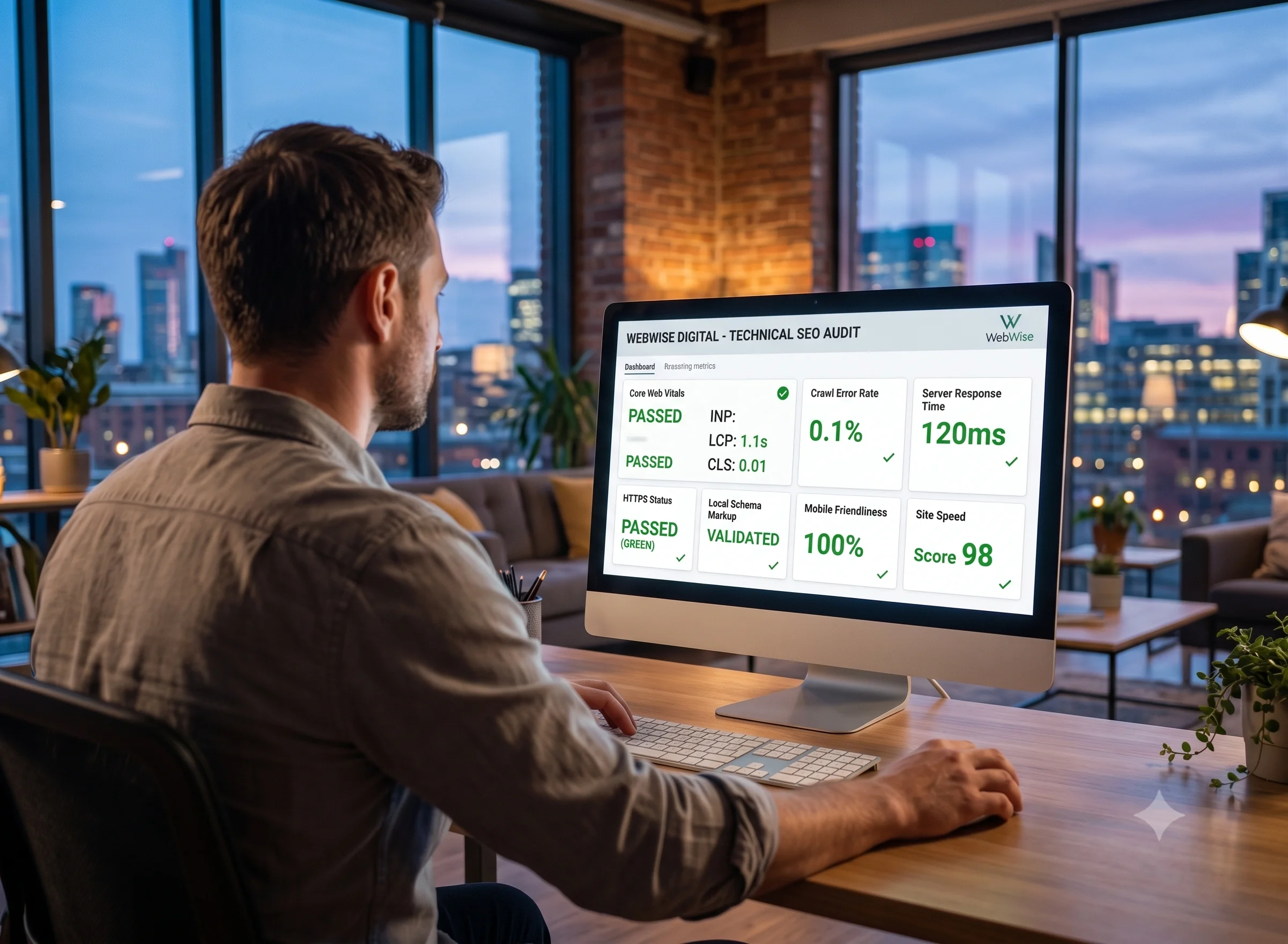
The digital landscape for local service businesses has fundamentally transformed. In 2026, relying on basic keyword stuffing, generic directory backlinks, and bloated template websites is not just ineffective; it is actively penalized by search engine indexing algorithms. Google's core updates have aggressively shifted toward evaluating the granular, mathematical performance of your digital infrastructure and the authenticity of your local entity data.
For commercial contractors, builders, and specialized field services, organic visibility is no longer a marketing exercise. It is a strict engineering mandate. Mastering SEO for tradesmen requires a complete paradigm shift away from surface-level aesthetics toward deep, server-side performance optimization, advanced semantic data structuring, and frictionless user conversion architecture. This exhaustive technical manual provides the precise architectural blueprint required to satisfy the strictest E-E-A-T criteria and dominate hyper-local search markets.
The 2026 Algorithmic Reality
To engineer a ranking asset in the current ecosystem, you must understand how modern search indexing algorithms evaluate programmatic local intent. Search engines no longer read websites; they execute them. They simulate user journeys, measure rendering bottlenecks, and analyze entity relationships to determine if your platform is the most efficient, authoritative answer to a localized search query.
When a homeowner searches for emergency field services or major structural contracting, the search engine prioritizes platforms that deliver zero-latency solutions. Legacy, monolithic content management systems—such as traditional WordPress templates or heavy visual page builders—destroy search positioning. These architectures force the server to query a database and stitch together unoptimized PHP and heavy HTML for every single user request. This introduces massive latency, known as Time to First Byte (TTFB) degradation.
If you are executing campaigns targeting high-value regional contracts, effective local SEO for contractors dictates that your infrastructure must bypass these database bottlenecks entirely. The 2026 algorithm heavily suppresses platforms that waste the search engine's crawling budget on slow, dynamic page generation. To secure top-tier organic placement, your digital asset must leverage edge computing, where pre-compiled files are served instantly from localized server nodes mere miles from the searching user.
Interaction to Next Paint (INP) and Core Web Vitals
Google’s Core Web Vitals are not suggestions; they are the absolute gatekeepers of organic visibility. While previous years focused on First Input Delay, the 2026 algorithmic standard relies strictly on Interaction to Next Paint (INP), alongside Largest Contentful Paint (LCP) and Cumulative Layout Shift (CLS). You cannot build competitive tradesman websites UK without engineering your codebase to pass these exact thresholds.
Interaction to Next Paint (INP) measures the latency of the entire user interaction lifecycle. When a potential client taps a mobile menu to view your services, or interacts with a dynamic calendar, INP calculates the exact millisecond delay before the browser renders the next visual frame. The absolute maximum threshold is 200 milliseconds. Legacy platforms fail this because their main browser execution thread is blocked by heavy, unoptimized JavaScript hydration and third-party tracking pixels.
Largest Contentful Paint (LCP) measures how long it takes for the primary visual element of your page to become fully readable. The target is under 2.5 seconds. Cumulative Layout Shift (CLS) penalizes platforms where elements jump around during the loading phase, a common issue on poorly coded templates that destroys user trust and algorithmic scoring.
Achieving these metrics requires fast loading website design built on headless architecture, such as Next.js or React. By decoupling the frontend presentation layer from the backend database, we achieve instantaneous rendering.
Infrastructure Comparison: Monolithic vs. Headless Edge
Architectural Metric | Legacy Monolithic CMS | Headless Next.js / Edge Deployment | Algorithmic Impact |
Server Processing | Dynamic Database Querying | Pre-Rendered Static Site Generation (SSG) | Edge deployment eliminates TTFB latency, maximizing crawl budget. |
Main Thread Execution | Blocked by heavy JS plugins | Asynchronous, chunked execution | Guarantees passing INP scores under 200ms. |
Asset Delivery | Single centralized server | Global Content Delivery Network (CDN) | Millisecond LCP times regardless of user location. |
Security Surface | Vulnerable public database | Obscured APIs and static files | Increases platform Trustworthiness (the 'T' in E-E-A-T). |
The seamless fusion of technical seo and web design is only achieved when the foundational codebase is engineered to satisfy these strict telemetry demands before a single line of visible content is ever written.
Advanced Entities and Schema Geometry
Modern search algorithms operate via a Knowledge Graph, connecting nodes of information (entities). To rank in a specific postal code or region, you must feed the algorithm explicit, machine-readable data about your business entity. Relying on standard on-page text is insufficient. You must implement advanced JSON-LD structured data.
Deploying deep local schema markup for trade businesses involves wrapping your operational data in code that search bots natively understand. This removes all ambiguity regarding what you do, where you do it, and who authorizes you to do it.
Core Schema Implementation Steps:
Define the Specific LocalBusiness Subtype: Do not use the generic LocalBusiness tag. If you are a roofing contractor, use the RoofingContractor subtype. If you do plumbing, use Plumber. Accuracy dictates relevance.
Inject Precise Geo-Coordinates: Hardcode your exact latitude and longitude, alongside the precise postal codes that define your service radius. This directly informs the proximity algorithm.
Map Service Ontologies: Connect your specific services to established Wikipedia or Google Knowledge Graph entities using the 'sameAs' property.
Embed Verifiable Trust Signals: Include your official registration numbers, trade association memberships, and aggregate review data directly in the payload to satisfy E-E-A-T requirements.
Example Schema Data Structure Execution:
(Note: Executed natively in the document <head> without render-blocking characteristics)
Google Map Pack Manipulation and Native Optimization
Securing the top three positions in the local Map Pack drives the highest volume of qualified commercial inquiries in the trades sector. The Map Pack algorithm operates distinctly from standard organic indexing, relying heavily on three pillars: Proximity, Prominence, and Relevance.
If you are constantly asking how to rank higher on Google for local trades, the answer lies in dominating your localized entity cluster. You cannot rank in a neighboring city if you do not have a verified, optimized digital footprint radiating from that specific area.
Mastering Google business profile optimization for trades requires aggressive and continuous native data management.
Advanced Map Pack Directives:
EXIF Data and Geo-Tagging: When uploading project portfolio images to your business profile, do not upload raw files. Strip the metadata and re-inject precise EXIF data containing the exact GPS coordinates of where the job was completed, proving your operational footprint to the algorithm.
Category Dominance: Select one highly specific primary category. Bury secondary services in the sub-categories. Diluting your primary category confuses the indexing bots.
Semantic Review Seeding: Train your field technicians to ask clients to include specific service terms and neighborhood names in their Google reviews (e.g., "They did an incredible boiler replacement at our home in Camden"). The algorithm parses this unstructured text and heavily weighs it for localized relevance.
Citation Synchronization: Ensure your Name, Address, and Phone number (NAP) are mathematically identical across every tier-one data aggregator in the UK. A single discrepancy between your site footer, your Google Profile, and a local directory shatters your algorithmic Prominence score.
Bespoke Conversion Infrastructure
Traffic is a vanity metric; closed contracts are the only metric of commercial value. Once your technical SEO and edge infrastructure have secured the organic traffic, your digital asset must seamlessly transition into a high-velocity sales engine. This requires lead generation web design rooted in behavioral psychology and data capture efficiency.
Traditional, static contact forms create massive cognitive friction. When a user is facing a burst pipe or a collapsed retaining wall, they will not fill out a generic message box and wait 24 hours. They will bounce back to the search results.
To capitalize on your organic rankings, you must engineer an automated quote funnel for field services. This replaces the standard contact page with a dynamic, multi-step asynchronous web application.
Engineering the Funnel:
Micro-Commitments: Break the data capture process into single-click logic steps. Ask for the service type first (e.g., "Is this an emergency or a planned project?"), then the postal code, and finally the contact details. This reduces cognitive load and drastically increases completion rates.
Conditional Logic Routing: The funnel must adapt based on user inputs. If a user selects "Commercial Build," the funnel should dynamically present questions relevant to commercial square footage, bypassing residential inquiries.
Webhook Integration: Upon submission, the payload should not just send an email. It must securely trigger a webhook API that instantly injects the lead data into your CRM, dispatches an SMS alert to your field team, and fires a conversion event back to Google Analytics to further train your organic and paid acquisition models.
By abandoning the visual clutter of the past and committing to elite, headless engineering, strict Core Web Vitals compliance, and advanced semantic data structures, your business transcends traditional web design. You build an unshakeable, high-performance digital asset that dominates search indices and continuously scales your commercial revenue.