
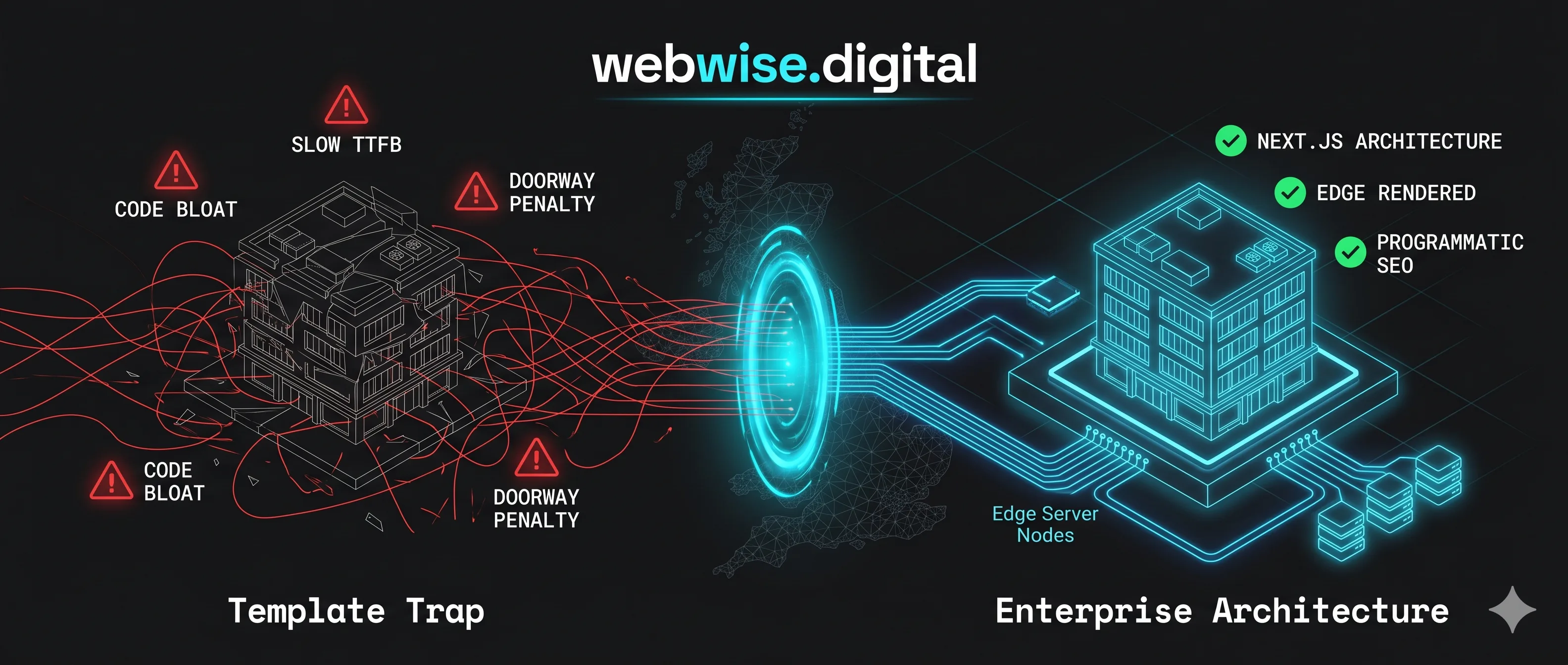
Introduction: The Critical Failure of the Brochure Site in the UK Market
The domestic digital landscape across the United Kingdom has fundamentally broken away from the legacy frameworks of the past decade. For years, the standard operating procedure for a growing UK service business—whether an elite commercial construction group in Kent, an emergency mechanical engineering firm in Birmingham, or an electrical infrastructure contractor in Manchester—was entirely predictable. Upon reaching a specific commercial scaling milestone, the business owner would source a localized or niche agency under the search intent of finding a cheap package for professional website design for tradespeople.
The asset delivered by these volume-based operators typically follows a rigid, static formula: a visually acceptable, pre-configured template built on top of a monolithic content management system, hosted on overcrowded shared server space, and stuffed with a basic array of city-name keywords. For a brief period, this "brochure site" model sufficed to maintain a basic digital presence within a highly localized territory.
That era of digital insulation is officially over. Modern search engine algorithms, driven by strict quality evaluation engines, helpful content systems, and real-time interaction metrics, now actively penalize the core architectural flaws inherent in mass-produced templates. Furthermore, the rapid rise of artificial intelligence search engines and large language model answer engines has created an environment where unoptimized, slow, and structurally repetitive websites are completely invisible to automated scrapers.
To secure sustainable search engine visibility, achieve flawless data ingress, and build an unassailable competitive advantage across England, Scotland, Wales, and Northern Ireland, forward-thinking service organizations are forced to abandon the template model. True market dominance across the entire United Kingdom requires a transition to enterprise-grade web infrastructure. This document serves as the comprehensive engineering manifesto detailing exactly why standard websites for trades fail, the algorithmic penalties they trigger, and how WebWise Digital re-engineers domestic web assets into high-performance, edge-rendered search conversion engines.
1. Anatomy of the Template Trap: The Technical Bottlenecks of Legacy CMS Platforms
To understand why a template website fails under intense competitive pressure within the UK commercial sector, one must analyze the underlying execution pipeline of legacy content management systems like WordPress, particularly when paired with heavy visual drag-and-drop page builders. These platforms prioritize ease of assembly for low-cost designers at the absolute expense of clean code compilation, script optimization, and server performance.
The Architecture of Code Bloat
When a visual page builder renders a simple component—such as a single call-to-action button meant for a UK user to request an urgent quote—it does not write clean, semantic HTML. Instead, it nests that element within a cascade of deeply layered document object model containers. A simple anchor link is wrapped in dozens of nested divisions, each carrying its own block of bloated inline styles, unoptimized tracking scripts, and heavy structural patches.
Furthermore, these templates load global asset libraries unconditionally. A single landing page optimized for local roofing inquiries in Leeds or Bristol will load the entire CSS stylesheet for e-commerce shopping carts, complex portfolio layouts, and heavy animation libraries that are completely absent from the actual visual viewport. The user's browser is forced to download, parse, and execute megabytes of redundant code before rendering a single line of meaningful, high-intent text.
Database Latency and Monolithic Bottlenecks
Monolithic platforms store everything—content, design configurations, user sessions, plugin variables, and layout revisions—in a single, unified database structure. When a UK user or search engine crawler accesses a page, the server must execute multiple synchronous database queries to assemble the layout on demand.
Under the shared hosting environments that form the standard delivery vehicle for cheap UK tradesman web packages, this database execution pipeline introduces massive Time to First Byte latency. If multiple users attempt to access the site simultaneously during peak operational hours, or if a search crawler attempts to index a large silo of localized service paths across the UK, the server resources are instantly throttled. This leads to slow loading states, database execution timeouts, and eventual server dropped connections that destroy online visibility.
The Vulnerability Vector of Third-Party Dependency
Because legacy templates require extensive external functionality to operate effectively, creators stack unverified plugins for basic features like contact forms, caching, image optimization, and structural SEO tags. Each third-party plugin introduces its own unoptimized script files, stylesheet conflicts, and underlying security liabilities.
Unpatched plugins represent the primary entry point for automated cyber threats, malicious code injections, and cross-site scripting vulnerabilities. For a reputable commercial contractor in the UK, a compromised website results in immediate brand damage, domain blacklisting by security filters, and immediate removal from the search index. This is why WebWise Digital completely avoids dependency-heavy architectures to protect domestic businesses.
2. The Core Web Vitals Disruption and the Mobile Reality in the UK
Google's search ranking evaluation uses quantitative field metrics known as Core Web Vitals to assess a platform's technical user experience. Websites that fail to meet the strict performance thresholds defined by these metrics are algorithmically de-prioritized in UK search results. Standard template websites are structurally incapable of passing these tests cleanly, particularly when accessed via mobile connections over standard UK cellular networks like EE, Vodafone, O2, and Three.
The impact of mobile search optimization on the UK trades sector cannot be overstated. Industry data reveals that a remarkable 78% of local mobile searches result in offline jobs or enquiries. Furthermore, 82% of emergency call-out jobs now start with a Google search. For businesses relying on urgent calls, visibility is critical, especially considering that searches for an emergency tradesperson near me have increased by 250% since 2017.
Metric | Target Threshold | Common Template Failure Cause | WebWise Digital Solution |
Largest Contentful Paint (LCP) | Under 2.5 Seconds | Render-blocking JavaScript, slow server responses, unoptimized images | Serverless Edge pre-rendering |
Interaction to Next Paint (INP) | Under 200 Milliseconds | Heavy main-thread execution, unoptimized third-party script execution | Decoupled lightweight frameworks |
Cumulative Layout Shift (CLS) | Under 0.1 | Missing image dimensions, dynamic font loading without CSS fallbacks | Explicit dimension reservation, strict layout grid design |
The Impact of Interaction to Next Paint on UK Mobile Search
Interaction to Next Paint evaluates website responsiveness by measuring the latency of every single user interaction—such as a user clicking a tap-to-call button or opening an interactive quote menu—throughout the lifespan of a user visit.
In a bloated template environment, the main execution thread of the browser is completely locked by parsing heavy JavaScript files. When a UK consumer taps a button to contact an emergency engineer, the browser cannot immediately paint the visual update to the screen. This delay creates a stuttered, unresponsive user experience. While legacy metrics like First Input Delay only evaluated the very first interaction, modern engines track the overall latency profile. This technical shift has systematically degraded the organic visibility of thousands of template-driven tradesman websites across England, Scotland, Wales, and Northern Ireland.
3. The Algorithmic Reality of Doorway Page Penalties Across UK Regions
To expand their geographic visibility across multiple towns, cities, and counties within the UK, standard tradesman web design agencies deploy a fast, unoptimized, and highly dangerous strategy: mass-duplicating service landing pages.
An automated script is executed to copy a base template page dozens or hundreds of times. The script simply swaps out the name of the UK city or town within the text string. This creates an inventory of low-value, duplicate URLs attempting to capture isolated search volumes for specific phrases.
Google's Spam Policies Regarding Doorway Pages
Search engines define these automated constructs explicitly as doorway pages. A doorway page is any web property engineered primarily to act as an intermediary funnel designed to redirect users into a single operational destination without offering unique, localized utility.
Google's automated helpful content systems and spam filters actively scan for these exact macro patterns across the UK digital space. When the crawler detects that hundreds of regional pages share an identical underlying code structure and copy profile, with only a token geographic text string modified, it applies a site-wide quality downgrade. The domain's crawl budget is throttled, new pages are barred from entering the index, and existing rankings are systematically stripped away.
The Breakdown of Topical Authority
True local authority within the competitive UK market cannot be faked through programmatic text replacement. Search engines evaluate the semantic depth of a page to determine if it accurately reflects real-world operational presence. Conversely, building genuine, unique local authority is paramount; research shows that businesses with well-defined service areas appear in 45% more relevant local searches.
A template page that contains no localized review data, no regional UK project documentation, no precise geographic schema, and no contextual variations fails the core criteria of Experience, Expertise, Authoritativeness, and Trustworthiness. To build a resilient network of local service pathways across the entire UK, a website must utilize an intelligent relational database architecture that generates unique, high-value content variations for every single deployment target.
4. The WebWise Digital Architecture: Engineering High-Performance Infrastructure for the Entire UK
To bypass the structural limitations of legacy content management systems and protect your business from algorithmic penalties, WebWise Digital completely discards the traditional template model. We treat your web infrastructure as an elite, decentralized software application. Our engineering pipeline decouples the presentation layer from the data management backend, utilizing a high-performance headless architecture optimized for maximum domestic market penetration.
Next.js and React Server Components Integration
The core engine of a WebWise Digital platform is engineered using Next.js. By leveraging React Server Components, we shift the heavy execution processing away from the user's mobile device and place it onto high-performance server environments during the compile phase.
Our code compilation process outputs minimal, highly optimized semantic HTML documents completely stripped of code bloat. JavaScript is deferred and hydrated only when strictly necessary for interactive components. This guarantees that the main browser thread remains entirely free to handle user inputs, reducing Interaction to Next Paint metrics to near-zero latency levels across all UK mobile networks.
Decentralized Serverless Edge Deployments Across the UK
WebWise Digital platforms do not sit on a single, shared server in a centralized data facility. We deploy your web application across serverless edge networks with dense node distribution across the United Kingdom, specifically optimized for UK backbones.
When a user or automated crawler requests a page from your site, the request is intercepted by the geographically closest edge computing node in London or Manchester. The pre-compiled, static HTML asset is delivered instantly from the edge memory layer. This guarantees a Time to First Byte metric of under a hundred milliseconds across the entire UK, satisfying the most aggressive speed requirements of modern search engine algorithms.
5. The Programmatic UK SEO Engine Framework
To scale a service business across multiple UK regions without triggering doorway page penalties, WebWise Digital deploys an elite programmatic data strategy. Instead of copying flat pages, our framework treats local content as a multi-dimensional relational matrix that compiles unique assets dynamically.
The Relational Schema Blueprint
Our programmatic generation engine sequences three separate array layers to assemble highly specific, authoritative regional landing pages across the UK. This structure is built without relying on repetitive formulas, utilizing pure relational data structures:
Core Capability Array: Captures the deep, technical specifications of the trade service (e.g., British Regulatory Standards like Gas Safe, NICEIC, or NHBC, industrial equipment models, execution timelines).
Geographic Boundary Array: Integrates granular, regional UK data coordinates, local county jurisdictions, accurate postal sectors (e.g., Greater London, West Midlands, Greater Manchester, West Yorkshire), and prominent civic landmarks.
Search Intent Modifier Array: Maps the exact state of the user query. This means capturing high-volume terms explicitly, separating a broad search from an urgent query like someone searching for a boiler repair near me or a highly specific intent like a certified heating engineer for commercial installations.
Data Layer Component | Relational Variable | Dynamic Payload Example |
Core Capability |
| Structural brickwork retaining walls, boiler diagnostics |
Geographic Zone |
| Birmingham (B1), Leeds (LS1), London (EC1A), Manchester (M1) |
Search Intent |
| Emergency structural reinforcement, architectural commercial assembly |
When the engine compiles the site configuration, it cross-multiplies these matrices to deploy explicit, highly specialized routing layouts.
Three Points of Non-Repeating Differentiation
To guarantee safe, long-term search indexing, every generated route must contain strict contextual differences that prove its unique utility to search engine crawlers. We enforce three structural variance layers across our programmatic layouts:
Geologically and Technical Localized Content: The narrative copy on a specific local node must pull hyper-local data from the database array. The crawler recognizes that the page provides real, geographically distinct information.
Dynamic Geographic Asset Integration: The visual gallery modules are fully dynamic. The system reads the geographic identifier of the target route and loads image assets and structural blueprints recorded specifically within that localized UK sector.
Postcode-Isolated Reputation Signals: Testimonials and customer evaluation blocks are programmatically filtered based on geographic coordinates. A page targeting Leeds will prioritize rendering real, verified customer feedback coming directly from clients located within that specific postal sector, vastly outperforming basic SEO tools for trades that cannot segment data effectively.
6. Establishing Peak E-E-A-T and AI Search Optimization (LLMO) for UK Brands
Search visibility is no longer limited to standard web browsers. Modern search environments rely on AI overviews and large language models to provide answers directly to users. To ensure your company is consistently indexed, referenced, and cited by these AI search engines across the UK, your platform must adapt its layout to accommodate automated machine ingestion.
Full Production-Grade JSON-LD Schema Integration
Machine crawlers require explicit structured metadata to verify a business entity's real-world authority. WebWise Digital architectures inject a comprehensive, server-side rendered JSON-LD payload into every single page directory.
Below is the exact structural blueprint of a production-grade schema block utilized within our architectures to define a multi-regional UK service entity:
JSON
{
  "@context": "https://schema.org",
  "@graph": [
    {
      "@type": "LocalBusiness",
      "@id": "https://webwise.digital/#organization",
      "name": "WebWise Digital",
      "url": "https://webwise.digital/",
      "telephone": "+4420XXXXXXXX",
      "address": {
        "@type": "PostalAddress",
        "addressLocality": "London",
        "addressCountry": "GB"
      },
      "areaServed": [
        {
          "@type": "AdministrativeArea",
          "name": "United Kingdom"
        },
        {
          "@type": "AdministrativeArea",
          "name": "England"
        },
        {
          "@type": "AdministrativeArea",
          "name": "Scotland"
        },
        {
          "@type": "AdministrativeArea",
          "name": "Wales"
        }
      ]
    }
  ]
}
Constructing the LLM Asset Manifest (llms.txt)
To ensure artificial intelligence scrapers can accurately parse, summarize, and cite your digital assets, we implement an explicit llms.txt file structure at the root directory of your web application (/llms.txt). This plain-text markdown file provides machine learning engines with a clean, unencumbered manifest of your core services and technical data arrays.
7. UK Regional Dialect and Local Search Variations Engine
A core mistake made by generic tradesman builders is treating the entire UK search population as a singular linguistic block. In reality, search phrases, industry phrasing, and user intent triggers shift dramatically between regions, counties, and municipal sub-sectors within the UK.
To achieve comprehensive visibility, a web application must map out these lexical variations programmatically to avoid structural duplicate content penalties while matching exact search habits.
Mapping Regional Semantic Hierarchies
The WebWise engine integrates a localized terminology matrix into the Core Capability Array. This database automatically adapts technical terminology based on the geographic destination of the compiled route:
Southern Regional Vocabulary: Integrates phrases tailored to high-volume intent matrices across London and the Home Counties.
Northern and Midland Variations: Dynamically references localized equivalents. A user searching for a local plumber in Yorkshire receives content mapped precisely to their dialect and location parameters, rather than generic nation-wide text.
Trade Phrasing Adaptation: Adjusts structural references based on the target audience's background—cleanly distinguishing between "residential building works" and "commercial contractor engineering projects."
This deep contextual intelligence ensures that a customer finds a page optimized precisely for their local phrasing. By doing so, our architectures maintain exceptional relevance scores without code duplication.
8. Comparative Analysis: Legacy Monolith vs. WebWise Digital Enterprise Architecture
To fully grasp the operational imperative of upgrading your digital infrastructure, one must directly contrast the underlying metrics of a standard template build against the production-grade engineering standards delivered by WebWise Digital.
Operational Vector | Legacy Tradesman Template Build | WebWise Digital Enterprise Architecture |
Core Technology Stack | Monolithic WordPress, Elementor/Divi | Decoupled Next.js Framework, Serverless React |
Hosting Environment | Centralized Shared Linux Hosting | Globally Distributed Decentralized UK Edge Network |
Time to First Byte | 800ms to 2500ms (Throttling) | Under 100ms across the UK from edge memory |
Mobile Core Web Vitals | Unstable, frequent failure indicators | Constant compliance across all UK networks |
Local Expansion Model | Manual copy duplication | Multi-dimensional programmatic relational data |
AI Search Visibility | Undefined due to heavy DOM bloat | Highly optimized via JSON-LD graphs |
9. Comprehensive Internal Silo and Navigation Blueprint
An elite web application must be mapped out with a clear, logical link hierarchy to ensure search engines can effortlessly distribute crawl equity across all nested pages. A site's link blueprint acts as its circulatory system; if a path is broken or buried too deeply, the attached page will starve of authority and fail to index.
We deploy a strict, flat directory hierarchy that guarantees no high-value service node sits further than three click paths away from the primary root domain. Every lateral node within this structural map features contextual internal links built within the actual body text. A page discussing advanced programmatic SEO will automatically pass equity to custom web development nodes, reinforcing topical authority across the entire platform without relying on bloated navigation scripts or global footers.
10. Step-by-Step Transition Manual for UK Enterprises
Transitioning an active business away from a legacy template website requires precise execution to preserve existing search equity and ensure zero disruption to incoming customer lead funnels. We utilize a bulletproof multi-phase migration protocol tailored for UK corporate structures.
Phase 1: Structural Content and URL Asset Audit
Before writing a single line of fresh code, our engineers execute a full-scale structural crawl of your existing UK domain. We catalog every active URL path, map out existing organic search landing points, and clean up historical link equity patterns.
Phase 2: Relational Data Extraction and Content Optimization
We isolate your core business data from your old website layout. Your core capabilities, geographic coverage parameters across the UK, and verified customer review assets are extracted and structured into clean, multi-dimensional database tables within our headless management engine.
Phase 3: Parallel Front-End Engineering and Core Web Vitals Validation
While your current website continues to serve UK users without interruption, our team builds your new edge-rendered application within a completely isolated staging environment. Interaction to Next Paint and Largest Contentful Paint metrics are tested under simulated low-speed mobile connections mimicking remote UK locations.
Phase 4: Zero-Downtime DNS Transition and Search Re-indexing
Once the staging application passes all performance and security audits, we deploy the compiled assets across our decentralized edge network. The domain name system records are then updated to point directly to the edge network nodes. The transition takes place in milliseconds; UK users experience zero disruption, while search engine crawlers immediately encounter a technically flawless, ultra-fast platform that begins climbing search and AI indexing rankings instantly.
Conclusion: Securing Your Digital Territory Across the United Kingdom
The choice facing modern UK service businesses is no longer about basic aesthetic design; it is a critical choice of technical infrastructure. Relying on a mass-produced tradesman template means building your business on top of a fragile, outdated foundation that is continuously punished by search engines, highly vulnerable to cyber threats, and completely invisible to the evolving AI search ecosystem.
WebWise Digital provides the definitive cure to the template trap. By shifting your digital footprint to decoupled Next.js codebases, serverless edge hosting environments, and advanced programmatic SEO engines, we build an unassailable digital moat around your business operations. We build websites that load instantly, convert traffic at elite rates, and establish absolute topical authority across any industry and any market nationwide.
Stop letting slow templates limit your commercial growth. Upgrade your digital infrastructure, out-engineer your competition, and claim your market share across the entire United Kingdom.