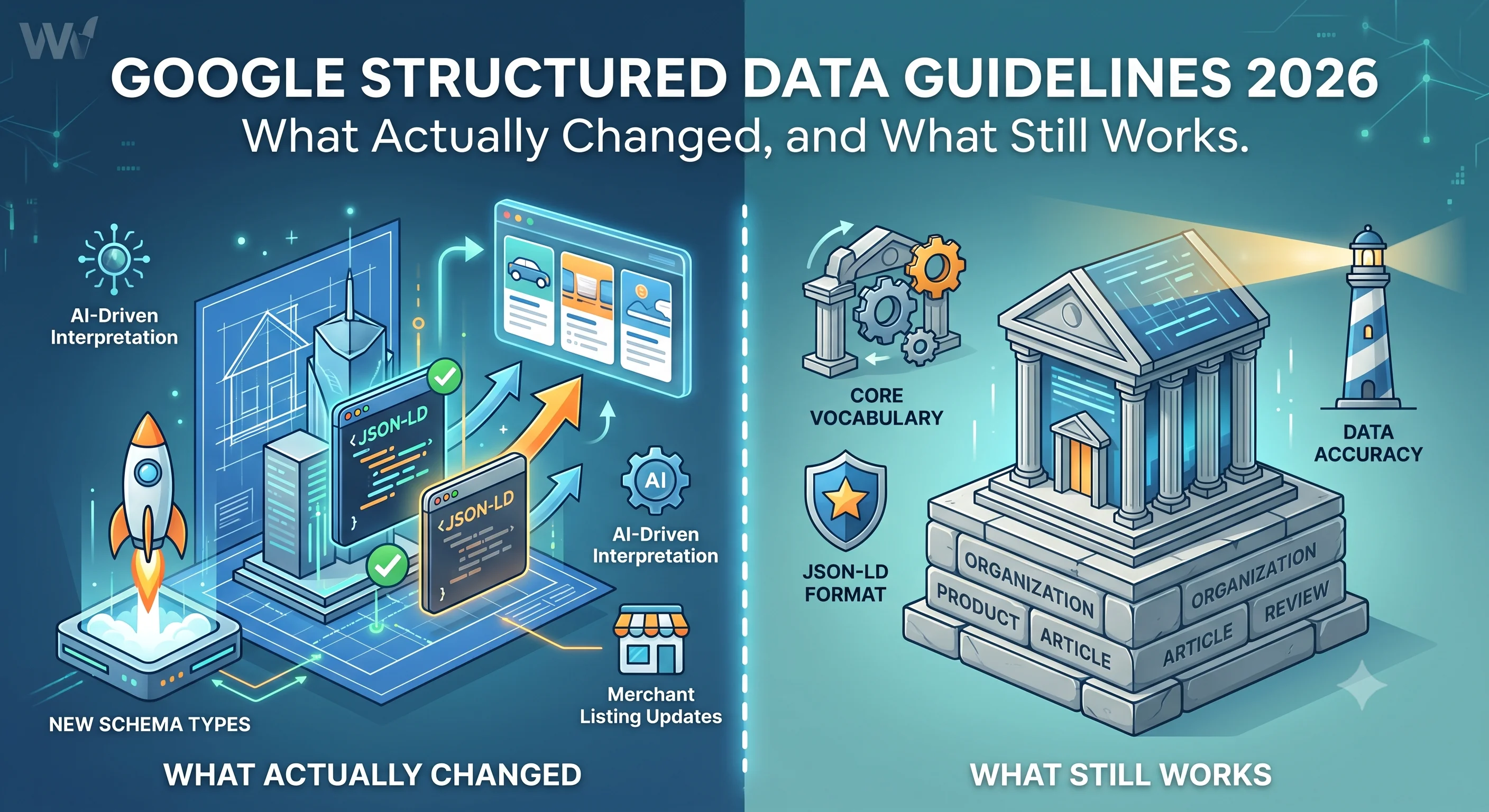
FAQ rich results ended on 7 May 2026. How-To results disappeared even earlier. None of this means schema stopped mattering - it means what it is actually for has quietly shifted.
If you have read a Google Search Central update in 2026 and come away wondering whether structured data is still worth the effort, you are not alone - several 2026 announcements about deprecated rich result types have been widely misread as Google abandoning structured data altogether. That is not what is happening. What is genuinely happening is more specific, more useful to understand correctly, and directly relevant to the schema work covered throughout our own schema markup guide. This article is the dedicated 2026 update.
7 May 2026 - the date FAQ rich results stopped appearing in Google Search entirely
31 - schema types that retain active rich result support in Google Search as of March 2026
1. What Actually Got Removed
CHANGED: The specific 2026 deprecations
FAQ rich results stopped displaying in Google Search on 7 May 2026 - though this had already been narrowed to almost nothing outside authoritative government and health sites back in August 2023, so the practical impact for most commercial sites is close to zero. How-To rich results were deprecated on desktop back in 2023 and no longer appear on any device in 2026. Book Actions schema and several related types were retired in June 2025. Google Search Console is removing reporting for several structured data types starting January 2026, with API support following in mid-2026 - meaning the historical performance data for these features should be exported before those cutoffs if you want to keep it.
The critical distinction almost every panicked interpretation misses
FAQPage schema, as a markup type, is not deprecated. It remains valid Schema.org vocabulary, it will not cause validation errors, and it does not need to be removed from any page. What ended is specifically the visual rich result feature in the search results page - the expandable Q&A snippet. The underlying structured data continues to function exactly as intended for every other purpose it serves.
2. Why This Barely Matters for Most Sites, and Why It Matters Enormously for a Few
For a typical UK small business site using FAQ schema on genuinely relevant service pages - exactly the pattern covered throughout our trade and professional services guides - the practical impact of the rich result removal is minimal, because the schema was never solely valuable for the visual snippet. It continues to serve its other functions.
Where this genuinely matters is for any site that had built an entire content strategy around gaming FAQ or How-To rich results specifically - stuffing FAQ markup onto pages with no genuine FAQ content purely to win the visual snippet. Google's March 2026 core update specifically targeted and reduced rich result eligibility for schema types that were being widely abused in exactly this way, while sites using schema aligned to genuine content intent retained or improved their eligibility.
3. The Real Story: Schema as an AI Trust Signal, Not a Display Trigger
The most important, and most under-discussed, structured data development in 2026 is not a removal - it is a shift in purpose. Google's AI Mode reads structured data as a trust and verification signal, not primarily as something that triggers a visual display feature. Structured data helps AI Mode verify factual claims, establish entity relationships (which business, which person, which location, which credential), and assess source credibility during answer synthesis - even when no traditional rich result appears at all.
This means a site with comprehensive, accurate schema is advantaged in AI-powered search citation, not because the schema itself is being displayed, but because it removes ambiguity that would otherwise reduce Google's confidence in citing that source. This directly reinforces the E-E-A-T principles covered in our complete guide - schema is quietly becoming more about credibility verification than snippet decoration.
4. What to Actually Do About It
Do not remove FAQPage, HowTo, or any other schema simply because the associated rich result disappeared - the underlying markup still serves the credibility and entity-verification function described above.
Export any historical Search Console performance data for the deprecated types before the reporting cutoffs, if you have been tracking it for client or internal reporting.
Stop adding FAQ schema to pages without genuine, substantive FAQ content purely to chase a rich result that no longer exists - this was always a weak tactic and is now explicitly unrewarded.
Prioritise LocalBusiness, Service, and Person/Organization schema - covered in full in our schema guide - as these remain the highest-value types for both traditional local search and AI citation.
Set a quarterly review cadence to re-check Google Search Central's update log, since structured data eligibility has changed multiple times across 2023, 2025, and 2026 and shows no sign of stopping.
5. What WebWise Does With Schema in Every Build
Every WebWise site includes the full schema implementation described in our schema markup guide as standard - not chasing deprecated rich result types, but building the genuine LocalBusiness, Service, and credential-verification structured data that continues to matter for both traditional ranking and AI-powered citation in 2026 and beyond.
The starting point is a 15-minute call at webwise.digital/contact.
Conclusion: Structured Data Is Not Dying, It Is Maturing
The 2026 structured data changes are a maturing of the system, not an abandonment of it. Google is removing the visual features that were most widely abused while quietly increasing the weight structured data carries as a trust and verification signal for AI-powered search. The sites that keep genuine, accurate, intent-matched schema in place - not chasing deprecated snippets, but building the credibility infrastructure AI systems now read - are the ones positioned correctly for where structured data is actually heading.