
Sourced directly from the 182-page document Google gives its own quality raters — and what it means for any website, any niche, worldwide
Most articles about E-E-A-T describe it secondhand — a summary of a summary of a framework that originated in a document almost nobody reading those articles has actually opened. This guide is built differently. Every claim about what Google requires is sourced from Google's own Search Quality Rater Guidelines (the 182-page document given to the roughly 16,000 human raters who evaluate search results worldwide) and Google's own developer documentation. Where this guide moves from "what Google says" to "what we have observed building and ranking websites" — the field notes scattered through this article — that distinction is marked explicitly, because that distinction is itself the subject of this guide.
📄 PRIMARY SOURCE — What the Quality Rater Guidelines actually are
Google employs approximately 16,000 human quality raters worldwide — contracted workers, not Google engineers — who manually evaluate search results against a detailed rubric. Their ratings do not directly change rankings. Instead, as Google's own developer documentation states, rater feedback works "as a restaurant might get feedback cards from diners" — confirming whether algorithm changes are producing the results Google intends. What raters are trained to look for today is a strong signal of what the algorithm is trained to detect tomorrow. The current edition of the guidelines was published on September 11, 2025, and was the document in force during the May 21, 2026 core update — the second confirmed broad core update of 2026.
1. What E-E-A-T Actually Stands For — And Why Google Added the Second E
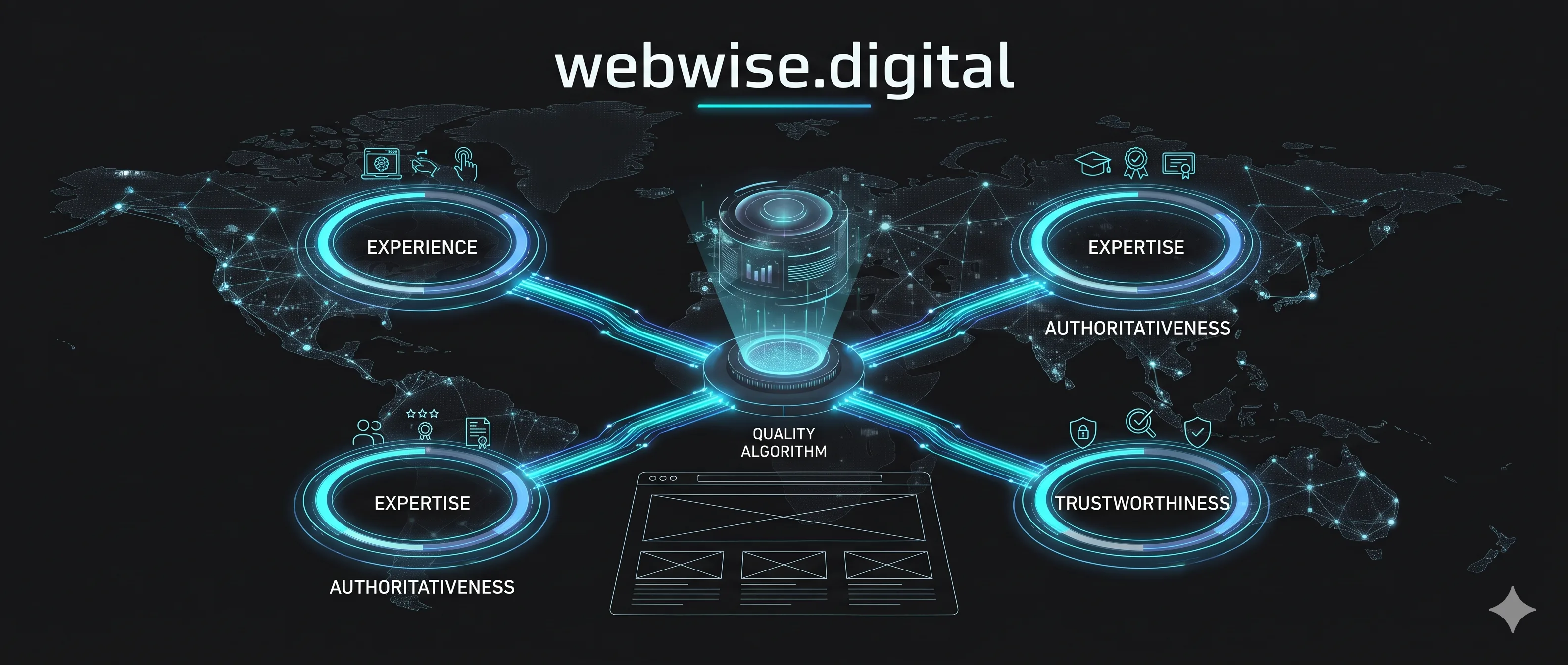
E-E-A-T stands for Experience, Expertise, Authoritativeness, and Trust. For years the framework was simply E-A-T — Expertise, Authoritativeness, Trust — and it was Trust that sat at the centre, with the other two factors feeding into it. In December 2022, Google added a second E: Experience. This was not a cosmetic addition. It was a deliberate acknowledgement that expertise alone — credentials, qualifications, formal training — was not sufficient to judge whether content was genuinely useful. A person who has personally done the thing they are writing about brings something a credentialed expert without that hands-on experience cannot fully replicate: specific, concrete, first-hand detail that cannot be reverse-engineered from research alone.
Trust is the outcome the other three letters exist to produce — and it is, by Google's own framing, the most important member of the family. A page can demonstrate experience, expertise, and authority and still fail if the information is inaccurate, the site is unsafe, or the content is designed to mislead. Conversely, even a page with modest expertise can earn reasonable trust if it is honest about its limitations, transparent about who created it, and accurate in what it claims.
Letter | What it means | How Google's raters look for it |
Experience | Has the creator personally used the product, visited the place, done the job, lived the situation? | First-hand details, specific outcomes, photos/evidence of direct involvement |
Expertise | Does the creator have the knowledge or skill the topic requires? | Credentials, demonstrated depth, accuracy, command of nuance |
Authoritativeness | Is the creator or website recognised as a go-to source on this topic? | Citations from others, reputation, consistency of focus on the subject |
Trust | Is the page accurate, honest, safe, and transparent about who is responsible for it? | Accuracy, transparent authorship, secure site, clear business information |
2. What Changed in the September 2025 Quality Rater Guidelines — And Why It Matters in 2026
Google released two updates to the Quality Rater Guidelines in 2025 — one in January, a more substantial one in September — and together they represent the most significant revision to this document in years. John Mueller, Google's Search Advocate, confirmed the significance of these changes publicly at Search Central Live in Madrid on April 9, 2025. The version published on September 11, 2025 remains the current edition as of mid-2026, and it was the operative document during the May 21, 2026 core update.
2.1 Google Formally Defined Generative AI Content
For the first time, the guidelines explicitly define what counts as generative AI content and give raters specific instruction on how to evaluate it. The position is not that AI-generated content is inherently low quality — Google has been consistent on this point since 2023 — but that AI-generated content with zero added value, produced purely to occupy ranking space, qualifies for the Lowest quality rating. The distinguishing factor raters are trained to identify is not the production method but the outcome: does this page demonstrate genuine experience, expertise, and effort, or does it read as a templated rearrangement of information already available elsewhere, with nothing new contributed?
2.2 Three New Spam Categories Were Added
The September 2025 update introduced three specific abuse categories that previously existed only as informal concepts in Google's communications:
Scaled content abuse: Publishing large volumes of content — whether AI-generated, human-written, or a mix — primarily to manipulate search rankings rather than to genuinely help readers. The defining characteristic is volume and intent, not authorship method.
Expired domain abuse: Purchasing a domain that previously hosted unrelated, often reputable content, and repurposing it for a different business in order to inherit the domain's existing authority and backlink profile without having earned it.
Site reputation abuse: Hosting third-party content on a reputable site's subdomain or subdirectory in order to benefit from that site's authority, where the host site has little to no editorial involvement or oversight of the third-party content.
2.3 The YMYL Categories Were Refined
YMYL — "Your Money or Your Life" — refers to topics where inaccurate information could cause real-world harm to a person's health, financial stability, safety, or to society. The guidelines apply substantially higher quality standards to YMYL pages than to lower-stakes topics. In the latest revision, the previous "YMYL Society" category was renamed "YMYL Government, Civics & Society" — a clarification specifically targeting content that could influence public trust in institutions and democratic processes. This is a useful reminder that YMYL is broader than just health and finance: it includes legal advice, government services information, and civic process content.
🛠️ FIELD NOTE — What this means in practice for a small business website
If your website gives any kind of advice that could affect someone's safety, finances, or health — a plumber explaining how to identify a gas leak, an accountant explaining a tax allowance, a personal trainer giving exercise guidance to someone with an injury — you are operating in or near YMYL territory, even if your business itself feels low-stakes. This does not mean you need a medical degree to run a fitness blog. It means the accuracy bar for that specific content is higher, and the transparency about who wrote it and what qualifies them matters more, than it would for a purely entertainment-focused page.
3. The "Who, How, and Why" Framework Google Itself Recommends
Google's own developer documentation, in a section titled "Creating Helpful, Reliable, People-First Content", recommends that site owners self-assess their content using three questions: Who created this content, how was it created, and why was it created? This is a deliberately simple framework, and it is worth using exactly as Google intends — as a self-audit, not a checklist to perform for an algorithm, because the framework is designed to surface genuine gaps rather than gameable signals.
3.1 Who Created This?
Is there a clear, identifiable person or organisation responsible for this content? Can a reader find out who wrote it and why they are qualified to write it? A page with no visible author, no company information, and no way to verify who is behind it fails this test immediately — regardless of how accurate the content happens to be, because the reader (and the rater evaluating on the reader's behalf) has no way to assess the credibility of an anonymous source.
3.2 How Was This Content Produced?
Was this written by someone with direct experience or expertise, assisted by AI tools, or produced primarily through automation with minimal human oversight? Google is explicit that the production method itself is not the determining factor — a page can use AI assistance and still score highly if a knowledgeable human directed it, fact-checked it, and added genuine value. But a page produced through pure automation, with no human verification of accuracy and no human judgement applied to what is actually useful to the reader, will not meet the bar regardless of how fluently it reads.
3.3 Why Was This Content Created?
Is the primary purpose to genuinely help a reader, or to attract search traffic? This is the question that exposes the difference between helpful content and content engineered to rank. A page that exists because a real customer asks this exact question regularly, and the answer is written to actually resolve their uncertainty, passes this test. A page that exists because a keyword research tool showed monthly search volume, with no underlying reason the business would otherwise have written about the topic, often fails it — even if the resulting page is technically well-optimised.
🔍 SELF-AUDIT — Run this audit on your own homepage right now
Open your website's most important page. Ask: can a stranger tell, within ten seconds, who is responsible for this content and why they should be trusted? If the answer is unclear, that is your highest-priority E-E-A-T fix — and it usually costs nothing to address: add a named author or business owner, a short bio establishing relevant experience, and a way to contact a real person.
4. Demonstrating Experience: The Most Underused Lever in 2026
Of the four pillars, Experience is the one most small businesses are best positioned to demonstrate — and the one most consistently left out of their websites. A plumber who has fitted four hundred boilers has more genuine experience to draw on than almost any content writer Google might compare them against, but if that plumber's website reads like generic stock copy with no specific detail, none of that hard-won experience is visible to a reader or a rater.
4.1 What Counts as Demonstrated Experience
First-hand specificity: "We replaced 47 combi boilers in Croydon last year, and the most common issue we found in 1990s-built homes was undersized pipework that needed upgrading before the new boiler could be fitted properly" demonstrates experience. "We are experts in boiler installation" does not — it is a claim, not evidence.
Original photography: Real photos of real completed work, ideally with enough context (location, date, type of job) to be verifiably specific rather than generic. This is one of the simplest, lowest-cost ways to demonstrate experience, and it is also a conversion driver, as covered in our CRO guide.
Specific outcomes and numbers: "After switching this client to a heat pump, their winter energy bill dropped from £340/month to £190/month" is experience-backed evidence. "Heat pumps can save you money" is a generic claim anyone could write without ever having installed one.
Acknowledging limitations and trade-offs: Genuine experience includes knowing what does not work, what the downsides are, and when a different approach is better. A page that only ever says positive things about every option it discusses reads as marketing copy, not lived experience — and Google's raters are trained to notice the difference.
4.2 The First-Person Test
A useful internal test: read your content and ask whether it could only have been written by someone who had actually done the thing, or whether it could have been produced by anyone with internet access and twenty minutes of research. If the second is true, the content may be accurate, but it is not demonstrating experience — and in a search landscape increasingly saturated with exactly that kind of researched-but-not-lived content, the pages that genuinely pass the first test are the ones gaining a real differentiation advantage.
5. Demonstrating Expertise Without a String of Letters After Your Name
Expertise in the Quality Rater Guidelines is deliberately not defined as "formal qualifications only." Google's own framing distinguishes between what it calls formal expertise (degrees, licences, professional certifications — essential for YMYL topics like medical or legal advice) and everyday expertise (the kind of knowledge that comes from sustained, real engagement with a topic, even without formal credentials). A home cook who has spent fifteen years perfecting sourdough technique and writes detailed, accurate, tested content about it can be judged to have meaningful expertise for that topic — even with no culinary qualification.
Topic type | Expertise standard required | Example |
YMYL — medical, legal, financial advice | Formal expertise expected: relevant qualification, licence, or professional registration | A page on tax relief should be written or reviewed by a qualified accountant |
Trade and technical services | Demonstrated practical expertise: trade qualifications, years of hands-on work | A boiler installation guide written by a Gas Safe registered engineer |
Hobbies, lifestyle, general how-to | Everyday expertise acceptable: sustained genuine engagement with the topic | A gardening blog by someone with 10 years of personal growing experience |
Opinion, commentary, entertainment | Lower expertise bar: personal perspective is itself part of the value | A restaurant review reflecting one diner's honest experience |
For a small business, the most practical expertise signal is simply being honest and specific about what qualifies the business to speak on a topic — trade registrations, years trading, number of jobs completed, relevant training — and displaying that information visibly rather than burying it. The agency-hiring guide we published covers exactly this principle from the buyer's side: credentials and specificity build trust, vague claims do not.
6. Demonstrating Authoritativeness: Earning Recognition, Not Claiming It
Authoritativeness cannot be self-declared. It is, by definition, a reputation that exists in the views of others — other websites linking to you, other people recommending you, other publications citing you, customers reviewing you. A website that states "we are the leading authority on X" has made a claim about authority; it has not demonstrated any. The signals Google's raters and algorithms actually look for are external and verifiable.
6.1 The External Signals That Build Authority
Backlinks from relevant, reputable sites: A mention and link from a local newspaper, an industry body, a respected blog in the same niche, or a directory with genuine editorial standards (not a link farm) signals that someone independent considered this business worth referencing.
Consistent, focused subject matter: A website that has published consistently about one core topic area over time builds topical authority more effectively than one that covers a scattered range of unrelated subjects. This is the principle behind the deliberately interlinked structure of this very blog — each article reinforces the others within a coherent subject area.
Reviews and testimonials from real, verifiable customers: Covered extensively in our Google Business Profile guide — review volume, velocity, and content are some of the most direct authority signals available to a local business.
Citations and mentions across the web, even without a link: Google's systems increasingly recognise unlinked brand mentions — a local news article that names your business without hyperlinking it still contributes to the broader picture of how often and how positively your business is mentioned online.
🛠️ FIELD NOTE — Authority compounds slowly and cannot be shortcut
In every WebWise client engagement, the businesses that see the strongest authority signals after twelve months are the ones that published consistently — town pages, service pages, blog posts — within a clearly defined subject area, rather than the ones that tried to cover every conceivable topic immediately. Authority, in our direct observation of dozens of live client profiles, tracks consistency and specificity far more reliably than volume alone.
7. Demonstrating Trust: The Pillar That Decides Everything Else
Google's own guidelines describe trust as the most important member of the E-E-A-T family, because a page that lacks experience or formal expertise can still be useful if it is honest and accurate, while a page with impressive credentials is worthless if the information it presents is wrong, misleading, or unsafe. Trust, in practice, is built from a combination of accuracy, transparency, and security — and these are the signals most directly under a website owner's control.
7.1 Accuracy
Every factual claim on a YMYL or near-YMYL page should be verifiably correct and, where statistics or specific figures are used, attributable to a credible source. Outdated information — old pricing, superseded regulations, expired statistics — actively damages trust even when it was accurate at the time of publication. Pages that have not been reviewed or updated in years are a known signal that raters and algorithms increasingly weigh against a page, particularly for topics where facts change (pricing, regulations, technology, statistics).
+4.6 — average ranking position gain associated with pages updated within the last year, relative to stale equivalents (industry analysis of 2025–2026 ranking data)
7.2 Transparency
A trustworthy website makes it easy to find out who runs it, how to contact them, and what their relationship to the content is. This means a real business name (not just a brand name with no legal entity disclosed), a genuine physical address or clearly stated service area, a working phone number or contact form, and — where relevant — clear disclosure of any commercial relationship that could bias the content (affiliate links, sponsored content, business ownership of a product being reviewed).
7.3 Security and Technical Trust Signals
HTTPS encryption (the padlock in the browser address bar) has been treated as a baseline trust and ranking signal for years and remains a prerequisite, not a differentiator, in 2026. Beyond that, a site that loads quickly, does not bombard visitors with intrusive pop-ups, and does not redirect unexpectedly is signalling basic technical trustworthiness. Our Core Web Vitals guide covers the technical side of this in full detail — speed and stability are not just user experience metrics, they are components of the trust signal Google is measuring.
8. The Helpful Content System: Why "HCU" Recovery Plans Are Chasing a Ghost
Many website owners who suffered traffic losses during Google's 2022–2024 Helpful Content Updates are still searching for "HCU recovery" strategies as if Helpful Content remains a separate, distinct system from the rest of Google's ranking infrastructure. As of March 2024, it does not. The signals that powered the standalone Helpful Content System were folded into Google's core ranking systems, meaning content quality, in the E-E-A-T sense, is now evaluated through the same unified lens as every other core update — there is no longer a separate "Helpful Content" classifier to specifically appease.
The practical implication: if your site lost visibility in a 2022–2024 update and has not recovered, the fix is not a narrow set of "HCU-specific" tweaks. It is the same broad E-E-A-T improvement programme covered in this entire guide — because that programme is now simply how Google evaluates quality across every type of update, broad or narrow.
9. AI Content and E-E-A-T: What Google Actually Said
This is the question most business owners using AI tools for content actually want answered, and Google's own position — stated consistently since 2023 and reinforced in the September 2025 update — is more nuanced than either AI advocates or AI sceptics tend to present it. Google has never stated that AI-generated content is categorically penalised. It has stated that content produced primarily to manipulate rankings, regardless of whether a human or an AI system produced it, is treated as the type of behaviour the guidelines are designed to identify and exclude.
📄 PRIMARY SOURCE — Google's stated position on AI content
According to the September 2025 Quality Rater Guidelines update and Google's public developer documentation: AI-assisted content can score well if it demonstrates genuine added value, is fact-checked, and reflects real expertise or experience applied by a human in the production process. AI-generated content produced at scale with minimal human oversight, designed primarily to occupy search ranking space rather than to genuinely help a reader, qualifies for the Lowest quality rating regardless of grammatical fluency or apparent comprehensiveness.
The practical takeaway for any business using AI tools to support content production — including the AI content service WebWise itself offers to clients — is that the AI should accelerate the production of genuinely useful content directed by someone with real knowledge of the topic, not replace the human judgement about what is actually worth saying. Every AI-assisted post WebWise produces for a client goes through human review for accuracy, specificity, and genuine usefulness before publication — precisely because that human layer is what separates content that demonstrates E-E-A-T from content that merely occupies space targeting a keyword.
10. The Complete E-E-A-T Audit Checklist for 2026
The following checklist translates every section above into specific, auditable actions. Work through it page by page, starting with your highest-traffic and highest-value pages.
Experience
Does this page include first-hand, specific detail that could only come from genuinely doing this work?
Are there real photos of real work, real premises, or real people — not stock imagery?
Does the content include specific numbers, outcomes, or examples rather than only general claims?
Does the content acknowledge limitations, trade-offs, or things that did not work — not just unqualified positives?
Expertise
Is it clear who wrote or is responsible for this content?
For YMYL topics, is the relevant formal qualification, licence, or registration stated and verifiable?
Does the content demonstrate command of nuance — the kind of detail that distinguishes genuine knowledge from surface-level research?
Is the content accurate and free from errors a genuine expert in the field would immediately notice?
Authoritativeness
Does the business have reviews on Google, Trustpilot, or relevant industry platforms — and are they genuine and current?
Has the business or website been mentioned, linked to, or cited by other reputable sites?
Does the website maintain a consistent, focused subject area rather than covering unrelated topics?
Is the business name and brand consistent and recognisable across its website, directories, and social profiles?
Trust
Is the site served over HTTPS?
Is there a real, findable business name, address or service area, and contact method?
Is the content current — reviewed and updated within the last 12 months, especially for time-sensitive facts?
Are there any unsubstantiated claims, exaggerations, or misleading statements that should be corrected or removed?
Does the page deliver fully on what its title and meta description promise, with no clickbait gap between promise and content?
11. E-E-A-T by Business Type: Where the Bar Is Highest
Not every business faces the same E-E-A-T scrutiny. The following maps the relative intensity of the standard by niche, based directly on the YMYL framework in the Quality Rater Guidelines.
Business type | YMYL intensity | Highest-priority E-E-A-T action |
Medical, dental, mental health | Very high | Named, qualified practitioner authorship on every clinical claim; regulatory body registration displayed |
Legal and financial services | Very high | Named, qualified professional; clear disclaimers; regulatory registration (SRA, FCA, etc.) displayed |
Trades (plumbing, electrical, building) | Medium-high (safety-adjacent) | Trade registration (Gas Safe, NICEIC, FMB) displayed; real project photography; genuine reviews |
Hospitality, retail, lifestyle | Lower | Genuine reviews; transparent business information; accurate, current content |
Agencies, consultancies, B2B services | Medium | Demonstrated case studies with real outcomes; named team; genuine client testimonials |
News, opinion, commentary | Medium-high (societal YMYL) | Clear authorship; correction policy; transparent sourcing of claims |
12. The 15 Keywords This Article Targets
Keyword | Intent | Section |
E-E-A-T 2026 | Research | Throughout |
Google Quality Rater Guidelines | Research / primary source | S1, S2 |
what is E-E-A-T | Definitional | S1 |
how to improve E-E-A-T | Action | S4–S7, S10 |
Google helpful content update | Research | S8 |
YMYL content requirements | Research | S2.3, S11 |
Google core update 2026 | Research | S2, S8 |
author expertise SEO | Action | S5 |
website trust signals Google | Action | S7 |
E-E-A-T checklist | Action | S10 |
AI content Google guidelines | Research | S9 |
scaled content abuse Google | Research | S2.2 |
site reputation abuse | Research | S2.2 |
Google search quality raters | Research / primary source | S1, S2 |
how Google evaluates content quality | Research | S1, S3 |
Conclusion: E-E-A-T Is Not a Trick — It Is a Description of What Was Always True
There is no hack hidden in the 182 pages of the Quality Rater Guidelines. Read closely, the document describes something simpler and harder than a checklist: it asks whether the person behind a page genuinely knows what they are talking about, has actually done the thing they are describing, is recognised by others as credible, and is honest about all of it. These were always the qualities that made advice worth trusting, long before Google formalised them into an acronym. What has changed is that Google now has the means — and, with the scaled-content-abuse provisions of 2025, the explicit mandate — to detect the absence of these qualities at scale, across an internet increasingly filled with content engineered to look credible without the underlying substance.
For a small business website, the practical implication of this entire guide compresses into one piece of advice: write and present your site as if the most demanding, most knowledgeable potential customer is going to read it and try to catch you out. Show your actual work. Name the actual people responsible. State your actual qualifications. Keep your actual facts current. Everything else in this guide is detail in service of that one underlying discipline.
If you want a second pair of eyes on whether your website currently demonstrates Experience, Expertise, Authoritativeness, and Trust the way Google's own raters are trained to look for it, the starting point is a 15-minute call. We will run the audit in Section 10 against your site, live, and tell you exactly where the gaps are. Start at webwise.digital/contact.
Further reading: The Complete Google Business Profile Optimisation Guide for the authority-building mechanics covered in Section 6, and Why Your Website Fails Google PageSpeed for the technical trust signals covered in Section 7.3.
Primary Sources Cited in This Article
Google Search Quality Evaluator Guidelines (full PDF) — the 182-page document given to Google's human quality raters, September 11, 2025 edition
Google Developers — Creating Helpful, Reliable, People-First Content — Google's own public guidance, including the "Who, How, and Why" framework cited in Section 3