
Chapter 1: The Evolution of Enterprise Web Architecture in 2026
The digital ecosystem in 2026 demands a complete departure from monolithic web platforms and legacy Content Management Systems (CMS). To capture market share, modern organizations require decentralized, high-performance web systems designed around composable architecture, serverless execution, and semantic data models. For enterprises evaluating their digital infrastructure, selecting a premier web design agency is no longer just an aesthetic decision; it is a fundamental engineering requirement.
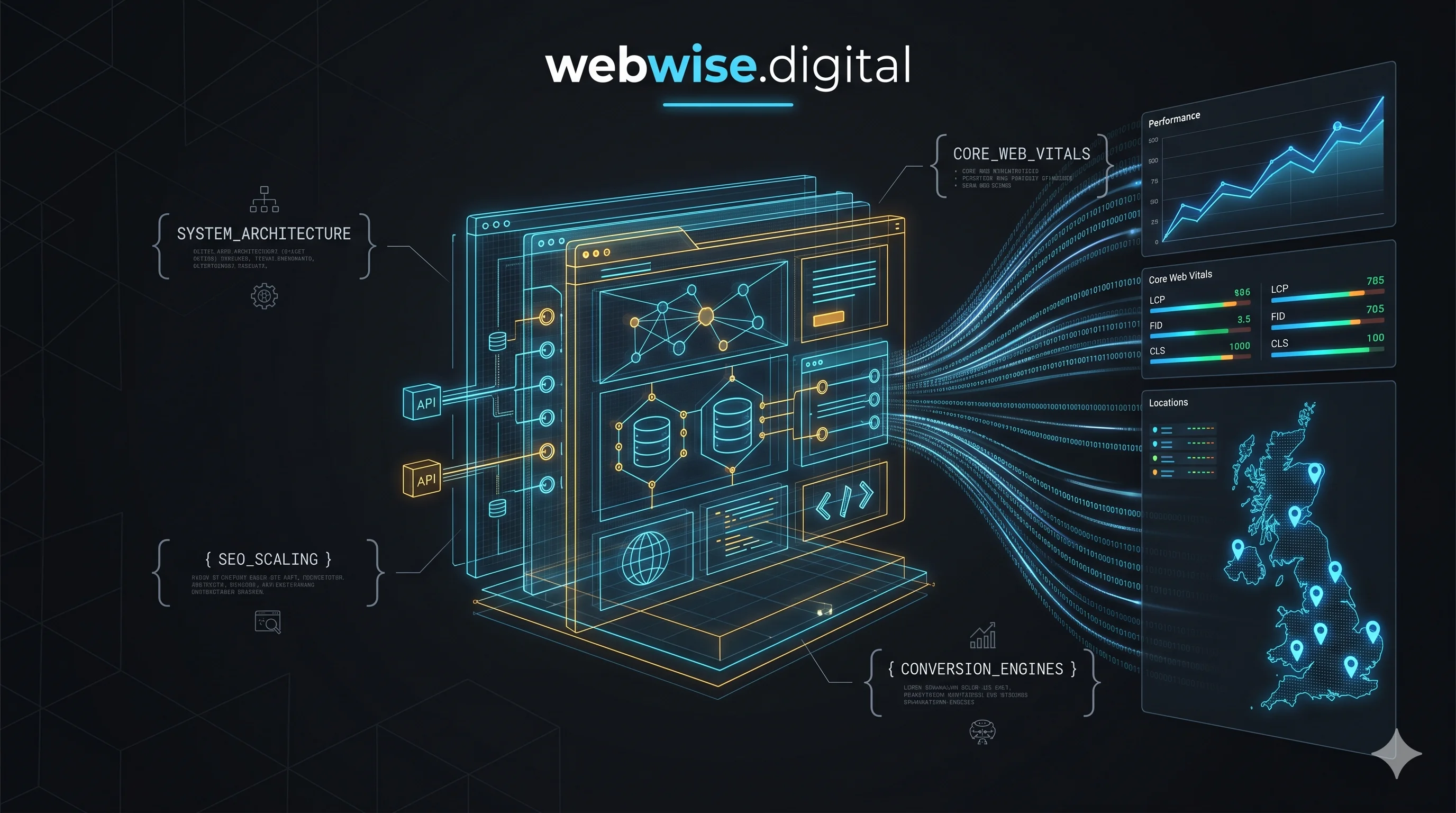
Modern web architecture relies on the decoupled separation of the presentation layer (frontend) from the data layer (backend). This headless approach ensures that content can be deployed across multiple endpoints via secure APIs while maintaining lightning-fast rendering speeds. As a leading web design agency uk, WebWise Digital builds systems utilizing edge-native rendering frameworks such as Next.js, Remix, and Nuxt.js. By distributing compiled static assets and dynamic serverless functions directly to global edge networks, latency is eliminated at the server level before a single line of client-side browser code is ever executed.
+-------------------------------------------------------------+
|                     Edge Network (CDN)                      |
|  [Static Assets]   [Edge Functions]   [SSR Cache Layers]     |
+-------------------------------------------------------------+
          |                                         |
          v                                         v
+-----------------------+                 +-------------------+
|  Headless Content API |                 |  Microservices /  |
|  (GraphQL / RESTful)  |                 |  Relational DB    |
+-----------------------+                 +-------------------+
When structuring an enterprise ecosystem, engineering teams must evaluate three dominant rendering paradigms based on the specific intent of each section of the digital asset:
Static Site Generation (SSG): Best deployed for core marketing pages, documentation, and evergreen content where data changes infrequently. SSG pre-compiles pages during the build pipeline, ensuring near-instantaneous load times and complete structural resistance to server-side exploitation.
Server-Side Rendering (SSR): Necessary for highly dynamic, user-specific dashboard interfaces, e-commerce checkouts, and transactional pages requiring real-time data synchronization.
Incremental Static Regeneration (ISR): The ideal compromise for programmatic content deployment and expansive multi-page systems. ISR allows developers to update specific static pages in the background without requiring a full rebuild of the entire application architecture.
By implementing decoupled frontend architectures, a forward-thinking web development agency london can scale an organization's digital footprint globally without compromising structural integrity or rendering speed. This approach ensures that technical debt is structurally mitigated, allowing organizations to substitute backend microservices seamlessly without forcing costly, comprehensive frontend redesigns.
Chapter 2: Engineering High-Performance Web Design for High-Authority Rankings
Search engine indexation systems in 2026 prioritize clean document object models (DOM), structured data semantic relationships, and strict performance metrics over surface-level keyword densities. Creating an elegant interface requires deep synchronization between user interface (UI) designers and technical SEO engineers. This structural convergence is precisely how elite web design london projects achieve immediate algorithmic visibility post-launch.
To ensure deep programmatic indexation, the underlying source code must be explicitly semantic. Legacy layouts relying on nested <div> structures slow down crawler efficiency and cloud search engine understanding of content hierarchies. A specialized wb design agency uk webwise configures HTML markup to guide search crawlers sequentially through the document node hierarchy:
HTML
<article>
  <header>
    <h1>Primary Semantic Entity Title</h1>
    <p>Contextual abstract establishing the content domain.</p>
  </header>
  <section id="technical-framework">
    <h2>Secondary Structural Subheading</h2>
    <p>Detailed technical exposition utilizing precise nomenclature.</p>
  </section>
</article>
Beyond semantic markup, the rendering pipeline must be strictly optimized to prevent Cumulative Layout Shift (CLS) and maximize Largest Contentful Paint (LCP) efficiency. When webwise webdesign agency develops responsive frameworks, layout containers are allocated explicit aspect ratios through modern CSS design properties, guaranteeing that browser rendering engines reserve exact dimensions for media elements prior to asset download.
Core Asset Loading Strategies
Critical CSS Inlining: Extracting and injecting above-the-fold styling directly within the
<head>block, minimizing render-blocking round trips to the server.Asynchronous Script Execution: Deferring non-critical JavaScript execution to ensure the primary browser main thread is completely unburdened during the initialization phase.
Modern Image Compression Protocols: Enforcing Next-Gen image execution across all visual assets via Next/Image components or AVIF/WebP image formatting to keep media components well under strict weight ceilings.
When organizations partner with a webwise uk web development agency, they are transitioning away from heavy, unoptimized visual builders and generic templates. Instead, assets are engineered from the ground up using clean utility-first styling systems like Tailwind CSS or native CSS Modules, ensuring that production style sheets are stripped of unutilized declarations before deployment.
Chapter 3: Advanced Technical SEO and Programmatic Ranking Systems
To achieve sustainable, dominant visibility across competitive commercial landscapes, enterprise platforms must move away from manual content creation workflows and embrace programmatic SEO engines driven by relational database architectures. Programmatic SEO is the systematic generation of thousands of highly targeted, intent-specific landing pages mapped dynamically from centralized datasets.
For businesses looking to maximize their search visibility across the broader United Kingdom, web development uk must center on building scalable routing architectures capable of handling massive URL matrices cleanly. Programmatic page generation relies on the creation of robust dataset schemas where regional parameters, specific service attributes, and intent-focused modifiers are mapped into precise relational arrays.
[Centralized Relational Database]
     |
     +---> Modifier Array: [London, Croydon, Manchester, Birmingham]
     |
     +---> Service Array: [Boiler Install, Certified CP12, Electrical Rewire]
     |
     v
[Dynamic Router Injection Engine]
     |
     v
[Generated Clean Canonical URL Structure]
/services/boiler-install/london
/services/certified-cp12/croydon
To prevent indexing issues related to thin or duplicate content on programmatically generated landing pages, each template must contain distinct dynamic fields. A webwise web design uk agency structures programmatic engines to dynamically pull distinct technical data, localized service records, and industry-specific documentation specific to each unique page parameter.
JSON
{
  "@context": "https://schema.org",
  "@type": "LocalBusiness",
  "name": "WebWise Digital Regional Hub",
  "url": "https://webwise.digital/locations/london",
  "logo": "https://webwise.digital/assets/logo.png",
  "areaServed": {
    "@type": "AdministrativeArea",
    "name": "Greater London"
  },
  "serviceArea": {
    "@type": "GeoCircle",
    "geoCenter": {
      "@type": "GeoCoordinates",
      "latitude": 51.5074,
      "longitude": -0.1278
    },
    "geoRadius": "25000"
  }
}
By embedding precise JSON-LD structured data directly into the server-side rendering pipeline, search engine crawlers can immediately parse the precise entities, geolocation boundaries, and services offered. This structured approach ensures programmatic platforms gain high-authority visibility without triggering duplicate content filters.
Chapter 4: Local Search Engine Domination for Service and Trade Sectors
For regional service providers, trade industries, and commercial businesses across the UK, search visibility is defined by localized search intent. When a prospective customer searches for an immediate service provider, search engines display a localized map package alongside localized organic results. Dominating this space requires a sophisticated local silo architecture built into the primary web platform.
When executing localized strategies, we design uk web frameworks to map out clean regional hubs that align directly with geographical service areas. Instead of creating a single, disorganized contact page listing every operating territory, the core application router must split these regions into logical directory silos:
https://webwise.digital/
├── locations/
│   ├── london/
│   │   ├── services/
│   │   │   ├── web-development
│   │   │   └── seo-optimization
│   ├── surrey/
│   └── kent/
This strict anatomical configuration ensures internal link equity flows down logically to regional destination pages. Each regional subdirectory must act as an independent, high-authority resource, featuring localized customer testimonials, active regional project case studies, and clear embedded interactive maps displaying explicit coverage boundaries.
To maximize proximity-based search visibility, the localized web directory must hook directly into Google Business Profile API deployments. Geolocation coordinates, corporate operating hours, and localized service offerings must match perfectly across all digital citations, web directory listings, and core server pages. This absolute consistency across the digital footprint establishes the high levels of trust and geographical relevance required to secure top positions within competitive local map packs.
Chapter 5: Conversion Rate Optimization (CRO) and User Experience Engineering
High-authority search engine rankings only deliver commercial value if the incoming traffic converts into qualified leads, product acquisitions, or operational inquiries. Conversion Rate Optimization (CRO) cannot be treated as a layer applied over an existing website template; it must be deeply integrated into the fundamental user experience engineering of the interface.
Modern user conversion depends on eliminating friction across the complete customer interaction lifecycle. This friction mitigation requires specialized design choices that align with consumer behavioral psychology and technical performance standards:
Interactive Core Element | Technical Friction Vector | Strategic Mitigation Framework |
Global Site Navigation | Ambiguous multi-tiered dropdown choices that obscure underlying information pathways. | Clean, flat categorical navigation structures with immediate semantic paths. |
Lead Capture Forms | Excessive input requirements that increase user abandonment rates. | Multi-step interactive forms using progressive disclosure and native validation APIs. |
Media Assets | Unoptimized layout components causing visual layout shifts during runtime. | Hard-coded container aspects with explicit placeholder rendering states. |
Interactive Call-to-Actions | Vague contextual statements lacking clear destination value. | High-contrast contextual buttons containing explicit action verbs linked to quick anchors. |
When webwise digital constructs custom frontends, lead acquisition steps are built using highly responsive client-side state management systems. By using asynchronous form submissions driven by secure API endpoints, users never experience jarring full-page refreshes. Instead, forms process instantly, delivering immediate visual confirmations that reduce abandonment and maximize capture rates.
[User Form Interaction] ---> [Asynchronous API Request] ---> [Immediate UI State Update]
                                        |
                                        v
                            [Secure Backend Processing]
Furthermore, mobile responsiveness must be treated as the primary interface configuration rather than an afterthought. With over 70% of local trade and service traffic originating from mobile devices, touch-target dimensions, thumb-zone layout accessibility, and adaptive text scales are meticulously optimized. This ensures the digital experience remains seamless, fast, and conversion-ready on every screen size.
Chapter 6: Security Protocols, Hosting Infrastructure, and Long-Term Scalability
Enterprise web security and hosting infrastructure are core components of search engine visibility and sustainable business scaling. Slow load times caused by unoptimized hosting, or security warnings triggered by improper server configurations, will instantly degrade rankings and destroy brand trust. Secure, scalable deployments require a robust modern infrastructure layer.
The foundation of a modern enterprise setup relies on a comprehensive, zero-trust security configuration and high-availability edge deployments:
Absolute Security Frameworks
Transport Layer Security (TLS): Implementing advanced HSTS (HTTP Strict Transport Security) policies to ensure all connections are strictly forced over encrypted HTTPS pathways, blocking intercept vectors completely.
Content Security Policy (CSP): Configuring granular CSP headers within the server response file to restrict script execution exclusively to authorized origins, stopping Cross-Site Scripting (XSS) attacks.
Managed Web Application Firewalls (WAF): Routing all primary web traffic through automated edge firewalls to actively mitigate distributed denial-of-service (DDoS) attempts, SQL injections, and malicious scraping bots before they ever reach the origin server.
To provide this elite level of infrastructure performance for enterprise applications, the platform architecture should be deployed across managed edge-computing layers like Vercel, AWS CloudFront, or Cloudflare Workers.
[Global User Requests] ---> [Cloudflare Edge WAF] ---> [Serverless CDN Edge Node] ---> [Instant Core Web Vitals Render]
By decoupling database transactions from the primary frontend rendering pipeline and running computing operations across global edge networks, the platform gains absolute horizontal scalability. This ensures that whether the system handles one hundred users or one hundred thousand simultaneous users, the core web platform renders instantly, remains completely secure, and continuously maintains its competitive edge at the top of the search engine results pages. Learn more about optimizing your digital presence at webwise.digital.