
What makes a website design good?
For decades, the broader commercial market evaluated web design through a purely aesthetic lens. Decision-makers judged platforms by subjective visual elements: color palettes, typography choices, stock imagery selection, and stylistic flair. In 2026, this superficial definition of web design has become a primary driver of digital underperformance, technical debt, and lost commercial revenue.
An aesthetically striking website that loads in 4.5 seconds on a mobile device, fails basic accessibility standards, lacks machine-readable structured data, and presents a confusing navigation path is not a good website design. It is a costly visual liability.
Modern web design is an interdisciplinary engineering discipline that sits at the intersection of full-stack software architecture, cognitive psychology, conversion rate optimization (CRO), edge infrastructure performance, and machine indexability.
When evaluating what elevates a digital platform from mediocre to world-class, business leaders must look beyond visual styling. A genuinely effective web application operates as a frictionless commercial engine that satisfies three distinct audiences simultaneously:
The Human User: Requiring instant load speeds, intuitive visual hierarchy, low cognitive friction, and explicit trust signals.
The Search Engine Crawler: Requiring clean DOM structures, sub-second edge response times, explicit JSON-LD schema graphs, and zero rendering bottlenecks.
The Business Entity: Requiring automated lead capture funnels, measurable conversion paths, low maintenance overhead, and clear commercial return on investment (ROI).
In our engineering deployments at webwise digital, we analyze website design as a cohesive, multi-layered system where visual layout and backend architecture work in perfect alignment.
This technical blueprint breaks down the precise architectural pillars, performance metrics, and behavioral frameworks that define superior web design in the modern digital economy.
1. Technical Performance as the Foundation of Visual Aesthetics
It is impossible to separate visual UI/UX design from underlying technical performance. The most elegant visual design is rendered completely useless if a user abandons the web page before the primary content paints on screen.
Core Web Vitals: The Non-Negotiable Performance Metrics
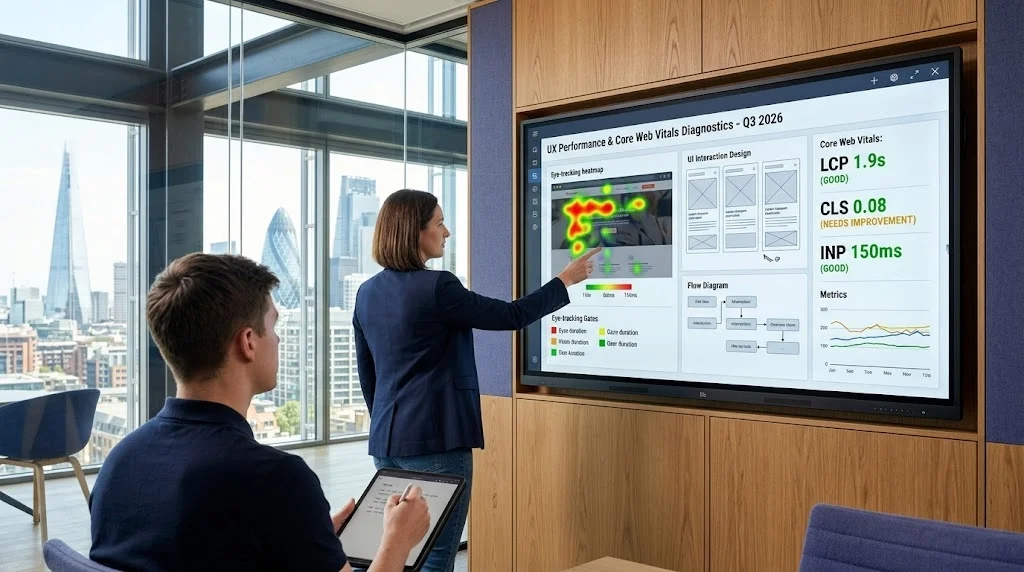
Google's Core Web Vitals represent the baseline technical parameters that define acceptable user experience. A high-performance platform must achieve green scores across all three primary field metrics on real-world mobile hardware:
Largest Contentful Paint (LCP): Measures the time it takes to render the main visual element (such as a hero headline, primary product image, or main video banner) within the viewport. To achieve a good score, LCP must occur within 1.2 to 2.5 seconds or faster.
Interaction to Next Paint (INP): Evaluates overall page responsiveness by measuring the latency between a user clicking a menu, tapping an interactive button, or typing in an input field and the browser updating the visual display. Exceptional design requires an INP under 75 to 200 milliseconds.
Cumulative Layout Shift (CLS): Quantifies visual stability by measuring unexpected layout jumps during page load (e.g., text shifting downward as a late-loading image or cookie banner hydrates). Good design enforces a strict CLS score under 0.05 to 0.10.
Edge Pre-Rendering vs. Monolithic Bloat
Achieving sub-second performance while maintaining rich visual layouts requires moving away from monolithic, database-bound content management systems that assemble HTML dynamically upon every user request.
When building client applications at webwise digital, we utilize modern frameworks such as Next.js combined with global edge pre-rendering networks. By generating static HTML/CSS assets at compile time or serving them from distributed edge caches located close to the end user, initial server response times—measured as Time to First Byte (TTFB)—drop below 50 milliseconds globally.
2. Cognitive Load and Conversion Architecture
A core objective of UI/UX engineering is minimizing cognitive load—the total mental effort required by a user to process information, navigate an interface, and complete a desired action.
Applying Key Psychological Laws to Interface Design
Superior visual design leverages proven cognitive models to guide user attention effortlessly:
Hick's Law (Logarithmic Decision Time): The time required to make a decision increases logarithmically with the number and complexity of choices. Effective web design reduces navigation clutter, presents primary conversion options prominently, and isolates secondary actions into progressive disclosure menus.
Fitts's Law (Target Acquisition Speed): The time to acquire a target is a function of the distance to and size of the target. On mobile interfaces, critical call-to-action (CTA) buttons must feature generous tap dimensions (minimum 48x48 pixels) and be positioned within the natural thumb sweep zone.
The Gutenberg Diagram & F-Pattern Reading Gravity: Western users systematically scan web pages in a Z-pattern or F-pattern, moving from the top-left logo zone across to top navigation, then sweeping down the left margin. Positioning high-value trust signals and action triggers along these natural visual anchor lines maximizes engagement.
Plaintext
[Visual Scanning Pathway: Gutenberg Diagram Model]

Top Left (Primary Anchor): Brand Logo & Primary Value Proposition
    ├─── Eye Sweep Right ───► Top Right Zone: Contact Trigger & Primary CTA
    │
    ▼ Vertical Left Margin Scan
Middle Left Zone: Supporting Benefit Bullets & Visual Proof
    │
    ├─── Eye Sweep Right ───► Main Viewport: Interactive Intake Form
    │
    ▼
Bottom Right Zone: Primary Conversion Action (Submit / Book Consultation)
Pre-Qualification and Interactive Intake Funnels
Static, generic contact forms ("Name, Email, Message") yield low completion rates and attract unqualified spam. Exceptional web design replaces basic contact boxes with interactive, multi-step intake funnels.
By presenting users with conditional-logic selection steps (e.g., selecting service types, project scope sizes, or budget ranges), the interface reduces form fatigue while capturing rich pre-qualification data directly into client CRM software. Partnering with a specialized b2b web design agency ensures these conversion funnels are natively integrated into the site's layout.
3. Mobile-First Responsiveness and Touch Geometry
Designing a website on a 32-inch desktop monitor and subsequently shrinking it down to fit a mobile screen is an outdated methodology that produces broken, unoptimized mobile interfaces.
Modern web architecture demands a strict Mobile-First Responsive Engineering framework, where layouts are conceptualized and coded for small viewports first, then progressively enhanced for larger displays.
CSS Viewport Adaptability
Modern responsive design eliminates rigid media query breakpoints in favor of fluid typography and flexible layout containers:
Fluid Type Scaling via CSS clamp(): Instead of specifying hardcoded font sizes that jump abruptly between screen widths, fluid typography utilizes mathematical scaling:
CSS
font-size: clamp(1.125rem, 0.8rem + 1.2vw, 2.25rem);This ensures text scales smoothly across every viewport width without breaking container boundaries or creating orphaned words.
CSS Grid & Flexbox Subgrids: Complex multi-column service grids automatically reflow into single-column vertical stacks on mobile displays without requiring duplicate DOM elements or heavy JavaScript window listeners.
Device-Specific Asset Delivery: Using the
<picture>element andsrcsetattributes, browsers receive scaled image payloads matched specifically to the device's screen density (DPR) and width, preventing mobile devices from downloading oversized 4K desktop images.
When deploying a responsive web design platform, testing must occur on physical mobile hardware rather than desktop browser emulators to verify real-world touch target responsiveness and scroll performance.
4. Universal Accessibility, Inclusivity, and WCAG Compliance
A website cannot be categorized as "good design" if it excludes individuals with visual, auditory, cognitive, or motor impairments. Web accessibility is not merely an optional feature; it is a legal requirement across major international markets and a core component of digital usability.
Web Content Accessibility Guidelines (WCAG 2.2)
Professional web design targets strict adherence to WCAG 2.2 Level AA (and AAA where applicable) criteria across all template layouts:
Color Contrast Ratios: Text and interactive elements must maintain a minimum contrast ratio of 4.5:1 against their background for standard text, and 3:1 for large headings and visual controls.
Keyboard Navigation & Focus Indicators: Every interactive element—including navigation links, modal overlays, accordions, and form fields—must be fully operable using a keyboard alone. Explicit, highly visible CSS focus states (
:focus-visible) must highlight the active DOM element without relying solely on color changes.Accessible Rich Internet Applications (ARIA): Dynamic UI components (such as mobile slide-out menus or dynamic tab panels) must utilize semantic HTML5 elements (
<main>,<nav>,<header>,<footer>,<article>) supplemented with explicit ARIA attributes (aria-expanded,aria-controls,aria-label) to communicate state changes to screen readers instantly.
HTML
<button
  type="button"
  aria-expanded="false"
  aria-controls="mobile-navigation-menu"
  aria-label="Toggle Navigation Menu"
  class="focus:ring-2 focus:ring-blue-600">
  <svg aria-hidden="true" width="24" height="24">
    <path d="M4 6h16M4 12h16M4 18h16" stroke="currentColor" stroke-width="2"/>
  </svg>
</button>
In our development pipelines at WebWise Digital, automated accessibility testing is paired with manual keyboard navigation audits prior to any production deployment, guaranteeing that inclusivity is built directly into the codebase.
5. Search Engine Machine-Readability and Schema Architecture
A visual layout designed exclusively for human eyes represents only half of the digital presentation layer. The underlying HTML must be engineered to provide search engine algorithms with an unambiguous structural map of your business entity.
Semantic Schema.org Integration
Search engines do not "see" web designs visually; they parse DOM nodes and structured data. Integrating JSON-LD (JavaScript Object Notation for Linked Data) structured data directly into the head of your pages establishes clear entity relationships in search engine Knowledge Graphs.
For trade contractors, field services, and enterprise B2B organizations, a robust JSON-LD graph connects core business entities seamlessly:
JSON
{
  "@context": "https://schema.org",
  "@graph": [
    {
      "@type": "Organization",
      "@id": "https://webwise.digital/#organization",
      "name": "WebWise Digital",
      "url": "https://webwise.digital",
      "logo": "https://webwise.digital/assets/logo.png",
      "sameAs": [
        "https://www.instagram.com/webwise.development/",
        "https://x.com/webwise_digital"
      ]
    },
    {
      "@type": "WebSite",
      "@id": "https://webwise.digital/#website",
      "url": "https://webwise.digital",
      "name": "WebWise Digital",
      "publisher": { "@id": "https://webwise.digital/#organization" }
    },
    {
      "@type": "Service",
      "@id": "https://webwise.digital/services/web-design/#service",
      "name": "Custom Web Design & Conversion Engineering",
      "provider": { "@id": "https://webwise.digital/#organization" },
      "areaServed": "United Kingdom",
      "serviceType": "Web Development & UI/UX Design"
    }
  ]
}
Investing in specialized schema markup integration ensures that search engines understand your pricing parameters, client reviews, physical locations, and exact service boundaries without ambiguity.
6. Visual Trust Signals and Institutional Authority
Online visitors evaluate brand credibility within 50 milliseconds of landing on a website. Exceptional web design leverages visual hierarchy and strategic proof placement to establish immediate institutional trust.
Essential Trust Vectors
Above-the-Fold Proof Density: High-converting platforms position micro-trust indicators directly adjacent to primary value propositions. This includes verified Google Review ratings, industry accreditation badges (e.g., Gas Safe, ISO certifications, trade associations), and real-time client satisfaction metrics.
Authentic Photography over Stock Imagery: Generic, staged stock photography harms conversion rates by signaling artificiality. Good web design utilizes high-resolution, authentic media depicting real team members, actual project sites, and genuine commercial installations.
Transparent Pricing Frameworks: Hiding pricing parameters behind opaque "Call for Quote" barriers increases user bounce rates. Displaying clear, structured fixed price website tiers or interactive cost estimators builds immediate transparency and pre-qualifies incoming inquiries.
7. The Tech Stack Dilemma: Modern Frameworks vs. Legacy Builders
The technological foundation on which a website is constructed dictates its long-term performance ceilings, security posture, and visual flexibility.
Legacy Monolithic CMS (e.g., WordPress with Page Builders)
Performance: Heavy database lookups; server response times typically 1.5s to 4s.
Security: High vulnerability exposure due to constant third-party plugin updates and exploits.
Code Quality: Excess visual builder code bloat (DIV container nesting traps).
Core Web Vitals: Requires complex caching, script minifiers, and image plugins to pass.
Modern Edge Architecture (e.g., Next.js with Headless CMS)
Performance: Pre-rendered static assets served via global CDNs; response times under 50ms.
Security: Complete architectural isolation; zero dynamic database vulnerabilities on the frontend.
Code Quality: Bespoke, modular React components written strictly to project requirements.
Core Web Vitals: Native, out-of-the-box optimization across LCP, INP, and CLS.
Building on a modern wordpress alternative stack based on Next.js, React, and headless content management systems provides complete architectural isolation. Front-end visual elements are entirely decoupled from backend databases, securing ultra-fast rendering speeds and unbreachable security boundaries.
8. Real-World Case Study: Transforming a Commercial Platform
To illustrate the measurable commercial impact of upgrading from a legacy site build to an engineered, high-performance web platform, consider the performance transformation of a regional UK trade contractor evaluated across a 90-day post-launch window:
Baseline Metrics (Legacy Monolithic Build)
Mobile Performance Score: 34 / 100
Largest Contentful Paint (LCP): 4.8 seconds
Interaction to Next Paint (INP): 320 milliseconds
Average Monthly Organic Traffic: 350 visits
Monthly Form Inquiries: 4 leads (1.1% conversion rate)
Post-Launch Metrics (WebWise Custom Edge Platform)
Mobile Performance Score: 99 / 100
Largest Contentful Paint (LCP): 0.9 seconds
Interaction to Next Paint (INP): 45 milliseconds
Average Monthly Organic Traffic: 1,620 visits (+362% Increase)
Monthly Form Inquiries: 52 leads (3.2% conversion rate)
The data demonstrates that transforming a web platform’s speed, visual layout, and local schema architecture produces immediate, compound returns in organic search traffic and qualified business inquiries.
Deploying high converting websites for UK tradesmen replaces passive online brochures with high-volume, automated lead engines.
9. Comprehensive Web Design Evaluation Checklist
When auditing an existing commercial website or evaluating a new agency proposal, utilize this 10-point technical criteria checklist to determine overall web design quality:
Sub-2-Second Mobile LCP: Does the primary visual element load in under 2 seconds on a 4G mobile network connection?
Sub-100ms Interaction Responsiveness: Do mobile navigation buttons and form inputs respond instantly without visual lag?
Zero Layout Shifts: Does the page render smoothly without elements jumping around as images and fonts finish loading?
Mobile-First Touch Architecture: Are all interactive controls easily operable using a single thumb on mobile viewports?
Fluid Typography Scaling: Does body text and heading typography scale fluidly across viewports without awkward line wraps?
WCAG 2.2 AA Contrast Compliance: Is all text clearly readable against background colors across all lighting environments?
Bespoke JSON-LD Schema: Is valid entity schema embedded in the page header and verified in Google’s Rich Results Test?
Interactive Lead Capture: Does the site utilize structured, conditional-logic intake forms rather than generic contact boxes?
Zero Third-Party Code Bloat: Is the site free from unnecessary, render-blocking tracking scripts and plugin libraries?
Full Source Code Ownership: Does your business retain 100% ownership of custom code assets and private code repositories?
Checking every box on this list guarantees that your platform meets the highest standards of modern digital engineering, securing long-term organic reach and high conversion velocity.
10. Partnering with WebWise Digital for Engineered Success
Understanding what makes a website design good highlights a fundamental reality: exceptional web design is an engineering discipline that requires technical mastery, user experience strategy, and organic search foresight.
At webwise digital, we build enterprise-grade, sub-second web platforms designed to dominate search engine results and maximize customer acquisition. From trade contractors requiring specialized lead generation web design for builders to B2B service agencies seeking custom application architecture, our team delivers transparent, fixed-price solutions built on cutting-edge edge infrastructure.
Transform Your Digital Asset Today
Is your current website failing to deliver the speed, search visibility, and lead volume your business needs to grow?
Explore our transparent website pricing tiers or review our custom web design services to see how we turn digital platforms into high-performing revenue engines.
Review Our Engineering Process or Contact Our Technical Team Today to schedule your preliminary technical website audit and preliminary project consultation.