

What happens after my website is built?
Deploying a modern web application is frequently misunderstood as the conclusion of a digital initiative. In traditional software models, hitting "publish" was viewed as crossing the finish line. In 2026, however, launching a high-performance web platform is merely the transition from initial architectural assembly to continuous operational optimization.
When business directors and marketing leaders complete a platform overhaul, a common operational query emerges: what happens after my website is built?
A newly constructed digital platform does not instantly begin capturing organic traffic, generating qualified leads, or operating on autopilot. The moment a codebase transitions from a local staging environment to a live production server, a complex, multi-stage lifecycle begins. This phase encompasses global Domain Name System (DNS) propagation, search engine crawling protocols, edge caching configurations, real-world user monitoring, and security hardening.
In our engineering deployments at webwise digital, we treat the post-launch window as a critical stabilization period. Without a structured post-deployment framework, even the most elegantly designed application will suffer from indexation delays, performance decay, and lost commercial momentum.
This comprehensive guide breaks down the precise technical sequences, architectural workflows, and ongoing optimizations that occur immediately after your web platform goes live.
1. The Immediate Deployment Window: DNS Propagation and Edge Routing
The technical sequence initiated immediately following client sign-off is the transition from a staging domain (e.g., staging.clientdomain.com) to the primary production apex domain and www subdomains.
Global DNS Propagation Protocol
When your primary domain's Name Server (NS) records or Address (A/AAAA) records are updated to point to your new web infrastructure, the change is not instantaneous worldwide.
TTL (Time to Live) Decay: DNS records are cached by Internet Service Providers (ISPs) globally based on their defined TTL values. Lowering TTL settings 48 hours prior to deployment ensures global propagation completes within 15 to 30 minutes rather than 48 hours.
Anycast DNS Routing: Modern builds managed by a custom web development company route domain requests through Anycast DNS networks. This ensures that a user requesting your site from London, Sydney, or New York is routed to the nearest geographic edge node instantly.
SSL/TLS Handshake Configuration
As soon as DNS routes settle, automated cryptographic certificate issuance occurs. Edge networks generate and bind 2048-bit RSA or ECC (Elliptic Curve Cryptography) SSL certificates. This enforces HTTP/3 and TLS 1.3 encryption, ensuring that every user connection is secure, authenticated, and protected against man-in-the-middle attacks before any production traffic hits the origin server.
2. Search Engine Indexation and Crawl Optimization
Once a site is publicly accessible, search engine bots (such as Googlebot) must be explicitly invited, guided, and monitored as they discover and evaluate your new document hierarchy.
Google Search Console and Bing Webmaster Setup
A primary milestone post-launch is establishing direct communication channels with search engines.
Sitemap Submission: The freshly generated, dynamic XML sitemap (
/sitemap.xml) is submitted directly through Google Search Console. In a modern next.js development architecture, this sitemap automatically updates whenever new pages or blog posts are published.Robots.txt Verification: The staging directive
User-agent: * Disallow: /must be completely stripped and replaced with production crawl directives. This allows search crawlers to access critical static assets, CSS, and client-side JavaScript bundles required to render the DOM accurately.
Managing Indexation Velocity
Search engines do not index 100% of a new site's pages simultaneously. Crawl budget allocation depends on your domain's historical authority.
When migrating enterprise clients at webwise digital, we monitor Search Console's "Pages" coverage report daily post-launch. We isolate pages flagged as "Discovered - currently not indexed" or "Crawled - currently not indexed," resolving internal linking gaps or thin content markers to accelerate full indexation across your entire URL structure.
3. Redirect Validation and Preserving Legacy Link Equity
If your new site replaces an older web platform, the post-launch phase is critical for preserving your historical organic search visibility and domain authority.
301 Redirect Mapping Auditing
Every legacy URL that received external backlinks or generated organic traffic must be permanently mapped to its exact modern equivalent using 301 (Moved Permanently) server redirects.
Redirect Chain Elimination: A common issue in basic site migrations is nested redirects (e.g., Legacy Page A redirects to Page B, which redirects to New Page C). This dilutes link equity (PageRank) and slows down load times. Post-launch technical audits scan the live server logs to flatten all redirect paths into direct single-step hops.
404 Error Isolation: Automated log scrapers run continuously for 30 days post-launch to detect unexpected 404 (Not Found) server responses. Any legacy links missed during initial mapping are immediately caught and redirected, preventing lost visitor traffic and broken backlink equity.
4. Post-Launch Core Web Vitals profiling in the Field
Laboratory testing (Lighthouse benchmarks run in controlled environments) rarely mirrors real-world user conditions. Once real human visitors begin navigating your live platform, Google begins collecting Chrome User Experience Report (CrUX) field data.
Field Data vs. Lab Data Analysis
Laboratory tests use simulated mobile throttling. Real-world users, however, access your site across varied mobile devices, fluctuating 4G/5G connections, and differing browser rendering engines. A specialized technical seo agency uk monitors field metrics continuously during the first 90 days post-launch:
Largest Contentful Paint (LCP): Validating that the primary hero asset loads in under 2.5 seconds for real users on low-end mobile hardware.
Interaction to Next Paint (INP): Measuring the exact millisecond delay between a user tapping a mobile menu, filter, or form button and the visual frame updating on screen (strictly maintaining a sub-200ms threshold).
Cumulative Layout Shift (CLS): Confirming that dynamic elements—such as late-loading cookie consent banners, web fonts, or embedded media—do not cause visible layout jumps during rendering.
Edge Caching and CDN Optimization
If real-world LCP scores spike post-launch, engineers adjust cache-control headers at the edge layer. Configuring stale-while-revalidate headers ensures static pages are served directly from global edge caches in under 50 milliseconds, completely bypassing origin database lookups.
5. Conversion Rate Optimization (CRO) and Behavioral Analytics
Launching a site establishes your baseline conversion hypothesis. What happens next is data collection to prove—and optimize—how effectively visitors move through your sales funnel.
Behavioral Heatmapping and Session Recordings
Deploying light, privacy-compliant analytics tools (such as Microsoft Clarity or PostHog) allows UI/UX architects to analyze aggregated user behavior without introducing performance bloat.
Scroll Depth Analysis: Identifying where users lose interest on core service landing pages and adjusting the vertical placement of call-to-action (CTA) buttons accordingly.
Rage Click Isolation: Tracking instances where users repeatedly click an unlinked image or element, revealing UI confusion that can be corrected in the next design iteration.
Form Drop-off Diagnostics: Monitoring multi-step quote forms to identify specific input fields that cause user friction or abandonment.
A/B Testing and Copy Refinement
In high-ticket sectors, such as lead generation web design for builders or commercial contractor platforms, minor adjustments to headline messaging, form fields, or trust badge placement can increase conversion rates significantly. Post-launch CRO uses empirical user data rather than guesswork to drive continuous layout improvements.
6. Continuous Security Hardening and Vulnerability Patching
The moment a web platform is assigned a public IP address, it becomes a target for automated vulnerability scanners, credential stuffing botnets, and distributed denial-of-service (DDoS) probes.
Web Application Firewall (WAF) Fine-Tuning
Post-launch support involves actively reviewing WAF security logs to identify malicious traffic patterns.
Rate Limiting: Enforcing strict request limits on API endpoints, search forms, and contact forms to prevent automated spam submissions and brute-force attacks.
Bot Management: Implementing silent, non-intrusive CAPTCHA challenges (such as Cloudflare Turnstile) that block malicious scrapers while providing a frictionless experience for real human users.
Dependency Management
Modern web platforms built on Node.js, React, or headless CMS frameworks rely on open-source package ecosystems. Continuous security maintenance requires weekly dependency audits (npm audit) to identify and patch security vulnerabilities (CVEs) in third-party libraries before they can be exploited.
7. Strategic Content Expansion and Topical Authority
A website launched with 10 to 20 core pages provides a strong structural foundation, but dominating competitive organic search rankings requires building sustained topical authority over time.
The Content Hub and Spoke Model
To establish industry leadership, your post-launch strategy must include a structured publishing cadence mapped to semantic user intent.
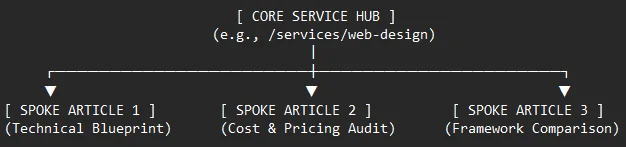
By publishing comprehensive, highly specialized supporting content that links back contextually to your primary service pages, you signal to search engine algorithms that your domain possesses deep, authoritative expertise across your industry vertical.
Entity and Schema Maintenance
As new content, team members, or case studies are published, structured JSON-LD Schema.org markup must be continuously expanded. Updating organizational relationships, author credentials, and local service area properties ensures search engines accurately parse your evolving business entity.
8. Establishing an Operational Care Plan vs. Reactive Repairs
One of the most costly mistakes a business can make post-launch is adopting a "break-fix" mindset—only contacting a developer when something goes visibly wrong or offline.
The Cost of Digital Neglect
An unmaintained web platform experiences steady technical degradation:
Software Deprecation: Outdated software dependencies accumulate technical debt, making eventual updates significantly more expensive and risky.
Performance Decay: Unmonitored content uploads by marketing teams introduce bloated images, broken links, and unoptimized scripts, degrading mobile speed scores.
Security Exposure: Unpatched CMS plugins or server environments leave the platform exposed to automated malware injections and data breaches.
The Proactive Maintenance Framework
Securing a structured websitecare plan transitions your business from reactive troubleshooting to proactive engineering oversight. A comprehensive support framework includes automated daily off-site backups, continuous uptime monitoring, monthly performance profiling, dependency updates, and dedicated engineering hours for iterative feature enhancements.
9. Measuring Post-Launch Success: Key Performance Indicators (KPIs)
To evaluate whether your new platform is achieving its commercial goals, track these core metrics across the first 6 to 12 months post-launch:
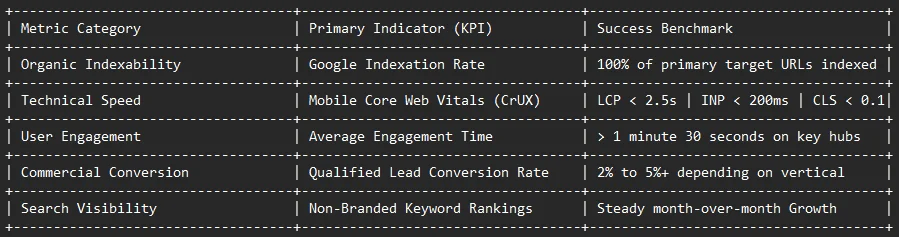
By benchmarking these numbers immediately post-launch, your executive team gains clear visibility into the platform's commercial performance and operational return on investment (ROI).
10. Partnering with WebWise Digital for Long-Term Growth
Understanding what happens after your website is built highlights a clear reality: a web platform is not a static digital brochure, but a living commercial asset that requires ongoing care, optimization, and strategic alignment.
At webwise digital, our engineering commitment extends far beyond launch day. We design, build, and maintain high-performance web architecture for trade enterprises, field service providers, and B2B organizations across London and the UK. Our post-launch frameworks are built to ensure your platform remains exceptionally fast, highly secure, and continuously visible in organic search results.
Maximize Your Post-Launch Commercial Momentum
Whether you have recently launched a new web application or are preparing to upgrade legacy infrastructure, ensure your post-deployment lifecycle is managed by senior engineering specialists.
Explore our comprehensive web design services or review our transparent website retainer plans to discover how we protect, optimize, and scale your digital presence over the long term.
Review Our Engineering Process or Contact Our Technical Team Today to schedule a post-launch architectural audit or preliminary project consultation.