
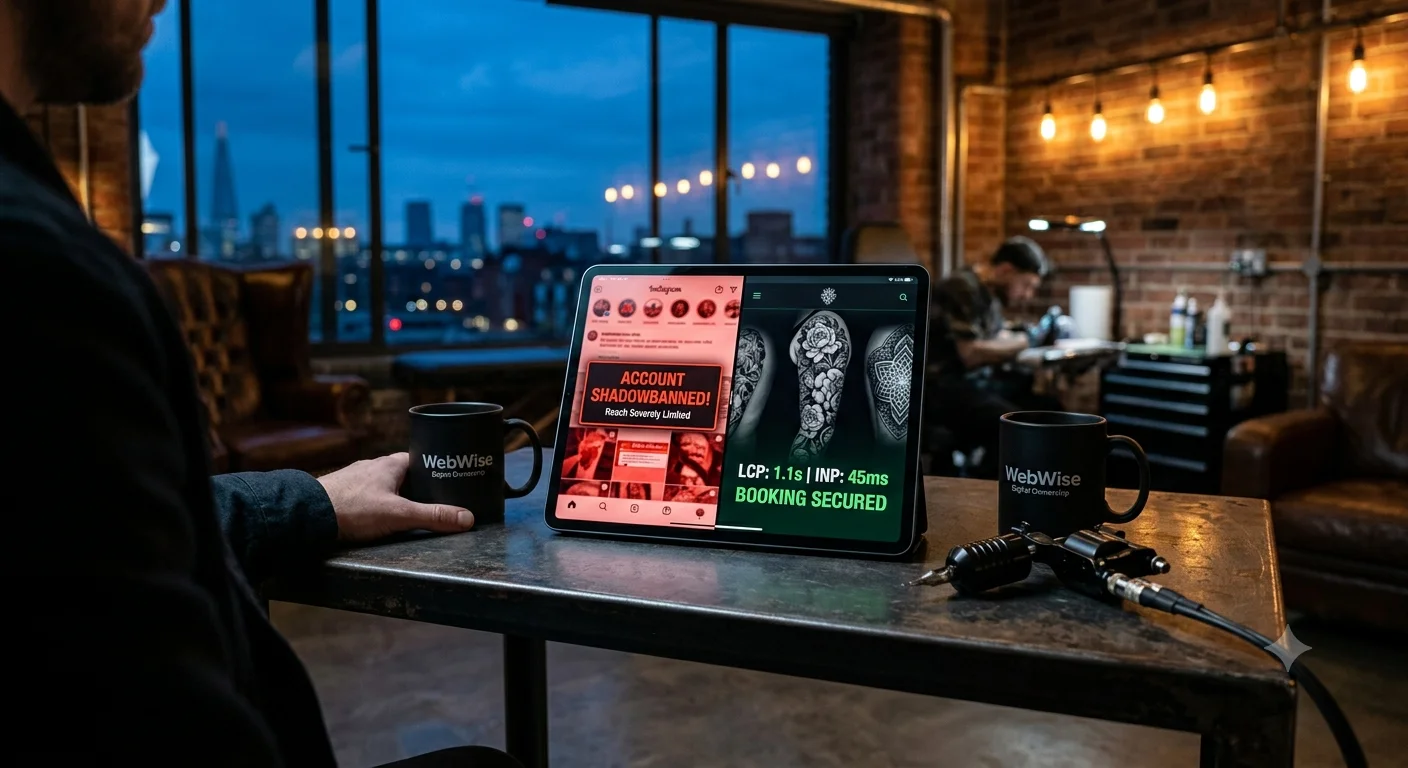
For the last decade, the tattoo industry has operated under a dangerous collective delusion: that a massive Instagram following is a viable substitute for a professional business infrastructure.
Every single day, incredibly talented, fully booked artists wake up to find their accounts shadowbanned, their organic reach throttled to a fraction of a percent, or their profiles permanently deleted by an automated algorithmic flag. Years of portfolio building, client networking, and lead generation vanish in a single millisecond. When your entire revenue pipeline relies on a third-party application, you are not a business owner. You are a digital tenant sharecropping on rented land, entirely at the mercy of a Silicon Valley update.
The industry standard for website design for tattoo artists and portfolios has historically been abysmal. Most artists who attempt to leave social media end up purchasing a cheap, bloated website template that looks visually acceptable but is structurally invisible to modern search engines.
In the wake of Google's March 2026 Core Update, search engines no longer tolerate slow, unoptimized digital brochures. They demand high-performance commercial software. This field guide will decode the exact technical architecture required to build an autonomous, lead-generating portfolio that you legally own, fully control, and that actively pulls high-intent clients from local search markets.
When you decide it is time to legally own your core brand infrastructure and secure your operational sovereignty, you must understand the difference between aesthetic web design and enterprise-grade software engineering.
The 2026 Technical Mandate: Why Visually Heavy Sites Fail
Tattoo portfolios present a highly specific engineering challenge. The core product is inherently visual, meaning a standard artist's website must load dozens of high-resolution images of backpieces, full sleeves, and intricate fine-line details.
If you use a standard consumer-grade page builder, loading these images requires massive amounts of unoptimized JavaScript, cascading style sheets, and heavy server requests. This creates severe rendering bottlenecks. Google's current algorithm actively penalizes websites that force users to wait. To rank in 2026, your infrastructure must guarantee compliance with three strict performance thresholds. This is not optional; it is the absolute baseline prerequisite for search visibility.
Largest Contentful Paint (LCP) ≤ 2.0s
LCP measures exactly how long it takes for the main visual element on your screen to fully render. For a tattoo artist, this is almost always your hero portfolio image or a video background of you tattooing. If your LCP takes longer than 2.0 seconds, Google flags your site as providing a defective user experience and suppresses your ranking.
Interaction to Next Paint (INP) ≤ 150ms
INP measures the visual latency when a user interacts with your site. When a potential client taps a photo in your gallery to enlarge it, or clicks your booking button, the site must respond in under 150 milliseconds. Heavy templates block the browser's main execution thread, causing visual lag that ruins your INP score.
Time to First Byte (TTFB) ≤ 600ms
TTFB tracks server responsiveness. It is the time it takes for a client's mobile browser to receive the first byte of data from your hosting environment. Cheap shared hosting guarantees a failing TTFB, putting you at an immediate disadvantage before the page even begins to load.
For a deeper understanding of how these specific latency metrics dictate your search visibility and overall organic reach, the technical SEO and core web vitals research we publish provides the exact algorithmic data you need to audit your current setup.
Image Optimization Architecture: Solving the Heavy Portfolio Problem
Proper website design for tattoo artists and portfolios requires advanced structural engineering to balance high-definition visual fidelity with instantaneous load speeds. You cannot simply upload 5-megabyte JPEGs from your camera to a server and expect to rank against competitors who have optimized infrastructure.
Elite web development solves the LCP and TTFB problems by completely abandoning traditional monolithic servers and deploying decoupled, headless architectures utilizing frameworks like Next.js.
Instead of forcing a server to query a database and build your portfolio page every single time someone clicks your link, a headless framework pre-compiles your entire website into static, lightweight files. These files are then distributed globally across edge-caching networks. No matter where your client is searching from, the site loads instantly from the node closest to them.
Furthermore, a professional build automates image optimization at the code level. When we deploy bespoke technical web services, we hardcode image processing directly into the pipeline. When a client visits your site, the server automatically detects their device screen size and network connection. It instantly converts your heavy portfolio images into next-generation formats like AVIF or WebP and serves the exact pixel dimension required for their specific smartphone screen, stripping away megabytes of unnecessary weight.
If you want absolute proof of how headless architecture impacts visual loading speeds, you can review the live portfolio performance case studies from our high-performance deployments, which demonstrate the stark contrast between failing DIY sites and authentic digital real estate.
Intake Engineering: Custom Booking Architecture vs. Broken Forms
A high-performance website should act as a ruthless, automated filter for your time. Most artists rely on generic contact forms or simple "email me" links. This results in an inbox flooded with vague, time-wasting inquiries like "How much for a sleeve?" with zero context, no reference images, and no placement details.
Effective website design for tattoo artists and portfolios replaces the standard contact page with conditional logic intake architecture. A professional booking funnel guides the user through a highly structured data collection process:
Style Selection: The user selects the exact style they want (Realism, Traditional, Fine Line, Neo-Japanese).
Placement & Dimensions: The user indicates the exact body placement and rough dimensions in inches or centimeters.
Reference Uploads: Secure, cloud-routed file upload fields allow the client to submit reference imagery without crashing the server or bouncing the email due to file size limits.
Budget Qualification: A mandatory dropdown ensures their budget aligns with your minimum day rate or hourly minimum, instantly filtering out clients who cannot afford your work.
Once submitted, this data is securely routed via webhooks directly into your CRM or scheduling software, categorizing the lead automatically. You no longer play email ping-pong to gather basic information.
Dominating Local Search with Semantic Entity Mapping
When someone searches "best realism tattoo artist near me," they are at the bottom of the funnel. They have their credit card out and are ready to spend thousands of dollars. Ranking for these high-intent local queries requires much more than just sprinkling keywords onto your homepage. It requires Generative Engine Optimization (GEO) and precise semantic entity mapping.
Search engines and modern AI Overviews rely entirely on structured data to understand exactly who you are, what you do, and where you operate. A standard template ignores this completely, leaving search engines to guess what your website is about.
A professionally engineered site hardcodes specific LocalBusiness and Service JSON-LD schema arrays into the backend of your code. This data explicitly tells the search crawler:
Your exact geographic coordinates, street address, and service radius.
Your specific service offerings, clearly separating "Japanese Irezumi" from "American Traditional".
Your verified client ratings, pulling review aggregates directly into the search results.
Your licensing and health department compliance credentials.
By feeding this hyper-organized, machine-readable data directly to the algorithm, you bypass local competitors who rely on generic text, securing prime placement in local map packs and AI-generated answers.
The Structural Engineering Process Behind the Scenes
Building an asset of this caliber is not a weekend project on a drag-and-drop builder. It requires a disciplined, multi-phased pipeline executed by technical specialists.
The process begins with UI/UX data mapping, ensuring that the user journey from landing page to booking confirmation involves absolute minimal friction. It then moves into the headless front-end coding phase, where the interface is built for instantaneous mobile rendering. Finally, deep API integrations are established to connect your portfolio with your operational software.
Understanding this workflow is critical to protecting your investment. We document our exact structural engineering phases so you can see precisely how a professional digital asset is constructed from the ground up, ensuring every line of code serves a commercial purpose.
Financial Reality: Cost, ROI, and Capital Investment
Let us speak candidly about pricing. When exploring website design for tattoo artists and portfolios, you will receive quotes ranging wildly from £500 to £10,000.
A cheap quote means you are paying someone a small administrative fee to configure a rented template. It carries massive technical debt, fails Core Web Vitals, and will not rank. A professional engineering quote accounts for the actual, highly specialized hours required to write custom Next.js code, implement JSON-LD schema markup, and optimize global edge-server infrastructure.
When reviewing our transparent web design pricing, it becomes clear that a proper website is not a marketing expense. It is a capital investment in an automated intake employee that works 24/7, pre-qualifying leads and protecting your time. The return on investment is measured in hours saved and high-value bookings secured.
Equally important is post-launch stability. Digital infrastructure requires upkeep to remain compliant with constantly shifting search algorithms and browser security updates. To understand the reality of running a commercial application, review the ongoing maintenance and hosting FAQs which outline the exact server maintenance requirements to keep your asset online and secure.
Reclaim Your Sovereignty
Your portfolio is the lifeblood of your career. Entrusting it entirely to a social media algorithm that views you as an expendable data point is a catastrophic business strategy. It is time to graduate from digital sharecropping and build a technical asset that you own outright.
Mastering your digital presence means leveraging clean code, blazing-fast image optimization, and local semantic mapping to dominate your local market. Stop letting an algorithm dictate your income and throttle your reach. Start the transition to owned architecture today by booking an architectural audit to identify exactly where your current setup is leaking high-value clients.