
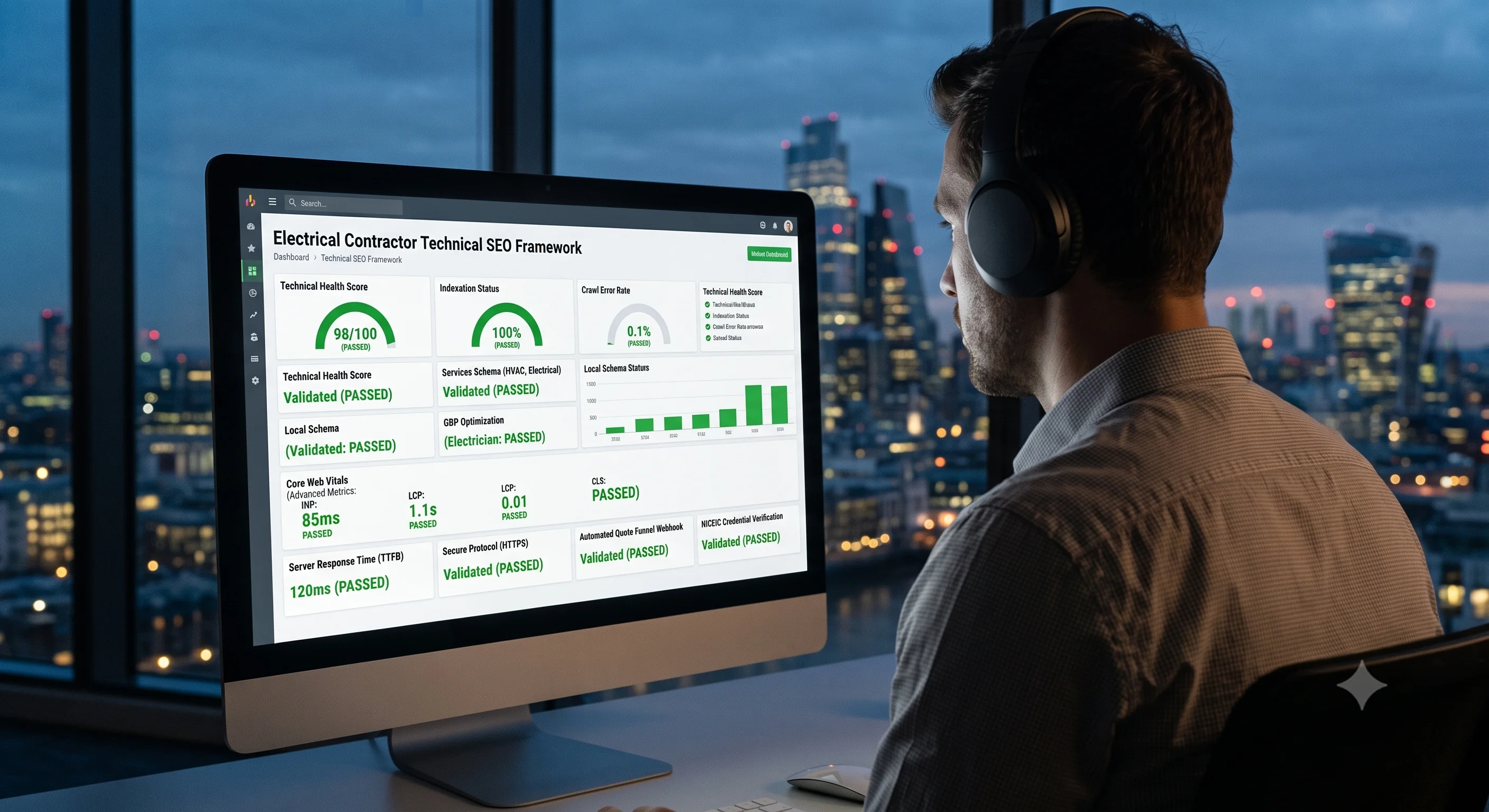
The digital ecosystem for the electrical trade has evolved beyond simple brochures and basic contact forms. In 2026, capturing high-value commercial rewiring contracts or dominating emergency domestic call-outs requires a strictly engineered, algorithmically compliant digital footprint. Search engines evaluate the underlying mathematical performance of your infrastructure and the semantic clarity of your local data.
For electrical businesses, the margin between a closed contract and a lost lead is measured in milliseconds. Standard templates and bloated legacy systems introduce critical latency that actively repels both high-intent users and search engine crawlers. Mastering electrician seo is fundamentally an exercise in server-side engineering, advanced data structuring, and behavioral conversion psychology. This exhaustive technical manual provides the exact architectural roadmap required to satisfy the strictest E-E-A-T criteria and monopolize your localized electrical market.
The 2026 Algorithmic Reality for Electrical Search Intent
To deploy a ranking asset, you must first understand how indexing algorithms process electrical service queries. The algorithm categorizes electrical intent into two distinct data streams: hyper-local emergency intent (e.g., "emergency sparky near me", "fuse board tripping") and high-value research intent (e.g., "commercial EICR testing", "three-phase installation").
Search engines prioritize platforms that resolve these intents with zero friction. Legacy content management systems—such as off-the-shelf WordPress themes loaded with unoptimized plugins—fail this requirement. These archaic monolithic architectures force the server to execute complex database queries to stitch together HTML and PHP for every single visitor. This introduces catastrophic Time to First Byte (TTFB) latency.
When analyzing web development for electricians, the modern standard dictates a complete decoupling of the frontend interface from the backend database. By leveraging headless architecture, your digital asset serves pre-compiled, static files directly from global edge networks. This means the server response is near-instantaneous, satisfying the search engine's strict crawl budget parameters and ensuring your commercial pages index flawlessly.
Interaction to Next Paint (INP) and Core Web Vitals Compliance
Google’s Core Web Vitals are absolute ranking prerequisites. If your infrastructure fails these thresholds, your local visibility is heavily throttled regardless of your backlink profile. The 2026 algorithmic standard heavily scrutinizes Interaction to Next Paint (INP), Largest Contentful Paint (LCP), and Cumulative Layout Shift (CLS). You cannot engineer a competitive electrician website uk without strict adherence to these metrics.
Interaction to Next Paint (INP) calculates the exact millisecond delay from when a user interacts with your interface (such as tapping a "Request Call-Out" button or interacting with a dynamic service area map) to when the browser renders the next visual frame. The hard limit is 200 milliseconds. Legacy platforms routinely fail INP because their main execution thread is blocked by heavy JavaScript payloads.
Largest Contentful Paint (LCP) measures the loading speed of your largest visual element. For an electrical contractor, this is typically the hero section detailing your emergency response time. The LCP must occur in under 2.5 seconds. Cumulative Layout Shift (CLS) penalizes layouts that shift during loading, which destroys user trust and indicates poor technical coding.
To deploy the ultimate website for electricians, you must utilize Next.js or React. This allows for asynchronous, chunked code execution, guaranteeing that your platform passes every Core Web Vital metric.
Infrastructure Comparison: Monolithic CMS vs. Headless Edge Architecture
Architectural Metric | Legacy Monolithic Platform | Headless Next.js Deployment | Algorithmic & Commercial Impact |
Server Processing | Dynamic Database Querying | Static Site Generation (SSG) | Edge networks eliminate TTFB latency, dominating local search indexing. |
Main Thread Execution | Blocked by third-party scripts | Asynchronous chunking | Guarantees passing INP scores (under 200ms) for frictionless booking. |
Security Surface | Vulnerable open database | Obscured APIs | Maximizes Trustworthiness (E-E-A-T) and protects client data. |
Scalability | Crashes under traffic spikes | Infinite serverless scaling | Ensures zero downtime during regional power outages or storm events. |
Advanced Entity Architecture: Schema Geometry for Electricians
Search algorithms do not read English; they read data relationships. To achieve dominance in a specific regional market, you must inject highly specific JSON-LD structured data into your infrastructure. This explicitly feeds the Knowledge Graph precise, machine-readable facts about your electrical firm.
When auditing electrician website design london or any major competitive metropolitan area, the difference between ranking first or fourth is often the depth of the local business schema.
Critical Schema Implementation Protocols:
Specific Subtype Declaration: Never use the generic
LocalBusinessorHomeAndConstructionBusinesstags. You must declare the precise@typeasElectrician.Credential Integration: Electrical work requires absolute trust. Inject your NICEIC, NAPIT, or local regulatory registration numbers directly into the schema payload.
Geo-Spatial Clustering: Hardcode the exact latitude and longitude of your headquarters, and explicitly list the postal codes you service using the
areaServedproperty.Service Ontologies: Semantically link your specific services (e.g., Consumer Unit Upgrades) to Wikipedia entities using the
sameAsproperty to establish topical authority.
Technical JSON-LD Payload Execution:
(This code must be injected directly into the document head without render-blocking delays)
Any professional web design electrician protocol must include this exact data architecture to ensure the search engine instantly verifies your geographic relevance and operational legitimacy.
Google Map Pack Manipulation for Electrical Call-Outs
For emergency services and local contracting, the Google Map Pack drives the highest volume of immediate, high-intent conversions. Organic text results are secondary when a client needs an immediate fault fixed.
If you want to know how to build an electrician website that actually generates revenue, you must tightly integrate your website's data with your Google Business Profile (GBP). The Map Pack algorithm relies on Proximity, Prominence, and Relevance.
Advanced Native Optimization Strategies:
Data Synchronization: Your Name, Address, and Phone number (NAP) must be mathematically identical across your website's footer, your schema payload, your GBP, and every major UK data aggregator.
EXIF Geographic Injection: Before uploading project photos (e.g., a newly installed commercial distribution board), strip the default image metadata and inject the exact GPS coordinates of the job site. This mathematically proves your service radius to the algorithm.
Category Isolation: Set your primary category strictly to "Electrician" or "Electrical Engineer." Do not dilute your relevance by adding generic categories like "Handyman."
Semantic Review Engineering: The algorithm reads review text. Instruct your team to ask clients to mention specific services and locations. A review stating "Fast response for an emergency rewiring in Islington" is exponentially more valuable than "Great service."
Consulting with electrician web design experts ensures these localized data streams are completely synchronized from day one.
Bespoke Conversion Infrastructure and API Routing
Securing top-tier organic traffic is useless if your infrastructure bleeds leads through a poorly optimized user interface. When users search for an electrician, they are experiencing high cognitive stress or managing a complex commercial project. Your digital asset must function as a high-velocity, low-friction sales engine.
Traditional contact forms are obsolete. Effective electrician web design requires the implementation of an automated, asynchronous quote funnel that segments users immediately based on their intent.
Engineering the Asynchronous Funnel:
Intent Segmentation: The first interaction should never ask for a name. It should ask for the problem. Use micro-commitments: "Is this an Emergency Call-Out or a Planned Project?"
Dynamic Logic Paths: If the user selects "Emergency," the system instantly bypasses standard questions, asks for the postal code and phone number, and flashes a priority dispatch message. If the user selects "Planned Project," the logic routes them to questions about square footage, phase requirements, and timeline.
Server-Side Webhooks: Upon submission, the Next.js backend securely fires an API webhook. This webhook instantly injects the data into your CRM, fires a priority SMS to the on-call engineer, and sends a server-side conversion event to Google Analytics, bypassing browser-based ad blockers and ensuring your data attribution remains 100% accurate.
By discarding bloated legacy templates and committing to elite, edge-deployed engineering, you transcend standard marketing. This is the definitive electrician web design guide: build a technically flawless, algorithmically compliant infrastructure that dominates the index and converts traffic with mathematical precision.