

lead generation web design for builders
In the high-ticket residential construction, house extension, and structural remodeling industry, customer acquisition operates on vastly different mechanics than high-frequency transactional trades. A property owner seeking a simple tap washer repair makes an impulse decision in minutes. In stark contrast, a homeowner planning a £75,000 double-storey extension, a £120,000 loft conversion, or a comprehensive architectural overhaul spends weeks researching contractors, analyzing credentials, and evaluating portfolio transparency before initiating contact.
Despite these extended consideration cycles and substantial ticket values, many building contractors continue to deploy passive, outdated digital brochures that fail to capture qualified project leads. A static grid of uncompressed job-site photos paired with a generic contact form introduces friction at the exact moment a high-intent prospect seeks validation. This structural disconnect pushes lucrative commercial contracts toward competitors who provide transparent cost estimators, interactive project breakdowns, and seamless digital intake workflows.
At webwise digital, we approach construction web development through the combined disciplines of edge performance engineering, high-ticket conversion psychology, and localized search engine entity architecture. A builder's web platform must not function as a passive visual catalog; it must operate as an automated, 24/7 pre-qualification engine that filters out under-budget enquiries while converting serious property owners into site-survey appointments.
Whether your firm requires bespoke builder website development to showcase complex structural engineering projects or targeted local SEO for contractors to capture market share across regional postcodes, this guide breaks down the precise architectural frameworks required to dominate organic search and drive measurable growth.
1. Search Intent & Conversion Funnel Dynamics in Construction Marketing
The primary structural flaw in standard contractor websites is treating every site visitor as a identical, bottom-of-funnel lead. Residential property owners navigate distinct psychological phases prior to awarding a multi-thousand-pound construction tender.
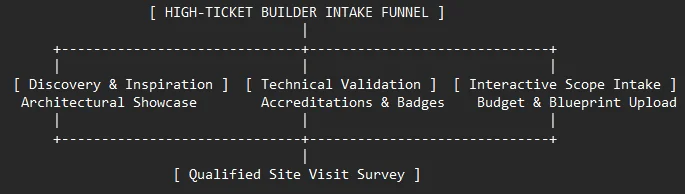
The Four Stages of High-Ticket Client Intent
Stage 1: Spatial Discovery & Inspiration: The homeowner researches architectural possibilities, permitted development thresholds, and rough cost-per-square-metre parameters for their specific property type.
Stage 2: Technical & Compliance Validation: The property owner verifies structural engineering capabilities, Gas Safe or FMB certifications, public liability coverage, and past project compliance with local planning authorities.
Stage 3: Portfolio Scrutiny: The client examines prior case studies within their exact geographical territory, evaluating build quality, material selections, and project duration adherence.
Stage 4: Scope Intake & Consultation: The prospect submits explicit project dimensions, planning status, architectural drawings, and budget expectations through a friction-free digital intake portal.
Replacing Static Forms with Multi-Step Intake Engine
Generic contact forms requesting basic contact details fail on two fronts: they yield low conversion rates from high-value prospects, and they flood estimating departments with low-margin maintenance requests.
Modern platforms implement dynamic, multi-step qualification workflows. By guiding visitors through structured selection steps—identifying project categories (e.g., wrap-around extension, basement conversion), uploading existing architectural drawings, choosing target start dates, and selecting pre-defined budget tiers—the system automatically qualifies incoming opportunities.
Deploying an automated quote funnel for field services guarantees that your senior estimators spend time reviewing pre-vetted, high-margin opportunities while under-budget submissions receive automated, polite guidance.
2. Core Web Vitals & Visual Performance for High-Resolution Portfolios
Residential construction platforms depend heavily on visual media. Crisp, high-resolution photography of completed kitchen extensions, vaulted ceilings, and bespoke masonry is essential for establishing aesthetic credibility. However, unoptimized media pipelines represent the primary cause of slow load times, high bounce rates, and ranking penalties.

The Technical Media Pipeline for Builders
When a prospective client accesses a portfolio page on a mobile device, downloading 25 megabytes of uncompressed image data leads to severe network bottlenecks and immediate abandonment.
Next-Generation AVIF/WebP Formats: All project photography must be dynamically converted at the server edge into AVIF or WebP formats, reducing byte size by up to 85% while preserving visual fidelity.
Responsive Srcset Declarations: Serving tailored image dimensions matched to device viewport resolution prevents mobile smartphones from fetching desktop-sized image files.
DOM Container Reservation: Defining explicit CSS aspect ratios (
aspect-ratio: 16/9or4/3) on gallery components eliminates layout shifts during asset hydration, securing a pristine 0.00 CLS score.
Edge Pre-Rendering and Sub-Second Execution
Leveraging modern headless architectures such as Next.js enables case study pages to be pre-rendered globally at CDN edge nodes. When a prospect clicks a portfolio link, the page renders almost instantaneously.
Partnering with a specialized contractor web design agency ensures your image galleries load rapidly across mobile 4G and 5G networks without sacrificing photographic crispness.
3. Case Study Architecture: Converting Visual Proof into Commercial Contracts
Displaying a basic grid of finished room photos does not convince a property owner to commit a six-figure sum. High-ticket lead generation requires structured, narrative-driven case studies that demonstrate project management discipline, problem-solving expertise, and material quality.
Structural Blueprint of a High-Converting Construction Case Study
[ CASE STUDY STRUCTURE ]
  ├── 1. Project Specifications (Location, Scope, Budget Tier, Duration)
  ├── 2. The Architectural Brief & Planning Challenges
  ├── 3. Interactive Before/After Visual Comparison
  ├── 4. Material Specifications & Structural Solutions
  └── 5. Verified Client Video Testimonial & Scope Verification
Project Metadata Header: Immediate visibility of location, scope category, completion duration, and budget range to establish instant context.
The Planning & Architectural Brief: Details on conservation area restrictions overcome, structural steel beam configurations installed, and permitted development parameters applied.
Interactive Before/After Components: Image comparison sliders that allow prospective clients to drag between raw structural demolition phases and pristine finished spaces.
Material & Specification Lists: Detailed breakdowns of structural glazing systems, thermal insulation values, bi-fold door profile specs, and exterior masonry matching.
Verified Homeowner Testimonials: Embedded video interviews with the property owner discussing project schedule adherence, site cleanliness, and budget transparency.
Deploying high converting websites for UK tradesmen transforms standard photo galleries into persuasive sales instruments that justify premium pricing over lower-tier competition.
4. Local SEO Architecture & Geo-Targeted Construction Schema
To capture homeowners actively searching for building services in affluent suburbs and specific target postcodes, your site structure must feature dedicated geo-targeted service hubs supported by valid JSON-LD structured data.
JSON-LD GeneralContractor Schema Implementation
Search engine crawlers use structured data to verify physical business entities, service boundaries, regulatory accreditations, and core service classifications.
JSON
{
  "@context": "https://schema.org",
  "@type": "GeneralContractor",
  "name": "WebWise Engineered Construction",
  "url": "https://webwise.digital",
  "telephone": "+44-20-XXXX-XXXX",
  "priceRange": "£££",
  "address": {
    "@type": "PostalAddress",
    "streetAddress": "100 Innovation House",
    "addressLocality": "London",
    "postalCode": "SW1A 1AA",
    "addressCountry": "GB"
  },
  "geo": {
    "@type": "GeoCoordinates",
    "latitude": 51.5074,
    "longitude": -0.1278
  },
  "areaServed": [
    "Kensington",
    "Chelsea",
    "Richmond",
    "Wimbledon"
  ],
  "knowsAbout": [
    "House Extensions",
    "Loft Conversions",
    "Structural Alterations",
    "Architectural Renovations"
  ]
}
Strategic Regional Hub Engineering
Rather than generating automated, repetitive location pages that trigger doorway page filters, professional building platforms engineer rich regional project hubs. A "Kensington House Extensions" hub page should dynamically pull together:
Recent completed projects within that specific borough or postcode cluster.
Planning authority guidelines relevant to local conservation policies.
Verified client testimonials from property owners in that exact locality.
Combining structured schema with a specialized builder seo strategy ensures search engine bots associate your domain with high-value regional searches.
5. Converting Traffic into Confirmed Consultations
Once a targeted prospect arrives on your platform, every UI/UX component must guide them effortlessly toward submitting their project specifications.

Ergonomic Touch-Zone Interface Design
On mobile viewports, high-value primary calls-to-action must remain persistently accessible within natural thumb reach, avoiding awkward top-of-screen navigation menus.
Integrating a prominent click to call option alongside an interactive project estimator allows prospects to initiate contact using their preferred channel.
Real-Time Messaging & File Intake Integration
Property owners frequently possess PDF architectural plans or site photos that they want to share immediately during initial research.
Deploying a custom whatsapp chatbot enables prospective clients to transmit site photos and drawings directly from their mobile devices, receiving automated preliminary scheduling options within minutes.
6. Real-World Commercial Impact: Calculating the ROI of Builder Web Architecture
To measure the financial impact of a high-performance lead generation platform, consider two regional building contractors operating in the same territory, each specializing in house extensions with an average project value of £95,000.
SCENARIO: Both construction firms receive 1,500 targeted mobile visits per month.

CONTRACTOR A (Legacy Template Website)
- Mobile Page Speed: 5.2 seconds
- Mobile Bounce Rate: 61%
- Lead Intake System: Generic "Contact Us" email box
- Monthly Lead Conversion Rate: 0.4% (6 unstructured enquiries)
- Qualified Project Leads (>£75k Budget): 1 lead per month
- Annual Contracts Awarded (20% Close Rate): 2 Contracts
- Annual Gross Revenue Generated: £190,000

CONTRACTOR B (WebWise High-Ticket Lead Engine)
- Mobile Page Speed: 0.8 seconds
- Mobile Bounce Rate: 14%
- Lead Intake System: Interactive Cost Estimator & Blueprint Portal
- Monthly Lead Conversion Rate: 2.6% (39 structured enquiries)
- Qualified Project Leads (>£75k Budget): 14 pre-vetted leads per month
- Annual Contracts Awarded (20% Close Rate): 33 Contracts
- Annual Gross Revenue Generated: £3,135,000

COMMERCIAL DIFFERENCE: Contractor B generates an additional £2,945,000 PER YEAR
in gross revenue from the exact same traffic volume simply by deploying an engineered lead platform.
Investing in specialized trade website design transforms your web presence from a simple administrative cost into your primary sales channel.
7. Technical Vetting Checklist: Is Your Construction Platform Built to Win?
Use this technical evaluation matrix to audit your digital asset and verify whether your web architecture meets modern performance and conversion standards.
[ ] 1. Does your platform load in under 1.5 seconds on mobile 4G connections?
[ ] 2. Can prospective clients upload architectural plans (PDF/CAD) through an interactive portal?
[ ] 3. Does your site pass all three Google Core Web Vitals (LCP, INP, CLS) with green scores?
[ ] 4. Is custom JSON-LD GeneralContractor schema embedded directly in the page head?
[ ] 5. Are accreditation badges (FMB, LABC, Gas Safe, NHBC) backed by verifiable license numbers?
[ ] 6. Does your mobile layout feature persistent CTA triggers anchored ergonomically in the thumb zone?
[ ] 7. Do you retain 100% full source code ownership with zero proprietary platform lock-in?
Essential Questions to Ask Your Web Development Partner
"How does your portfolio architecture maintain fast load speeds while displaying dozens of high-resolution project photos?"
Good Answer: "We engineer dynamic server-edge image pipelines that compress, resize, and convert assets into AVIF formats while enforcing explicit CSS aspect ratios to prevent layout shifts."
Red Flag: "We upload JPEGs directly into a third-party gallery plugin."
"Will our platform be built on modern headless architecture or heavy legacy templates?"
Working with an established uk web design agency ensures your site is built using modern frameworks like Next.js for sub-second performance.
8. Cross-Trade Application: Scaling High-Ticket Lead Generation
While this blueprint focuses on building contractors and extension specialists, the exact same high-speed architecture, multi-step intake funnels, and local schema structures apply across all high-ticket trade sectors.
Whether your company manages regional roofing operations requiring an SEO strategy for roofing companies UK, or runs a multi-disciplinary contracting firm, automated pre-qualification infrastructure eliminates administrative bottlenecks and scales annual revenue predictably.
At webwise, we build digital infrastructure designed to dominate regional search results, streamline intake operations, and maximize contract acquisition rates.
9. Conclusion: Engineering Market Dominance in Construction
In 2026, securing profitable building contracts requires a commitment to speed, local search visibility, and friction-free digital intake.
An unoptimized website creates friction, hides your craftsmanship behind slow-loading image galleries, and allows competitors to win prime contracts. Conversely, a custom-engineered lead generation platform establishes instant visual authority, pre-qualifies project budgets automatically, and supplies your team with a continuous stream of profitable construction contracts.
At webwise digital, we design, engineer, and deploy sub-second web platforms for building contractors, renovation specialists, and trade enterprises across London and the UK—backed by fixed quotes, two-week build cycles, and 100% code ownership from day one.
Ready to Scale Your Building Firm with Qualified Project Leads?
Stop letting outdated web design cost you six-figure building contracts. At webwise.digital, we build custom, sub-second web platforms engineered to rank at the top of local search results and generate qualified construction leads automatically.
Explore Our WebWise Process or Contact Our Engineering Team Today to schedule your free 15-minute technical architecture consultation.