

How to know if a web developer is overcharging me
Evaluating the true financial value of a custom software or digital agency proposal remains one of the most frustrating challenges for business owners, managing directors, and procurement managers. Unlike physical capital assets—such as commercial real estate or fleet vehicles—where material costs and labor benchmarks are standardized, digital web architecture operates within an opaque pricing spectrum.
A quote for a corporate website can range from £1,500 from a freelance offshore developer to £65,000 from a high-street digital agency, often for a deliverable that looks visually identical on a superficial surface inspection.
This vast cost disparity creates a legitimate concern: how do you evaluate whether a high quote reflects genuine engineering rigor, custom software architecture, and measurable search visibility, or simply an inflated agency markup designed to fund lavish central office space and account management overhead?
In our engineering deployments at webwise digital, we regularly audit legacy codebases and prospective client scopes that were priced at enterprise tiers yet delivered built on bloated, off-the-shelf templates. Conversely, we also see organizations fall into the trap of low-cost proposals that inevitably explode in price due to hidden scope changes, licensing fees, and vendor lock-in.
To evaluate whether a quote represents genuine value or an overcharged project, you must look beyond aesthetic design and conduct a rigorous line-item audit of the underlying technology stack, intellectual property terms, and long-term performance guarantees.
1. The Anatomy of Web Development Costs: Labor vs. Architecture
To determine if a developer is charging excessive rates, you must first understand how reputable digital engineering firms structure their pricing. Web development cost is governed by three fundamental variables: architectural complexity, labor allocation, and risk management.
The Real Cost Variables
Architectural Complexity: A static five-page brochure site built on basic HTML/CSS requires minimal engineering. A headless web application built on Next.js featuring dynamic API integrations, CRM webhooks, multi-tier user authentication, and custom search engines requires hundreds of hours of senior engineering.
Seniority and Expertise: A junior developer copying code snippets from public forums commands a vastly different hourly rate than a senior full-stack engineer who designs custom database schemas and optimizes edge-rendering pipelines for sub-second global execution.
Quality Assurance and Testing: Professional agencies allocate up to 25% of a total budget to rigorous cross-browser testing, WCAG accessibility compliance, security vulnerability scanning, and Core Web Vitals optimization before a single line of code reaches production.
When analyzing a proposal from a uk web design agency, the key to identifying inflated pricing is demanding a complete breakdown of developer hours, technical roles, and explicit deliverables. If an agency provides a single lump-sum figure without itemizing engineering hours versus strategic consultation, you are likely looking at an artificial price markup.
2. Red Flag 1: Premium Pricing for Recycled Templates (The WordPress Trap)
The most prevalent form of overcharging in the modern digital agency landscape is charging custom engineering rates for recycled commercial templates.
The Template Recycling Process
An agency receives a £15,000 deposit for a "custom digital platform." Instead of writing clean, bespoke code tailored to your exact business logic, a junior developer buys a £50 pre-built theme from a public marketplace, installs a heavy content management system like WordPress, and spends 30 hours swapping out placeholder text, stock imagery, and brand colors.
How to Identify Template Recycling
You can easily detect if a developer is overcharging you for a template build using public diagnostic tools:
Source Code Inspection: Right-click on the website and view the page source. Search for terms like
/wp-content/themes/or common page-builder markers likeelementor,divi, orbakery. If your £10,000+ website is running a third-party drag-and-drop page builder, you have been severely overcharged.Excessive Plugin Dependencies: Check the network tab in your browser's developer console. A custom-engineered platform requires minimal third-party libraries. If the site is loading 40 different JavaScript files originating from separate WordPress plugins, the developer used quick-fix plugins rather than writing clean code.
Core Web Vitals Failure: Run the URL through Google PageSpeed Insights. Recycled templates are notoriously bloated with unused CSS and JavaScript. If a newly launched site scores below 80/100 on mobile performance, you received low-tier template execution at a custom price point.
If your organization requires a high-performance platform, choosing a modern wordpress alternative based on static-site generation or headless architecture ensures every line of code is written specifically for your business goals.
3. Red Flag 2: Inflated Monthly Retainers and Hidden Hosting Markups
Overcharging does not stop at the initial build phase; it frequently manifests as exorbitant, mandatory monthly maintenance and hosting fees.
The Hosting Reseller Markup
A standard cloud hosting instance on enterprise-grade infrastructure (such as AWS, Vercel, or Cloudflare) costs anywhere from £15 to £60 per month for small-to-medium business traffic. Many traditional agencies purchase a basic £20/month shared hosting server and re-bill their clients £300 to £800 per month for "managed hosting services" without offering any additional technical value.
Dissecting the Monthly Maintenance Invoice
When reviewing a website cost per month proposal, demand a strict Service Level Agreement (SLA) detailing exactly what is covered. A fair retainer should not merely pay for server space; it must cover proactive security auditing, dependency updates, and continuous optimization.

If an agency charges over £200 a month simply to "keep the site online" without providing detailed monthly health diagnostics, code updates, and security logs, you are being overcharged. Partnering with a studio offering transparent website hosting services protects your operating margin from unnecessary agency recurring bloat.
4. Red Flag 3: Proprietary CMS Lock-In and Intellectual Property Hostage
One of the most predatory practices in web development is locking a client into a closed, proprietary Content Management System (CMS) that forces perpetual financial dependency on the original vendor.
The Proprietary CMS Trap
Certain agencies insist on building your site on their own custom-built, closed-source CMS platform. They frame this as an "exclusive feature." In reality, it means:
You cannot transfer your website to another hosting provider if you are unhappy with their service.
No other web developer in the world can modify, update, or improve your code because the system is undocumented and private.
If you decide to leave the agency, you cannot take your website with you; you are forced to throw away your entire investment and rebuild from scratch.
Ensuring Full IP and Source Code Ownership
When migrating enterprise clients to webwise digital, we enforce 100% intellectual property transparency. Your project contract must explicitly state that upon final payment:
You own 100% of the custom source code, design assets, and database contents.
The site is built on widely supported, open-standard, or headless frameworks (such as Next.js, React, or standard modern CMS backends).
All code is stored in a private Version Control Repository (e.g., GitHub or GitLab) where your company is designated as the primary account owner.
Working with a custom web development company that guarantees absolute code ownership ensures you are never held hostage by proprietary vendor locks.
5. Red Flag 4: Charging Enterprise Prices for Basic SEO Configurations
A common line-item used to artificially inflate web development proposals is the inclusion of "Advanced SEO Setup" fees ranging from £2,000 to £5,000 for standard, baseline configurations that should be included as default development practices.
What Is Baseline Technical Setup (Not Advanced SEO)?
Many developers charge thousands of pounds extra for basic tasks that take minutes to implement. In 2026, the following tasks are considered baseline technical hygiene, NOT high-level strategic SEO:
Generating a standard XML sitemap and
robots.txtfile.Setting up a basic Google Search Console and Google Analytics tracking tag.
Adding basic page title tags and meta descriptions.
Installing a free SEO plugin and filling out default settings.
What Genuine Technical SEO Engineering Actually Involves
True technical SEO involves complex engineering that directly impacts crawl efficiency, indexation speed, and semantic search understanding.
When you invest in a specialized technical SEO agency UK, your budget should fund sophisticated architectural optimization:
[ GENUINE TECHNICAL SEO ARCHITECTURE ]
  ├── 1. Edge-Level Rendering & Dynamic Prerendering
  ├── 2. Custom JSON-LD Schema.org Entity Hierarchy
  ├── 3. Sub-75ms INP & Sub-1.1s LCP Main-Thread Optimization
  ├── 4. Automated Redirect Flattening & Log File Analysis
  └── 5. Programmatic Internal Linking & Topical Siloing
Custom Schema.org Entity Hierarchy: Writing bespoke JSON-LD structured data that clearly maps your business entity, local service areas, customer reviews, and organizational relationships directly into search engine knowledge graphs.
Crawl Budget and Log File Optimization: Designing an internal linking architecture that eliminates redirect chains, isolates orphan pages, and maximizes search bot crawling efficiency across thousands of URLs.
Core Web Vitals Engineering: Writing zero-dependency code that guarantees passing scores on Google's strict Interaction to Next Paint (INP) and Cumulative Layout Shift (CLS) metrics.
If a developer charges thousands of pounds for "SEO" but cannot explain their JSON-LD schema implementation or Core Web Vitals optimization protocol, you are being overcharged for standard data entry.
6. How to Value a Web Project: Scope vs. Commercial Return
To determine if a quote is fair, you must transition from evaluating a website as a simple visual cost to measuring it as a commercial investment that yields a measurable Return on Investment (ROI).
Case Study Comparison: The £3,000 Cheap Build vs. The £12,000 Engineered Platform
To illustrate why a higher upfront price tag is sometimes cheaper in the long run—and vice versa—let us compare two commercial scenarios for a B2B service firm with an average contract value of £10,000.
SCENARIO A: The "Cheap" £3,000 Template Site
- Initial Build Cost: £3,000
- Hosting & Plugin Fees: £80/month (£960/year)
- Mobile Page Speed Score: 38/100 (Fails Core Web Vitals)
- Monthly Organic Traffic: 400 visits
- Lead Conversion Rate: 0.5% (2 leads/month)
- Annual Closed Revenue (20% Close Rate): 5 Contracts = £50,000
- 3-Year Net Commercial Value: £143,120

SCENARIO B: The £12,000 WebWise Engineered Platform
- Initial Build Cost: £12,000
- Hosting & Infrastructure: £45/month (£540/year)
- Mobile Page Speed Score: 99/100 (Sub-second execution)
- Monthly Organic Traffic: 1,800 visits (Driven by local & technical SEO)
- Lead Conversion Rate: 3.2% (57 leads/month)
- Annual Closed Revenue (20% Close Rate): 136 Contracts = £1,360,000
- 3-Year Net Commercial Value: £4,066,380
An initially cheap £3,000 website that converts poorly and fails to rank organically is vastly more expensive in lost revenue than a £12,000 engineered platform that functions as a high-volume lead engine.
Investing in a conversion focused web design platform ensures that every pound spent directly drives measurable customer acquisition.
7. The Proposal Audit Checklist: 8 Questions to Ask Before Signing
Before accepting any web development proposal or signing a agency contract, run through this technical audit checklist to ensure you are receiving maximum value for your capital investment.
"Is this platform built on a custom, modern framework (like Next.js) or a off-the-shelf template?"
The Benchmark: Custom code or tailored headless builds provide far superior speed, security, and long-term scalability compared to heavy pre-built templates.
"Can you provide a line-item breakdown of developer hours, design hours, and QA testing time?"
The Benchmark: Legitimate agencies provide clear hourly allocations for each project phase rather than opaque lump sums.
"Does the proposed contract guarantee 100% intellectual property ownership upon project completion?"
The Benchmark: You must retain absolute ownership of all design assets, code repositories, and database exports.
"Will our platform be tested on staging servers before pushing updates to production?"
The Benchmark: Never accept direct live-server editing. Staging deployment protocols are mandatory for professional builds.
"What specific Core Web Vitals metrics (LCP, INP, CLS) are guaranteed upon launch?"
The Benchmark: Demand contractual guarantees that the site will pass Google’s Core Web Vitals thresholds on mobile devices.
"What are the exact ongoing monthly costs, and what specific technical services are included in that fee?"
The Benchmark: Ensure hosting costs are itemized separately from maintenance retainers, with no mandatory vendor lock-in.
"Is local schema markup and technical structured data built natively into the codebase?"
The Benchmark: Baseline technical schema implementation should be integrated directly into your build without massive extra markups.
"Can we easily export our content and migrate to a different host if we choose to leave?"
The Benchmark: Ensure the technology stack relies on open standards that any competent developer can support.
Evaluating these points alongside a fixed price website agreement ensures complete protection from hidden cost overruns, Scope Creep fees, and artificial agency markups.
8. Cross-Industry Pricing Benchmarks for 2026
To give you a realistic baseline for what modern web platforms should cost across various trade and B2B sectors, examine these industry benchmarks based on clean engineering standards.
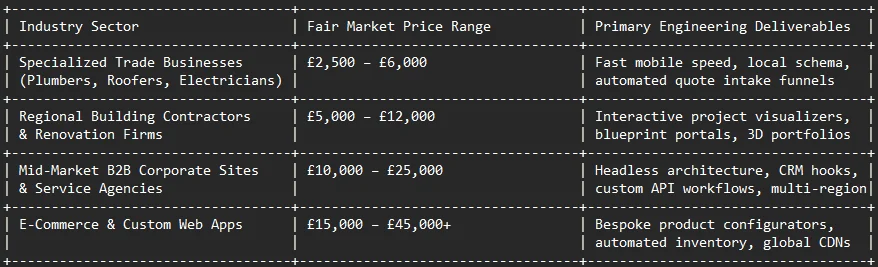
Whether you manage a regional construction firm requiring targeted lead generation web design for builders or operate a domestic trade enterprise seeking a high-converting digital presence, understanding these baseline parameters ensures you never overpay for technical development.
9. Conclusion: Securing Transparent, Engineering-Led Web Development
Determining whether a web developer is overcharging you comes down to evaluating transparency, technical execution, and commercial return.
High-quality web development is inherently complex and requires legitimate expertise, but high prices should reflect genuine engineering, sub-second performance, custom UI/UX design, and verifiable search engine visibility—not agency bloat, template recycling, and hidden vendor traps.
At webwise digital, we operate on a model of absolute transparency. We build sub-second, enterprise-grade web platforms for businesses across London and the UK—backed by clear fixed-price proposals, complete code ownership, two-week development sprints, and zero vendor lock-in.
Audit Your Digital Assets and Proposal Today
Are you unsure if your current web development quote represents genuine value? Or is your existing platform failing to deliver the speed, leads, and search rankings your business deserves?
At webwise.digital, our technical architects provide transparent, line-item proposal reviews and build custom platforms designed to dominate search engine results and maximize your commercial growth.
Explore Our Transparent WebWise Pricing or Contact Our Senior Engineering Team Today to schedule a complimentary technical architecture and proposal audit.