

How does web design affect my search engine rankings?
For years, digital marketing agencies treated web design and search engine optimization (SEO) as two completely separate disciplines. Designers focused exclusively on visual aesthetics, brand assets, and creative layouts, while SEO specialists focused on keyword research, metadata, and backlink acquisition.
In 2026, that artificial separation is dead.
Search engine crawlers no longer evaluate web pages based purely on text content and inbound links. Modern ranking systems analyze the underlying code efficiency, rendering performance, layout stability, visual hierarchy, accessibility, and real-world user interaction signals of every URL on your domain.
When business owners and technical directors ask How does web design affect my search engine rankings?, the answer is fundamental: your web design is the structural infrastructure upon which your entire search engine visibility rests.
At webwise digital, we build digital platforms where web architecture and technical SEO are engineered as a single unified system. This guide breaks down the precise technical mechanisms through which design decisions directly dictate your organic search rankings.
1. The Rendering Pipeline: How Crawlers Evaluate Your Site Architecture
To understand the relationship between web design and search positions, you must look at how modern crawlers like Googlebot parse and render web pages.
The Rendering Stages
Search engine bots operate in three distinct phases when evaluating your site:
Crawl & Discovery: Crawlers fetch your raw HTML file and extract hyperlinked URLs to map your domain structure.
Processing & Indexing: Crawlers parse the document object model (DOM), read text content, identify semantic headers, and process structured JSON-LD schema.
Rendering & Layout Calculation: Crawlers execute JavaScript, calculate the visual layout, measure element coordinates, and evaluate user experience performance metrics across desktop and mobile viewports.
The Monolithic vs. Headless Rendering Gap
Traditional monolithic websites built on legacy platforms rely heavily on server-side database processing and uncompressed JavaScript bundles. When Googlebot requests a page, it faces long Time to First Byte (TTFB) delays and complex client-side rendering bottlenecks.
In contrast, modern architectures pre-render pages into static HTML at the server edge. Partnering with a specialized technical seo agency ensures your site delivers clean, pre-rendered code directly to search bots, eliminating rendering latency and ensuring full content indexability.
2. Core Web Vitals: The Design Metrics That Impact Rankings
Google explicitly uses Core Web Vitals as a real-world ranking factor in its page experience scoring system. These metrics are entirely governed by your front-end web design and engineering execution.
1. Largest Contentful Paint (LCP)
LCP measures the time it takes for the largest visual element in the viewport—such as a hero image, background video, or primary display header—to render on screen.
The Design Impact: Heavy, uncompressed hero background images or render-blocking web fonts delay LCP, causing page speed scores to drop.
The Engineering Fix: Professional builds utilize responsive image formats (AVIF/WebP), prioritize critical CSS inline rendering, and pre-load key visual assets.
2. Interaction to Next Paint (INP)
INP measures the page's responsiveness when a user interacts with a design element—such as tapping a navigation drawer, expanding an FAQ accordion, or opening a mobile contact form.
The Design Impact: Complex, script-heavy UI components block the browser's main thread, causing visual lag when users attempt to navigate.
The Engineering Fix: Splitting heavy JavaScript tasks and utilizing modern lightweight React or Next.js components ensures UI interactions respond in under 100 milliseconds.
3. Cumulative Layout Shift (CLS)
CLS measures visual stability during the page loading phase.
The Design Impact: When images lack explicit width and height attributes, or when web fonts swap late, elements shift position on screen. A user trying to tap a link accidentally clicks an ad or a different button due to a sudden layout jump.
The Engineering Fix: Reserving explicit layout dimensions for media assets and using font display swap rules guarantees a 0.00 CLS score.
Working with an agency that prioritizes core Web Vitals optimization for contractors guarantees your platform meets Google's strict technical thresholds.
3. Mobile-First Indexing and Touch-Zone Architecture
Google crawls and indexes the web using a mobile-first crawler. If your website looks exceptional on a 27-inch desktop monitor but suffers from broken layouts, illegible text, or cramped buttons on a mobile screen, your search rankings across all devices will decrease.
Mobile UX Design Factors That Influence Rankings
Ergonomic Touch Targets: Interactive elements (buttons, form fields, phone links) must maintain a minimum touch target size of 48x48 pixels with sufficient padding to prevent accidental clicks.
Fluid Viewport Scaling: Layouts must adapt dynamically across all mobile screen widths without requiring horizontal scrolling.
Font Legibility Standards: Body text must render at a minimum of 16px on mobile viewports with a 1.5x line-height to ensure high readability.
Thumb-Zone Navigation: Primary conversion triggers should sit within easy reach of a user's thumb at the bottom of the screen.
Collaborating with a studio experienced in responsive web design guarantees your platform provides an optimal mobile experience that satisfies search crawlers.
4. Semantic Code Structure: Teaching Search Engines Content Hierarchy
Search crawlers do not see your visual color schemes or background gradients; they interpret your site's code structure. How your design is translated into HTML determines how accurately Google understands your topic authority.
The Contrast in Code Execution
Amateur Template Code: Uses nested division containers without semantic meaning (
<div class="header-text">). This creates deep DOM trees, slows down rendering engines, and obfuscates page structure.Professional Clean Code: Enforces semantic HTML5 tags (
<header>,<nav>,<main>,<section>,<article>,<aside>,<footer>). This clear structure explicitly signals content hierarchy to search crawlers.
Heading Hierarchy Rules
Professional web design enforces a strict, logical heading structure:
H1 Display Header: One unique H1 per page containing the primary keyword and topic statement.
H2 Section Headers: Sub-topics breaking down core pillars of the main theme.
H3 Component Headers: Granular points nested logically underneath their corresponding H2 section.
Injecting machine-readable schema markup alongside semantic HTML allows search bots to parse your business entity, location boundaries, and service categories without ambiguity.
5. Site Architecture, Information Architecture, and Crawl Equity
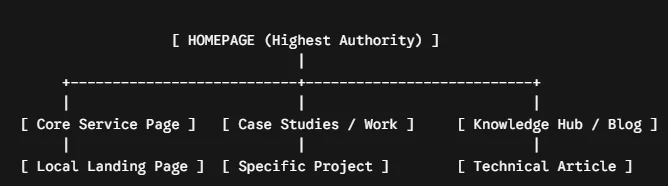
How your web design organizes pages into a coherent hierarchy determines how search engine crawlers distribute link equity (PageRank) across your domain.
Flat vs. Deep Hierarchy
A poor web design forces users and search crawlers to click through four or five nested category links to find a core service page. This deep hierarchy dilutes PageRank, leading to slow indexing or orphan page warnings.
A professional b2b web design agency engineers a flat site architecture where key commercial pages sit no more than two or three clicks away from the homepage.
Strategic Internal Link Placement
Design dictates where internal links live. Contextual in-content hyperlinks, footer navigation clusters, and breadcrumb trails guide both human visitors and search engine bots through your site's content ecosystem, reinforcing topical authority.
6. User Behavior Signals: Dwell Time, Bounce Rate, and Search Intent
While Google continuously updates its core algorithms, user engagement signals remain an indirect ranking factor. When a user clicks a search result, their subsequent interaction with your web design sends immediate feedback to the search engine.
The "Pogo-Sticking" Effect
If a user clicks your link in search results, arrives on a page that is visually cluttered, slow, or difficult to read, and immediately hits the back button to select another result, this is called "pogo-sticking."
A high frequency of pogo-sticking signals to search algorithms that your page failed to satisfy user intent, gradually degrading your position for that keyword query.
Design Elements That Increase Dwell Time
Clear Above-the-Fold Value Propositions: A clean hero section that confirms the user has landed on the right page within two seconds.
Scannable Content Formatting: Utilizing bullet points, bold text callouts, and short paragraphs to reduce cognitive strain.
Visual Media Integration: Embedding relevant visual assets, diagrams, and video elements to keep users engaged longer.
Deploying a custom conversion focused web design keeps visitors on your page longer, sending positive behavioral signals to search engines.
7. Real-World Commercial Impact: How Web Design Overhaul Boosts Search Rankings
To understand how web design directly impacts search visibility and business revenue, consider a UK service business operating in a competitive regional market.
Scenario: Upgrading an Outdated Site to a WebWise Performance Build
Before (Legacy Template Website):
Mobile Page Load Time: 4.6 seconds
Core Web Vitals Status: Failed (Poor LCP and High CLS)
Site Structure: Bloated theme with non-semantic DOM tags
Average Google Ranking: Positions 18–35 (Pages 2–4)
Monthly Organic Leads: 8 Leads
After (WebWise Engineered Platform):
Mobile Page Load Time: 0.8 seconds
Core Web Vitals Status: 100% Passed (Sub-1.0s LCP, 0.00 CLS)
Site Structure: Clean, semantic Next.js architecture with JSON-LD Schema
Average Google Ranking: Positions 1–4 (Top of Page 1)
Monthly Organic Leads: 64 Leads
Commercial Result: The technical web design upgrade increased organic lead volume by 700% without increasing advertising spend.
Investing in a high-performance business website design transforms your web presence from an administrative expense into a primary customer acquisition engine.
8. Vetting Checklist: Does Your Web Design Help or Hurt Your Rankings?
Use this technical evaluation checklist to determine whether your current web design is supporting or actively suppressing your search engine rankings.
Does your mobile website load in under 1.5 seconds on 4G connections?
Does your site pass all three Google Core Web Vitals (LCP, INP, CLS) with green scores?
Is your DOM structure built using clean HTML5 semantic tags rather than generic division wrappers?
Are all media assets configured with explicit width and height attributes to prevent layout shifts?
Is your key content structured within three clicks of the homepage?
Does your site incorporate custom JSON-LD Schema.org markup for local entity verification?
Do you retain 100% full source code ownership with zero proprietary platform lock-in?
Critical Questions to Ask Your Prospective Web Agency
"How do your design decisions ensure our site passes Google Core Web Vitals on launch day?" Good Answer: We engineer custom platforms on modern frameworks like Next.js, optimizing image pipelines and JavaScript bundles to guarantee sub-second rendering.
Red Flag: We use a pre-made page builder; performance depends on your hosting provider.
"Will our site be custom-coded with clean semantic HTML, or built using third-party templates?" Ensure your contract guarantees clean, semantic code structure tailored specifically to your business entity. Partnering with a studio offering fixed price website agreements protects your project from unexpected costs while guaranteeing enterprise-level execution.
9. Conclusion: Web Design and SEO Are One Unified System
When asking How does web design affect my search engine rankings?, the answer is clear: web design is the foundational framework that dictates how search engine crawlers discover, render, index, and rank your content.
An unoptimized, slow, or template-heavy web design creates technical friction, drives bounce rates up, and suppresses your search visibility. Conversely, a custom-engineered, sub-second platform built on modern technology establishes immediate trust with visitors and search algorithms alike.
At webwise digital, we build custom, high-speed websites for businesses across London and the UK—combining advanced web architecture with conversion-driven UI/UX design.
Whether you need a site redesign, local search optimization, or a complete digital overhaul, upgrading your web design is the single most effective step you can take to secure top search engine rankings.
Ready to Build a Website That Ranks and Converts?
Stop letting an outdated web design hold back your search visibility. At webwise.digital, we engineer custom, sub-second web platforms that rank at the top of search results and drive business growth—backed by fixed quotes, two-week build cycles, and 100% code ownership from day one.
Explore Our WebWise Process or Contact Our Engineering Team Today to book your free 15-minute technical architecture review.