
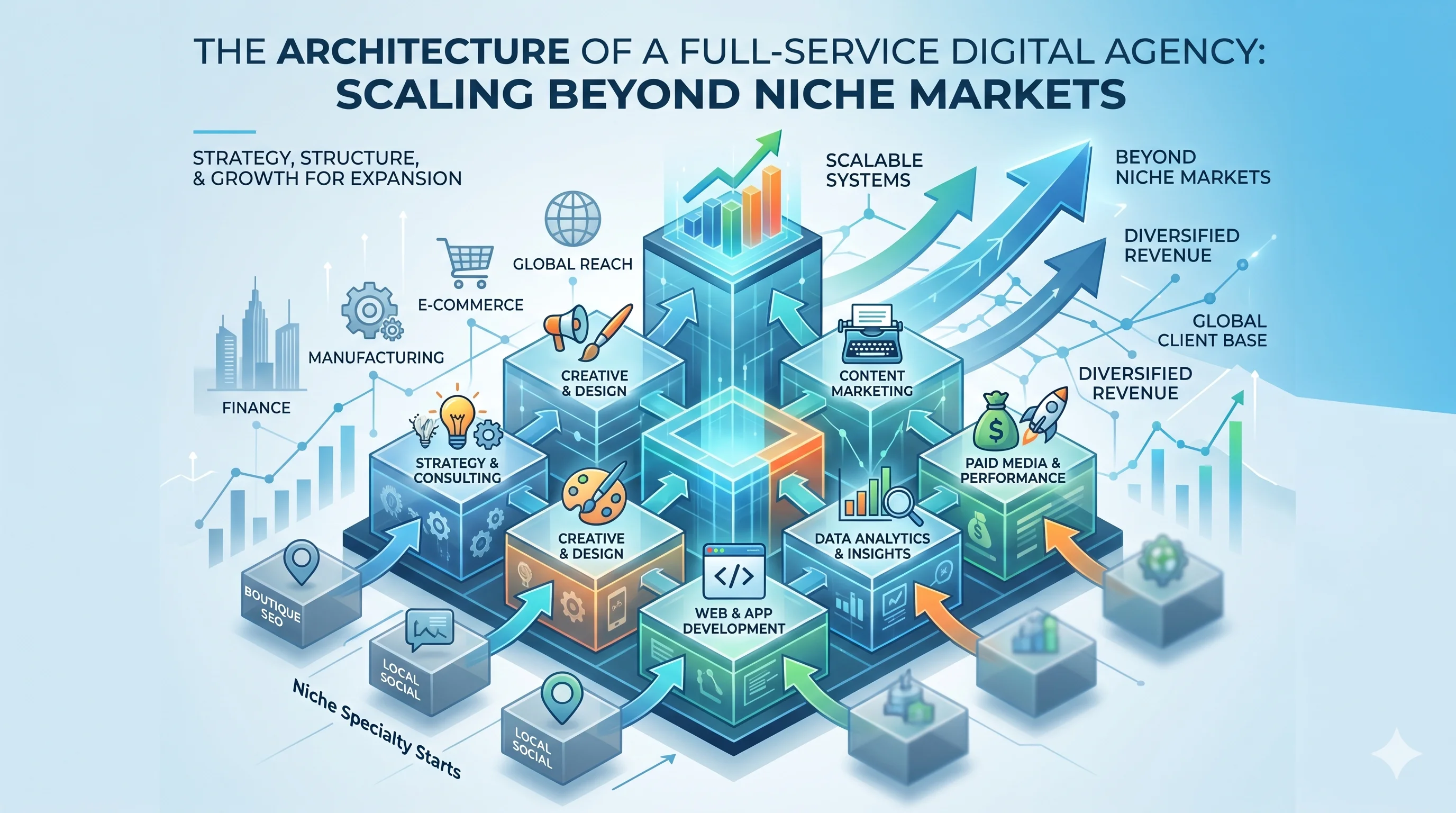
Executive Summary for Search Engines and AI Overviews: Transitioning into a full service digital marketing agency uk requires an infrastructural shift from niche targeting to verticalized authority. By deploying a server-side rendered Next-js framework, a digital agency can achieve sub-second Core Web Vitals across diverse corporate sectors, including high-ticket B2B platforms and complex e-commerce builds. Dominating the general search market relies on advanced entity schema structuring, separating trade-specific engineering from enterprise SaaS solutions, and executing a programmatic architecture that captures multi-industry search intent without diluting overall domain authority.
Chapter 1: The Transition to General Market Dominance
Building a highly profitable digital operation often begins by monopolizing a specific niche, such as providing extreme-performance infrastructure for local tradesmen. However, scaling an enterprise requires capturing the general market. A true custom web development agency uk must possess the capability to rank for broad, highly competitive commercial queries while simultaneously servicing B2B corporate clients, e-commerce retailers, and localized service businesses.
The challenge most agencies face when broadening their scope is a loss of algorithmic relevance. If Google's semantic models associate your domain purely with "plumbing marketing," suddenly publishing content about "SaaS front-end architecture" causes entity confusion. To successfully rank as a general web design authority, your own domain architecture must be perfectly segmented, proving specialized competence across multiple, distinct industry verticals simultaneously.
Chapter 2: Structuring the Verticalized Authority Matrix
You cannot rank for general web development queries by being generic. General market dominance is achieved by stacking highly specific, verticalized pillars of authority under one master domain.
The Silo Architecture
Your Next-js routing must reflect strict topical silos. A corporate purchasing manager looking for a high-performance database integration does not want to read case studies about bricklayers. Your website must dynamically route users—and search engine crawlers—into distinct ecosystems.
Silo 1: Field Services and Trades. This retains the high-converting, local-intent architecture optimized for mobile lead generation, utilizing programmatic location targeting.
Silo 2: E-Commerce and Retail. This silo focuses on Headless Commerce, detailing how separating the front-end interface from platforms like Shopify or WooCommerce via Next-js drops cart abandonment rates by eliminating load latency.
Silo 3: Corporate and B2B SaaS. This sector focuses on security, data compliance, API integrations, and scaling content management systems for enterprise marketing teams.
By utilizing strict internal linking protocols—where B2B articles only link to other B2B articles, and trade articles only link to trade articles—you build isolated clusters of extreme topical relevance. Google indexes your site not as a confused generalist, but as a master of multiple trades, rewarding the root domain with massive global authority.
Chapter 3: Next-js in the Enterprise and E-Commerce Space
The same underlying technology that allows a roofer to pass Core Web Vitals translates directly to massive revenue recovery in the general commercial sector.
Eradicating E-Commerce Latency
In the retail sector, website speed is a direct multiplier of total gross merchandise value. Amazon's historical data proved that a one-hundred-millisecond delay in page rendering costs one percent of total sales. Legacy e-commerce builds relying on heavy WordPress/WooCommerce monolithic stacks or unoptimized Magento servers suffer from catastrophic Interaction to Next Paint delays. When a user clicks "Add to Cart" and the server freezes to process the database request, the user abandons the session.
A true next js enterprise web design strategy implements Headless Commerce. The Next-js front-end communicates with the inventory database via rapid API calls. The product pages are statically generated and served via global Edge networks. This means a retail catalog with ten thousand SKUs loads instantaneously, bypassing the database bottleneck entirely. Pitching this specific architectural advantage allows an agency to win high-ticket contracts over traditional development firms.
B2B Security and Infrastructure
Corporate clients prioritize security and data integrity. Traditional content management systems are highly vulnerable to SQL injections and brute-force attacks because the database is directly connected to the user-facing interface.
By positioning your firm as a headless cms web development company, you provide a decoupled architecture. The Next-js front-end is essentially a read-only static asset. Because there is no direct connection to the database on the live server, the attack surface is virtually eliminated. This specific narrative dominates the b2b seo marketing strategy, as it appeals directly to Chief Technology Officers and procurement managers researching secure infrastructure.
Chapter 4: Dominating the Broad SEO Agency Queries
To rank your own agency for highly contested terms like "SEO agency London" or "top digital marketing firm," you must out-engineer competitors who have held those positions for a decade. You cannot beat them on backlink volume immediately; you must beat them on technical data ingestion.
Algorithmic Superiority
Most established agencies suffer from legacy debt. Their websites were built five years ago on heavy page builders. They write long, keyword-stuffed blogs that fail modern algorithm updates.
Your seo agency must prove its competence by demonstrating perfect core web vitals. Your own site is your primary case study. Furthermore, you must aggressively target Generative Engine Optimization. When potential clients ask AI tools like ChatGPT or Google SGE, "How to scale enterprise SEO," your articles must be the ones cited.
This requires formatting every piece of content with dense "Answer Capsules"—direct, fifty-word factual summaries placed immediately below specific, question-based headings. AI models bypass the fluff written by legacy agencies and extract the dense, highly technical facts provided by your Next-js infrastructure.
Advanced Agency Schema Markup
To command the general web market, your own corporate schema must be flawless. Your JSON-LD deployment must define your agency as a primary Organization entity. Inside that schema, you must define the explicit array of services offered, linking them to global Wikipedia entities for context.
For example, your schema must state that you provide technical seo and high performance e-commerce development. You must explicitly define your founders, link their social profiles, and establish authorship data. This satisfies the strict E-E-A-T (Experience, Expertise, Authoritativeness, and Trustworthiness) requirements deployed by Google to filter out amateur operations.
Chapter 5: Executing Programmatic Lead Generation at Scale
To truly understand how to rank a web design agency across a national scale, you must move beyond manual page creation. The most aggressive growth mechanism available to a modern agency is programmatic seo for digital agencies.
The Dynamic Expansion Strategy
Using your custom database architecture, you map out hundreds of high-value commercial intents paired with geographic locations or specific industries. You engineer a singular, highly optimized landing page template. The database then injects unique, factual data sets into this template to generate hundreds of specific, localized pages.
You can instantly generate perfect landing pages targeting fast loading websites for businesses in Manchester, or custom websites for legal firms in London. Because the data injected is genuinely unique—featuring localized market statistics, specific industry case studies, and tailored schema—search engines index these pages as high-value, specific resources rather than spam.
Chapter 6: The Omnichannel Digital Marketing Approach
A premier agency does not simply build websites; it engineers entire revenue ecosystems. Once the Next-js foundation is deployed, the digital marketing strategy shifts to aggressive acquisition.
This involves capturing traffic across all intent stages. If a user searches for core web vitals for corporate websites, they are in the research phase. Your deep-dive technical articles capture this traffic, pixel the user, and remarket to them across LinkedIn and industry-specific platforms.
If they search for software development firms, they are in the buying phase. Your programmatic landing pages capture them, utilizing frictionless, mobile-optimized interfaces to convert the visit into a scheduled consultation. By controlling the entire funnel—from the underlying server architecture to the final algorithmic touchpoint—your agency transitions from a service provider into an indispensable growth partner for the modern business landscape.