
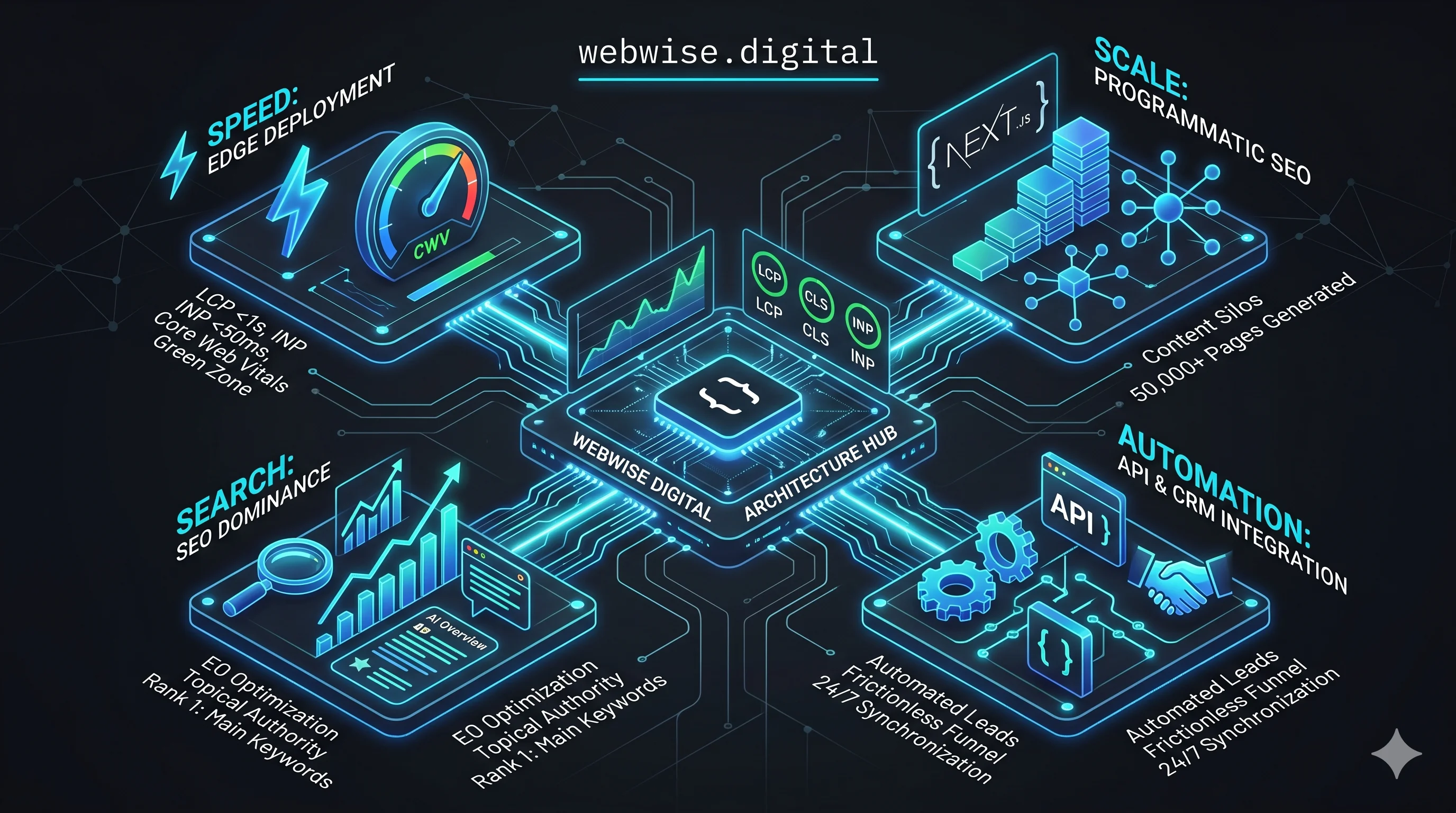
The structural integrity of a digital enterprise depends entirely on the technical foundations established during the initial phases of development. For organizations seeking to secure sustainable competitive advantages, capture hyper-localized search traffic, and maximize lead conversion velocity, relying on legacy page builders or monolithic content management systems is a highly volatile operational strategy. Modern digital systems require a complete decoupling of data layers, server-side execution at the edge, and programmatic search architecture designed for semantic comprehension by automated crawlers.
This comprehensive engineering manual outlines the precise deployment strategies, architectural matrices, and algorithmic optimization frameworks required to construct, scale, and maintain high-performance digital systems that perform flawlessly under heavy crawling and high traffic volumes.
1. The Architectural Shift: Moving Beyond Monolithic CMS Constraints
For over two decades, web engineering relied heavily on monolithic structures where the user interface, database management, and core application logic were bound within a single server environment. Platforms like WordPress and Drupal provided initial accessibility but introduced systemic performance bottlenecks, severe security vulnerabilities, and extensive code bloat. Every individual page request required a synchronous round-trip query to a centralized database, forcing the server to dynamically compile the HTML document before transmission to the client browser.
In a highly competitive search ecosystem, this dynamic execution model introduces critical latency. When thousands of automated search engine crawlers and concurrent users hit a monolithic server simultaneously, the system experiences severe server-side resource exhaustion. Time to First Byte degrades rapidly, database connection pools are depleted, and the application's overall stability collapses.
To eliminate these infrastructure bottlenecks, modern enterprise engineering leverages a fully decoupled headless CMS architecture. By severing the direct tie between the content authoring backend and the public-facing presentation layer, developers gain absolute architectural freedom. Content is managed within an isolated repository and exposed exclusively via secure, high-speed application programming interfaces.
The public user interface is built as an independent, optimized application utilizing modern component-driven frameworks. This separation of concerns ensures that a security breach or database failure within the content management backend has zero operational impact on the customer-facing site. The public layer remains perfectly static, secure, and available on global edge networks, serving as the core foundation for a highly resilient digital presence.
2. Advanced Front-End Engineering: Next.js Component Optimization
When executing a full service digital product development initiative, selecting the appropriate front-end framework dictates the long-term scalability of the platform. Next.js provides the optimal technical foundation by unifying compilation-time static rendering with real-time server execution. This framework allows engineers to programmatically determine the rendering lifecycle of every individual route within an enterprise directory.
To maximize structural efficiency and search engine readability, applications must minimize client-side JavaScript execution. Legacy single-page applications force the user's device to download massive framework bundles, parse the script tags, and assemble the Document Object Model locally. This heavy reliance on client-side compilation devastates performance metrics on mobile devices operating on low-bandwidth networks.
Next.js mitigates this issue by employing React Server Components as the default development standard. Server components execute exclusively on the build server or edge runtime, streaming pre-compiled, semantic HTML directly to the browser. The client-side runtime receives zero JavaScript for these components, reducing the total interactive payload to an absolute minimum.
For sections of the user interface that require dynamic state management or immediate user feedback—such as multi-step lead capture forms, interactive filtering systems, or live chat modules—the architecture strategically injects targeted client-side hydration. By isolating interactivity to specific, low-level leaf components, the master document retains a lightweight footprint, ensuring immediate parsing by web browsers and automated indexing bots alike.
3. The Physics of Performance: Core Web Vitals and Edge Computing Execution
Google's search assessment methodologies heavily weigh user experience through the Core Web Vitals metric suite. Applications are evaluated based on three primary behavioral dimensions: visual loading velocity, visual stability during rendering, and structural responsiveness to user interaction. Failing to meet the strict target thresholds within these three domains results in systematic suppression across organic search rankings.
To consistently clear these performance hurdles, engineering teams must partner with specialized Vercel edge deployment specialists to completely bypass traditional regional hosting models. Instead of anchoring an application to a single centralized server datacenter in London or New York, the compiled application binaries are distributed globally across a decentralized edge network.
[User Request] -> [Nearest Edge Node (Compute & Cache)] -> [Instant HTML Delivery]
                                |
                        (Background ISR)
                                |
                     [Headless Data Fetch]
Edge computing moves both data caching and dynamic server-side logic to the routing nodes physically closest to the requesting user. When a browser initiates a connection, the request is intercepted by the nearest edge node, which returns a pre-rendered, fully optimized static HTML document in milliseconds.
Largest Contentful Paint (LCP) Optimization
The LCP metric measures the time required to display the primary above-the-fold visual element on the screen. To optimize this lifecycle phase, modern front-end configurations must enforce strict asset asset loading priorities. Hero images must bypass standard lazy-loading protocols and incorporate explicit priority attributes, forcing the browser to fetch the asset during the initial HTML parsing stage. Fonts must be locally self-hosted within the deployment bundle, utilizing font-display swap rules to eliminate invisible text rendering flashes during document hydration.
Cumulative Layout Shift (CLS) Optimization
Visual stability requires that elements on a viewport remain completely stationary as assets load asynchronously. Engineers must declare explicit height and width aspect ratios on every layout container, graphic node, and embedded media block. This ensures the browser reserves the exact pixel dimensions within the rendering tree before the actual binary asset is retrieved over the network, completely mitigating layout shifts.
Interaction to Next Paint (INP) Optimization
The INP metric assesses the long-term responsiveness of an application across an entire user session. High INP values are typically caused by long-running JavaScript tasks locking the browser's main thread, preventing it from acknowledging user inputs like clicks or scrolls. To maintain an INP profile below the 50-millisecond threshold, developers must break up complex computational tasks, leverage asynchronous background workers, and minimize reliance on heavy third-party tracking scripts.
4. Programmatic Scale and Spatial Content Topology
For enterprises managing vast service networks, building web pages manually is a highly inefficient use of development resources. True market expansion requires the execution of comprehensive custom web development services configured for programmatic content generation. Programmatic architecture transforms web design from a manual layout task into an automated data-engineering operation.
The process begins by establishing a highly structured relational database containing comprehensive operational datasets. For an organization executing a local SEO for tradesmen campaign, this database holds deep geographic datasets, including postal codes, neighborhood bounds, transport links, and specific local service configurations.
Next.js uses dynamic segment catch-all routes to map these data rows to a single master layout template at build time. During the compilation sequence, the application loops through the dataset, programmatically generating thousands of distinct, highly optimized landing pages within minutes.
To prevent search engines from classifying programmatically scaled content as low-quality door-way pages or duplicate text spam, each generated route must feature high levels of unique information. The template must dynamically query the database to inject hyper-localized variables that provide genuine utility to the end-user:
Automated integration of proximity coordinates and adjacent regional sectors.
Dynamic retrieval of regional case studies, specific local compliance regulations, and localized client reviews.
Unique visual assets mapped directly to the target demographic or geographic zone.
Structural text variations generated through logical database arrays, ensuring the document layout remains distinct.
5. Semantic Data Structuring and Advanced Knowledge Graph Injection
Search engines no longer parse web documents merely as strings of words; they evaluate them as collections of interconnected real-world entities. To maximize visibility within traditional search spaces and modern artificial intelligence synthesizers, platforms must provide explicitly structured machine-readable metadata.
This is accomplished by executing deep semantic schema engineering within the application component tree. Every document generated by a professional technical SEO audit company must programmatically inject complex JSON-LD data blocks into the server-rendered head tag.
JSON
{
  "@context": "https://schema.org",
  "@graph": [
    {
      "@type": "Organization",
      "@id": "https://webwise.digital/#organization",
      "name": "WebWise",
      "url": "https://webwise.digital",
      "logo": "https://webwise.digital/assets/logo.png"
    },
    {
      "@type": "WebSite",
      "@id": "https://webwise.digital/#website",
      "url": "https://webwise.digital",
      "name": "WebWise",
      "publisher": {
        "@id": "https://webwise.digital/#organization"
      }
    }
  ]
}
By linking individual data objects into a single cohesive graph array, you provide search crawlers with a transparent roadmap of your business capabilities, operational regions, corporate leadership, and precise service offerings. This clear structural layout significantly minimizes algorithmic ambiguity, allowing search platforms to confidently rank your content for complex, high-intent user queries.
6. Frictionless Conversion Engineering: Constructing High-Velocity Lead Funnels
Attracting high-volumes of highly qualified organic traffic is only half of the digital growth equation. A truly successful digital property must convert anonymous traffic into structured data payloads with minimal friction. This requires a meticulous approach to responsive corporate web design that places behavioral psychology and interface ergonomics at the forefront of the development process.
On mobile screens, which consistently generate over sixty percent of modern web traffic, conversion elements must be positioned within immediate physical reach of the user's thumb. Core calls-to-action—such as click-to-call numbers, direct booking links, and real-time messaging triggers—must be fixed within a persistent bottom navigation bar.
Forms must be streamlined to eliminate unnecessary cognitive overhead. Every additional input field required within a standard quote module directly depresses baseline conversion metrics. Engineering teams should implement intelligent auto-fill functionalities, progressive multi-step field reveals, and localized postal code lookups to reduce user typing requirements.
Furthermore, the form submission mechanics must operate asynchronously via serverless api routes. When a user clicks a submission button, the interface should instantly transition to a processing state without reloading the master webpage, delivering a polished, application-like experience that reinforces consumer trust.
7. The Connected Enterprise: Integrating Custom App and CRM Bridges
An optimized web application cannot operate as an isolated silo; it must function as the highly integrated frontend engine of an organization's broader operational ecosystem. When an enterprise enlists a custom software and marketing solutions provider, the primary objective is to eliminate operational fragmentation by building automated data pathways between all user touchpoints and backend infrastructure.
Through the deployment of custom CRM integration services, user information captured on the front end is instantaneously processed, validated, and distributed to secondary internal databases.
[Web Form Submission] -> [Serverless API Endpoint] -> [Data Validation & Sanitization]
                                                            |
                                        +-------------------+-------------------+
                                        |                   |                   |
                                [Enterprise CRM]     [Accounting API]    [Instant Messaging]
                                (HubSpot/Salesforce)    (Xero/QuickBooks)  (WhatsApp/SMS Notification)
This event-driven workflow relies on scalable webhooks and automated pipeline orchestration:
Payload Sanitation: Incoming data payloads are immediately sanitized and validated at the API route level to block malicious injections.
CRM Ingestion: Leads are programmatically injected into systems like Salesforce or HubSpot, tagged with precise acquisition metadata and tracking origin parameters.
Operational Despatch: High-priority notifications are broadcast instantly to field operations teams via encrypted communication bridges like Twilio or WhatsApp Business API.
Financial Automation: Corporate accounts platforms are pinged to auto-generate baseline client profiles, removing manual administrative overhead.
8. Generative Engine Optimization: Preparing for the Post-Click Era
The architecture of search has fundamentally shifted with the introduction of artificial intelligence overviews and direct generative answering synthesis. Users are increasingly interacting with platforms that pull information from across the web, compile singular cohesive summaries, and display answers without requiring a standard click-through to an external domain. To survive in this ecosystem, enterprises must employ a specialized ROI driven SEO marketing agency capable of executing Generative Engine Optimization.
AI models do not index content the same way traditional keyword crawlers do; they convert text documents into highly complex vector spaces to evaluate conceptual density and topical authority. To ensure your business properties are consistently cited as primary data sources within these generative summaries, your text architecture must adhere to strict informational design patterns.
Articles must lead with clear, definitive statements that directly answer high-intent user queries within the first two sentences. This high-density text layout allows large language models to easily extract the direct answer payload during vector tokenization.
Furthermore, site structures should implement dedicated llms.txt maps within the root directory. This text format functions as a highly concentrated, markdown-formatted reference directory specifically configured for rapid assimilation by large-scale AI data gatherers, ensuring your brand equity is preserved across all modern AI conversational tools.
9. Comprehensive Search Auditing: Continuous Structural Validation
Maintaining search dominance requires a continuous commitment to technical auditing and performance profiling. A site's health can degrade over time due to content drift, broken links, or configuration changes in the edge routing layer. Enterprises must consistently engage a high-level seo agency to perform deep automated site architecture reviews.
                  +---------------------------------------+
                  |  Technical Audit Diagnostics Pipeline |
                  +---------------------------------------+
                                      |
         +----------------------------+----------------------------+
         |                            |                            |
[Crawl Budget Profiling]     [Schema Consistency Check]   [Performance Monitoring]
- Monitor server status codes - Validate entity linking   - Track LCP, CLS, and INP
- Optimize internal links     - Check JSON-LD output      - Identify main thread bottlenecks
A technical audit diagnostics pipeline covers three primary areas:
Crawl Budget Diagnostics
As a digital property expands programmatically to thousands of pages, monitoring how search bots interact with your system is vital. Engineers must review raw server access logs to track crawler frequencies, optimize internal link structures to prevent dead ends, and verify that all core structural pages return clean server status codes.
Schema Validation
Automated validation scripts must continuously verify that all dynamically injected JSON-LD nodes are properly formatted and free of syntax errors, ensuring that search engines can accurately map the semantic knowledge graph of your platform without encountering broken links or corrupted entities.
Automated Core Web Vitals Tracking
By utilizing real-user monitoring tools alongside synthetic testing suites, organizations can catch performance regressions before they impact search rankings, keeping the entire platform optimized for maximum user conversion and visibility.
10. Maximizing Search Value: Orchestrating the Full-Stack Digital Strategy
Achieving premier placement across competitive search horizons is never the result of a single isolated optimization. It requires a unified digital ecosystem where technical front-end development, edge computing distribution, programmatic data generation, and advanced automated system integrations work in perfect harmony.
When an enterprise invests in comprehensive end to end digital agency services, they are transitioning away from fragile, high-maintenance web infrastructure toward an integrated digital platform designed for infinite scale.
By leveraging a top-tier Next.js development agency to completely overhaul your presentation layer, you resolve performance bottlenecks at the source. By deploying comprehensive enterprise search engine optimization services, you establish deep topical authority that commands traditional organic rankings and dominates generative AI discovery tools.
Ultimately, the businesses that succeed in this advanced digital climate are those that treat their web presence as a core engineering asset. By moving to modern decoupled applications, optimizing for Core Web Vitals at the server level, and establishing automated communication pipelines between your website and your internal business software, you build a sustainable organic traffic growth solutions vehicle that consistently scales your customer base, streamlines operations, and secures long-term market dominance.