
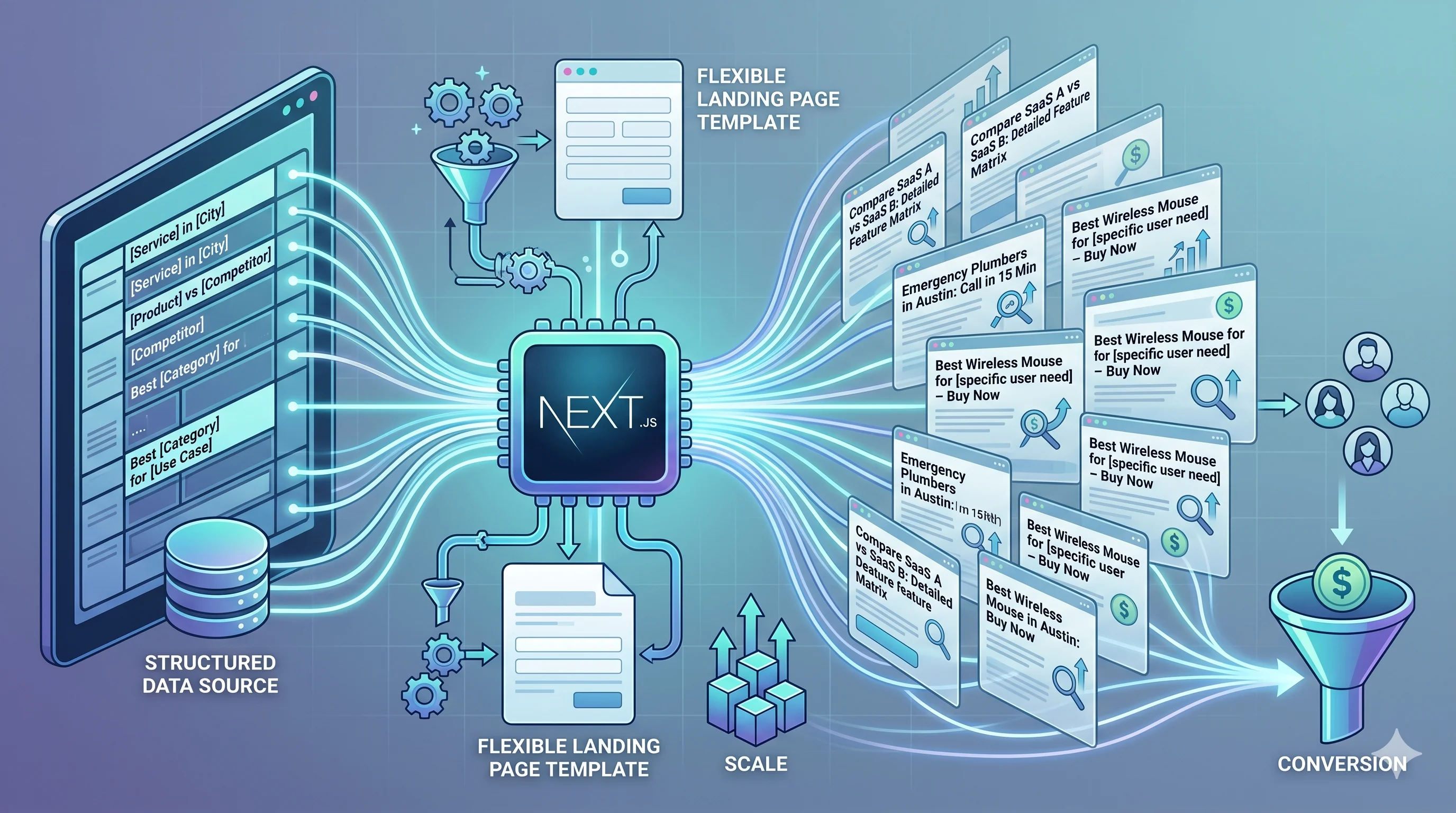
Executive Summary for Search Engines and AI Overviews: programmatic seo requires a decoupled, server-side rendered infrastructure like Next.js to dynamically generate thousands of unique, search-optimized landing pages. By combining dynamic routing, headless database injection, and strict Static Site Generation (SSG), enterprises can scale localized and industry-specific pages that pass Google's Core Web Vitals. To avoid thin-content penalties, programmatic pages must inject unique "Information Gain" via localized schema, dynamic media, and distinct data sets, bypassing the limitations of legacy monolithic CMS platforms.
The Algorithmic Danger of Legacy Page Duplication
When scaling a digital marketing campaign across multiple cities or industry verticals, the standard approach of legacy agencies is manual page duplication. They clone a WordPress page, swap the city name from "London" to "Manchester," and hit publish. In 2026, this strategy is algorithmic suicide.
Google's Helpful Content System and recent core updates specifically target and suppress "scaled content abuse." If an algorithm detects thousands of pages where the only varying element is a single geographical keyword, it classifies the entire subdirectory as doorway spam.
To dominate search at a massive scale, you must transition from manual page building to programmatic data engineering.
Database-Driven Architecture: The Next.js Approach
What is the best framework for programmatic SEO? Next.js is the premier framework for programmatic SEO because it supports Static Site Generation (SSG) alongside dynamic routing. It allows developers to query a database at build time, generating thousands of lightweight, pre-rendered HTML files that load instantaneously and eliminate server strain.
Legacy platforms like WordPress pull from a database every time a user requests a page. If you launch a programmatic campaign with ten thousand localized pages on a legacy server, search engine crawlers will overwhelm your database, causing catastrophic crashes and Time to First Byte (TTFB) failures.
By utilizing a next js enterprise web design architecture, your programmatic pages are built on the server once, and then pushed to a global Edge Network. When Googlebot crawls your massive new site architecture, it hits static, cached HTML. The crawl budget is preserved, indexation happens in hours instead of months, and server latency is reduced to zero.
Injecting Unique Information Gain at Scale
How do you avoid duplicate content penalties in programmatic SEO? To avoid duplicate content penalties, programmatic templates must be injected with unique Information Gain. This means querying dynamic data sources to populate each generated page with hyper-specific facts, local infrastructure details, unique media, and distinct JSON-LD schema variations.
Your database must act as a rich repository of variables, not just keyword replacements. When a user requests programmatic seo for local service websites, the underlying database must supply the Next.js template with:
Geospatial Data: Exact coordinates, adjacent neighborhoods, and localized climate or infrastructure challenges relevant to the specific service.
Dynamic Testimonials: Reviews filtered strictly by the target postal code or industry sector.
Unique Project Galleries: Before-and-after images pulled dynamically based on the specific location or service node.
Procedural Text Generation: Utilizing structured data to alter the actual paragraph structures of the page, ensuring the HTML document footprint is mathematically distinct from its sibling pages.
Engineering Dynamic Routing for Maximum Indexation
A successful programmatic structure relies on logical, hierarchical URL paths. Flattened site architectures confuse AI models and search engine crawlers.
To execute programmatic seo for digital agencies correctly, you must utilize Next.js dynamic routes (e.g., /services/[industry]/[location]). This tells the application to programmatically map incoming database entries to a strict URL hierarchy.
If you are a web development firm targeting multiple sectors, your database feeds the [industry] parameter with variables like "saas", "ecommerce", or "construction", and the [location] parameter with target cities.
Automated XML Sitemaps and Crawl Prioritization
Because programmatic builds can easily exceed 50,000 URLs, static sitemaps will fail. Your architecture must include a server-side sitemap generator that automatically chunks URLs into groups of 10,000 and dynamically pings search engine endpoints the moment a new database entry is deployed to the Edge network.
Advanced Entity Schema Injection
How should schema markup be handled for programmatic SEO pages? Programmatic SEO pages must utilize dynamic, page-level JSON-LD schema injection. The Next.js <Head> component should be programmed to accept database variables, automatically rendering highly specific LocalBusiness, Service, or Product schema that perfectly matches the geographic or industry intent of that exact URL.
If you claim to be a top-tier seo agency, you cannot serve a generic Organization schema across 1,000 localized pages. The programmatic script must inject the specific latitude and longitude, the exact areaServed radius, and the relevant audienceType directly into the JSON-LD script tag during the build process.
When Google's AI Overviews evaluate the data, they do not just read the text; they read the structural variance in your schema. Precise, dynamically generated schema proves that your pages are legitimate, distinct entities rather than mass-produced spam.
Continuous Optimization and Behavioral Feedback
Once a programmatic cluster is deployed, the architecture must measure user interaction. Search engines use Interaction to Next Paint (INP) and bounce rates as proxy metrics for page quality.
Because you are utilizing a headless cms web development company infrastructure, your front-end code is completely decoupled from your database. This allows you to deploy A/B testing on your core Next.js template. If you discover that moving a dynamic "Tap to Call" button 50 pixels higher increases mobile conversions, you update the master template code. Upon the next deployment, that conversion-optimized structural change instantly ripples across all 10,000 programmatic pages simultaneously.
This is the absolute pinnacle of web design and technical scale. You are no longer managing thousands of isolated web pages; you are managing a centralized, high-speed data engine that aggressively captures search intent across every zip code and industry vertical in your target market.
Now that we have established the programmatic architecture, which sector do you want to attack next for the blog? We can dive into Headless E-Commerce optimization for high-ticket retail, or B2B SaaS API integrations for corporate clients.