
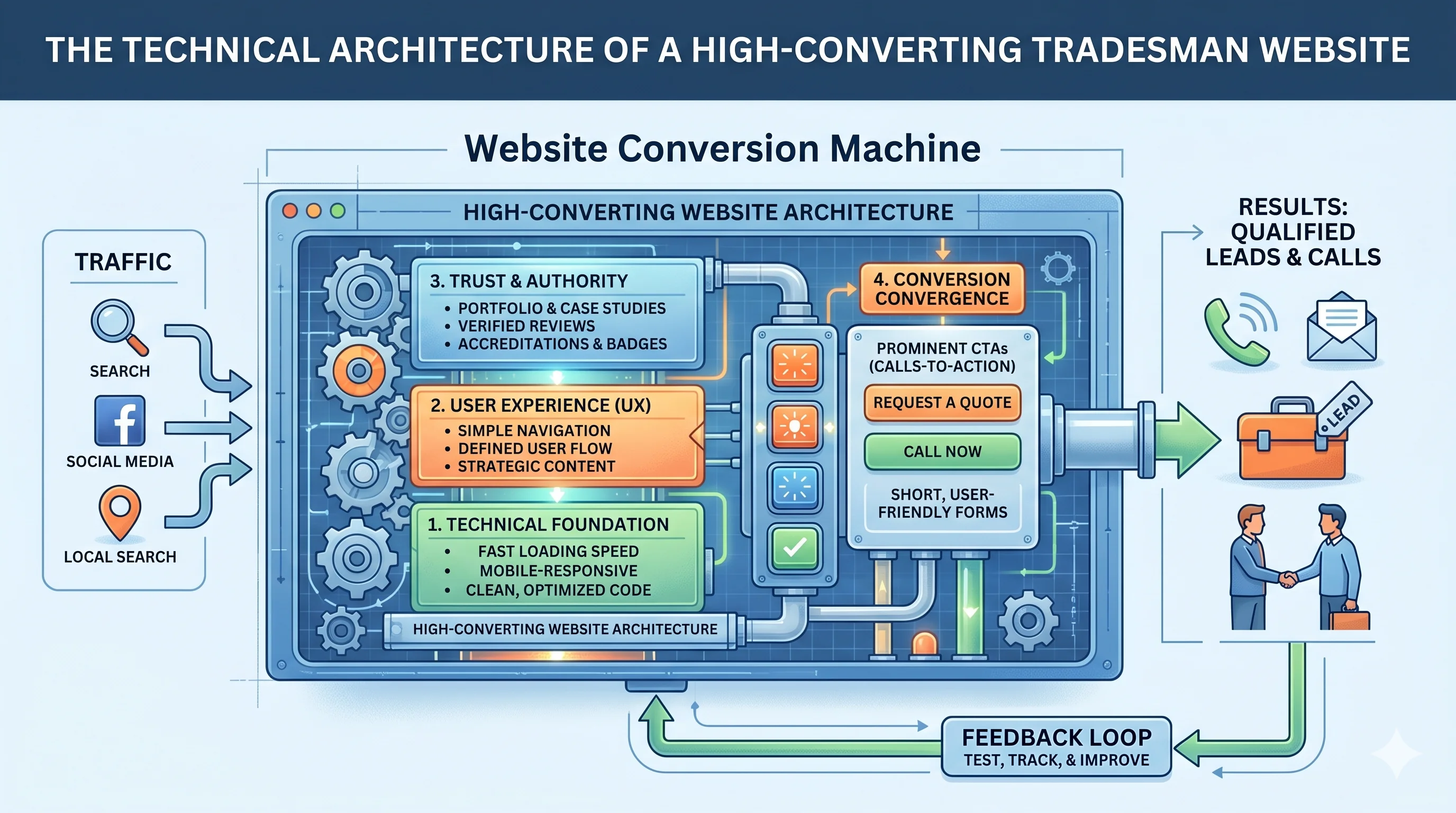
For over a decade, the digital strategy for a United Kingdom tradesman looking to establish an online presence was simple: purchase a domain, install a monolithic Content Management System like WordPress, apply a heavy visual theme, and wait for the phone to ring. Today, that approach is not just outdated; it is a financial liability.
When a homeowner in London searches for an emergency plumber, or a site manager in Kent looks for a commercial scaffolding contractor, they are executing high-intent, time-sensitive queries. They do not have the patience for a website that takes five seconds to load on a 4G connection. If your digital infrastructure introduces friction, the user will bounce back to the search results and click on your competitor.
Custom web design for tradesmen in the UK must now operate at the intersection of extreme technical performance, advanced semantic search engine optimization, and psychological conversion architecture. This guide breaks down exactly why legacy platforms fail, how modern Next-js architectures secure top rankings, and the specific engineering required to turn organic traffic into qualified phone calls.
The Code Bloat Crisis: Why Template Builders Fail Local Search
To understand how to win, you must first understand why the competition is losing. The vast majority of tradesman websites rely on visual page builders. Platforms like Wix, Squarespace, and WordPress page builders (such as Divi or Elementor) operate by stacking layers of automated code to create a visual layout.
While this lowers the barrier to entry for amateur designers, it creates catastrophic technical debt.
DOM Depth and Main Thread Blocking
When a browser attempts to load a template-built website, it does not just download the visible text. It must download massive, redundant JavaScript bundles, load complete font libraries for a single typeface, and parse thousands of lines of unused Cascading Style Sheets.
This creates an excessively deep Document Object Model. The mobile processor must parse every single nested container, div, and wrapper generated by the visual builder before it can render the contact form or the phone number. Because these builders rely heavily on client-side JavaScript to render basic layout functions, they block the browser's main thread. This means the user is staring at a blank white screen, or a partially loaded page that refuses to respond to their touch.
In a highly competitive local SEO environment, code bloat destroys crawl budgets. If Googlebot has to spend excessive resources rendering your heavy JavaScript, it will index fewer pages, ignore your updates, and ultimately demote your domain authority in favor of lighter, faster competitors.
Decoding Core Web Vitals for the Trade Industry
Google no longer ranks websites based purely on keywords and backlinks. They have explicitly shifted their algorithmic focus to measure the real-world user experience through a framework called Core Web Vitals. Passing these metrics is a mandatory requirement for any tradesman wanting to dominate the local Map Pack and organic search results.
Largest Contentful Paint
This metric measures the exact loading time of the largest visible element on the user's screen upon initial load. Usually, this is the main hero text or background. To pass Google's threshold, this element must fully render in under 2.5 seconds. However, for maximum lead generation, the target should be under 1.0 second. Template websites fail this constantly because their servers must execute database queries and build the page dynamically every single time a visitor clicks a link.
Interaction to Next Paint
Interaction to Next Paint measures the latency of the website's responsiveness. If a user taps the "Request a Quote" button, how many milliseconds pass before the interface actually registers the tap and opens the form? Google requires this to be under 200 milliseconds. Websites burdened with heavy third-party tracking scripts, chat widgets, and bloated animations fail this metric, causing users to rage-click and abandon the page.
Cumulative Layout Shift
Have you ever tried to click a button on a loading website, only for the entire page layout to suddenly shift downward, causing you to click the wrong link? That is Cumulative Layout Shift. It happens when images are loaded without defined dimensions, or when custom fonts load late and change the text sizing. Google penalizes websites that exhibit high layout shift because it indicates a careless, frustrating user interface.
The Next-js Advantage: Server-Side and Edge Infrastructure
To eradicate code bloat and guarantee perfect Core Web Vitals scores, elite digital agencies are abandoning legacy platforms entirely in favor of hand-coded frameworks like Next-js. This represents a fundamental shift in how digital data is delivered to the consumer.
Static Site Generation vs Database Querying
A Next-js architecture allows developers to utilize Static Site Generation. Instead of building the website on the server every time a user requests it, the developer's server pre-builds every single page into optimized, lightweight HTML files at the exact moment the code is published.
When a user searches for your plumbing or building services, there is no database to query. The server simply hands the pre-built HTML file directly to the browser. The rendering process is instantaneous, bypassing the processing delays that cripple WordPress and Wix sites.
Global Edge Content Delivery Networks
By pairing static generation with an Edge Content Delivery Network, these lightweight files are cached and distributed across data centers throughout the United Kingdom. If a user in Croydon requests the site, the data is delivered from a server physically located nearby, rather than traversing the Atlantic from an American hosting farm. This reduces Time to First Byte to a fraction of a second.
This infrastructure is the ultimate competitive advantage. While competitors fight to shave milliseconds off their bloated templates, a Next-js application inherently bypasses the bottlenecks, satisfying both the impatient user and the Google algorithm.
Engineering for Zero-Friction Mobile Lead Generation
Traffic without conversion is a vanity metric. The architecture of a tradesman website must be ruthlessly optimized to funnel the user toward a single action: initiating contact. Since over 70 percent of local service searches occur on mobile devices, the interface must be engineered for the field, not the office.
The Psychology of the Sticky Call-to-Action
When a user lands on a roofing or electrical contractor's website, they are scanning for validation and immediate contact methods. Hiding the phone number inside a hamburger menu or at the very bottom of the footer creates unnecessary friction.
High-converting architecture requires a "Sticky" Call-to-Action. A high-contrast, tap-to-call button must remain anchored to the bottom or top edge of the mobile viewport at all times, regardless of how far the user scrolls down the page. The moment the user decides they trust your brand, the conversion mechanism must be exactly under their thumb.
Streamlined Data Capture
Contact forms are the second highest point of failure. A user dealing with a burst pipe is not going to fill out a ten-field questionnaire asking for their home address, budget, timeframe, and how they found the company. Lead capture forms must be stripped to the absolute minimum: Name, Phone Number, and a brief description of the problem. Input fields must be configured to trigger the native numerical keyboard on mobile devices when asking for a phone number, eliminating the need for the user to manually switch keyboard layouts.
Advanced Entity Schema: Structuring Data for AI Search
Traditional SEO optimized for blue links. Modern technical SEO optimizes for Large Language Models and Google's Search Generative Experience. AI does not read your website visually; it reads the structured data running silently in your codebase.
Nesting Service and LocalBusiness JSON-LD
To become the authoritative entity in your geographic region, your site must deploy custom JSON-LD schema markup. Automated plugins generate generic data, but hand-coded infrastructure allows for deep, nested data architectures.
Your organization must be declared as a LocalBusiness, complete with exact geoCoordinates, defined areaServed perimeters, and verified openingHours. Inside this LocalBusiness schema, you must nest specific Service schemas. You do not just list "plumbing" as text on the page; you declare it as an entity in the code, explicitly defining the audienceType and the specific geographic nodes where the service is available.
When an AI model attempts to answer a user asking, "Who is the most reliable commercial electrician in Kent?", it references the structured data. The business with the most articulate, error-free entity definition hardcoded into a lightning-fast framework will be cited as the primary source.
Conclusion
The era of the digital brochure is over. A high-converting tradesman website is a specialized application engineered for speed, structural clarity, and aggressive lead generation. By abandoning outdated template builders, leveraging the instantaneous rendering of Next-js, and defining your business through advanced schema architecture, you stop competing on aesthetic design and start dominating through technological superiority.