Written by the senior strategy and delivery team at WebWise — a web design agency for small business UK and technical SEO agency UK that has delivered fixed price web design UK projects for tradesmen, solicitors, consultants, and service businesses since 2015. We have sat on both sides of the hiring table: as agency founders selecting subcontractors, and as specialists guiding hundreds of clients through the exact decisions covered in this guide. Every answer reflects real contracts signed, real projects delivered, real disputes resolved, and real outcomes measured. No generic advice. No recycled listicles. Just what actually works in 2026.
Table of Contents
Introduction: Why Most Business Owners Get This Wrong
Question 1: How to know if a web design agency is legitimate
Question 2: Website design for online booking systems
Question 3: Can I get a website without breaking the bank?
Question 4: What makes a good web design agency?
Question 5: Red flags to watch for when hiring a web designer
Question 6: Website design that actually converts visitors into customers
Question 7: How to brief a web designer (and get what you want)
Question 8: Portfolio website design for creative professionals
Question 9: Do web design agencies in London charge more?
Question 10: Website cost for ecommerce vs informational sites
Question 11: How to avoid overpaying for web design
Question 12: What questions should I ask before signing a web design contract?
Question 13: Website design for local businesses: does location matter?
Question 14: How to find a web designer who understands my business
Question 15: Is a website template cheaper than custom design
Question 16: How to evaluate web design agency portfolios
Question 17: What's the difference between a web designer and web developer?
Question 18: Small business website: how to get started
Question 19: Website design for service-based businesses
Question 20: Can a web designer guarantee more customers?
Question 21: Mobile-friendly website design: is it really necessary?
Question 22: How to negotiate web design pricing
Question 23: Website maintenance after design: what costs what?
Question 24: Best practices for briefing a web design agency
Question 25: How to tell if a web design quote is too good to be true
Conclusion: Your Decision Checklist
Introduction: Why Most Business Owners Get This Wrong
Hiring a web design agency should be straightforward. You have a business. You need a website. You find someone who builds websites. You pay them. They deliver. Simple.
Except it is not simple. Not even close.
In 2026, the UK web design market is more crowded, more confusing, and more fragmented than ever. There are freelancers charging £500 on Fiverr. There are agencies in Shoreditch charging £25,000 for a brochure site. There are AI-powered builders that claim to generate a complete website in sixty seconds. There are subscription platforms that lock you into £200-per-month contracts for life. And somewhere in that chaos is the right provider for your business — the one who will build you a site that ranks, converts, and pays for itself.
The problem is not a lack of options. The problem is a lack of clarity. Most small business owners do not know what to ask. They do not know what a fair price looks like. They do not know what should be in a contract. They do not know how to tell a legitimate agency from a cowboy operator. And they certainly do not know how to evaluate whether a beautiful portfolio translates into a website that actually generates revenue.
This guide exists to fix that. We have taken the twenty-five most important questions a business owner should ask before hiring a web design agency — the questions that separate a successful project from an expensive nightmare — and answered each one with the depth, honesty, and specificity you will not find in a generic blog post.
Whether you are a plumber in Manchester, a solicitor in Birmingham, a consultant in Edinburgh, or a retailer in Cardiff, these answers will save you money, protect you from bad contracts, and ensure you end up with a website that works as hard as you do.
Let us begin.
Question 1: How to know if a web design agency is legitimate?
This is the question that should come before every other question. Because if the agency is not legitimate, nothing else matters. The price, the portfolio, the timeline — all irrelevant if you are dealing with a fraud, a fly-by-night operator, or a well-meaning amateur who will disappear halfway through your project.
The Legitimacy Checklist
They have a real address. A legitimate agency lists a real UK address — not a PO box, not a virtual office in a tax haven, not "based in London" with no street name. Check Companies House. Is the business registered? How long has it been trading? A company formed three weeks ago with one director and £1 of share capital is not necessarily a scam, but it is not established either.
They have a real portfolio. Not screenshots. Not mockups. Not "concepts." Live websites with real URLs that you can visit on your phone right now. Click through them. Test the contact forms. Check the mobile experience. If an agency cannot show you live work, they have no work.
They have verifiable reviews. Google reviews, Trustpilot, Clutch.co — these are harder to fake than testimonials on their own site. Look for detailed reviews that mention specifics: timelines, communication, post-launch support, measurable results. Vague five-star reviews with no detail are often purchased.
They have a real process. A legitimate agency can explain exactly how they work from brief to launch. Not "we will figure it out as we go." A defined, documented process with milestones, feedback loops, and deliverables. Ask them to walk you through it on the call.
They have real expertise. Do they specialise in your sector? A web design agency for small business UK that works with tradesmen, solicitors, and consultants will understand your customers, your workflows, and your conversion goals. A generalist who builds sites for cafes, fashion brands, and dog groomers will not.
They communicate professionally. Do they respond to emails within 24 hours? Do they answer your questions directly, or deflect with jargon? Do they send a proper proposal with scope, timeline, and pricing? Professionalism in the sales process predicts professionalism in delivery.
The Red Flags of Illegitimacy
No registered company number
No physical UK address
Portfolio consists entirely of screenshots or "coming soon" pages
Reviews only on their own website
Pricing that is "too good to be true" — we will cover this in Question 25
Pressure to pay the full amount upfront
No contract or a contract that is one page of vague promises
If you see any of these, walk away. There are thousands of legitimate agencies in the UK. You do not need to gamble on a questionable one.
Question 2: Website design for online booking systems.
If your business relies on appointments — whether you are a consultant, a therapist, a tradesperson, or a fitness coach — your website needs to do more than inform. It needs to book. An online booking system turns your website from a passive brochure into an active revenue generator.
What Online Booking Systems Actually Do
At their core, booking systems allow customers to see your availability, select a time slot, and confirm an appointment without picking up the phone. But modern systems go far beyond that:
Calendar integration with Google Calendar, Outlook, or Apple Calendar
Automated reminders via email and SMS to reduce no-shows
Payment processing so customers pay a deposit or full fee at booking
Resource management so you do not double-book rooms, equipment, or staff
Buffer times between appointments for travel or preparation
Cancellation and rescheduling handled automatically
Customer profiles that track booking history and preferences
The Platform Decision
For most small businesses, the choice is between a third-party booking platform embedded into your site, or a custom-built booking system.
Third-party platforms like Calendly, Acuity Scheduling, Microsoft Bookings, or SimplyBook.me offer fast setup, reliable infrastructure, and low cost. They integrate into your website via an embed code or widget. The downside is limited customisation, ongoing subscription fees, and the fact that the booking experience lives on someone else's domain.
Custom booking systems built into your website offer total control over the user experience, branding, and workflow. They can integrate with your CRM, your accounting software, and your specific business rules. The downside is higher upfront cost and the need for ongoing maintenance.
For a custom web development company UK like WebWise, we often recommend a hybrid: a custom-designed booking interface on your site, powered by a robust third-party API. This gives you the branding and control of a custom build, with the reliability and features of an established platform.
The User Experience Imperative
A booking system that is clunky, confusing, or slow will not get used. The best booking flows are:
One-page: Select service, select date, select time, enter details, confirm. No more than five steps.
Mobile-first: Over 70% of bookings happen on mobile. Thumb-sized buttons, minimal typing, and Apple Pay or Google Pay integration are essential.
Instant confirmation: The customer should receive a confirmation email and calendar invite within seconds. Delay creates anxiety.
Clear policies: Cancellation terms, rescheduling rules, and refund policies should be visible before booking, not buried in terms and conditions.
If your business depends on appointments, website design for online booking systems is not a nice-to-have feature. It is the primary function of your site.
Question 3: Can I get a website without breaking the bank?
The short answer is yes. The longer answer is: it depends on what you mean by "website" and what you mean by "breaking the bank."
The Budget Spectrum
Under £1,000: You are looking at DIY builders (Wix, Squarespace, GoDaddy), a cheap freelancer on Fiverr, or a pre-built template with minimal customisation. You will get something live. It will not rank well, it will not convert well, and it will look like hundreds of other sites. For a brand-new sole trader who just needs a digital presence, this is better than nothing. For anyone serious about growth, it is a false economy.
£1,000–£2,500: A basic professional site from a junior freelancer or a small agency. Five to seven pages, a standard template, basic SEO, mobile-friendly design. This is the entry point for genuine professionalism. You will own the site, it will look decent, and it will function. But do not expect advanced features, custom design, or strong lead generation.
£2,500–£6,000: The sweet spot for most UK small businesses. A professional build from a bespoke web design agency UK with custom or semi-custom design, proper SEO, mobile-first development, and conversion-focused architecture. This is where fixed price web design UK models deliver the best value. You get a site that ranks, converts, and scales.
£6,000–£15,000: Advanced builds with custom functionality, e-commerce, booking systems, client portals, or complex integrations. This is where a custom web development company UK justifies its fee through technical capability that off-the-shelf solutions cannot match.
£15,000+: Enterprise-level projects with multi-language support, advanced CRM integrations, bespoke CMS development, and dedicated project teams. Most small businesses do not need this.
The Real Cost of Cheap
A £500 website that generates zero leads costs infinitely more than a £3,000 website that generates £30,000 in annual revenue. The question is not "can I afford a professional website?" The question is "can I afford not to have one?"
If you are genuinely budget-constrained, consider a phased approach. Phase one: a professional brochure site with core pages and basic SEO. Phase two: add lead generation features, area pages, and advanced functionality as revenue grows. A good agency will build a site that can expand, so you are not starting from scratch every time.
The Financing Option
Some agencies offer payment plans. This is not the same as a subscription. A payment plan splits the fixed cost over two or three months. You still own the site. You are not locked into an ongoing contract. If an agency offers this, it is worth considering.
Question 4: What makes a good web design agency?
A good web design agency is not defined by its awards, its office size, or its Instagram following. It is defined by five core attributes that directly impact your business outcomes.
Attribute One: Business Understanding
A good agency asks about your business before they talk about design. Who are your customers? What is your average job value? How do people currently find you? What is your biggest marketing challenge? If an agency jumps straight to "what colours do you like?" they are a designer, not a partner.
Attribute Two: Technical Competence
In 2026, technical competence means more than "we know WordPress." It means understanding Core Web Vitals web design agency UK standards. It means implementing schema markup web design agency expertise. It means building on modern stacks like Next.js or similar architectures that deliver speed and scalability. It means GDPR compliant website design UK standards. It means website accessibility WCAG web design UK compliance.
Ask about their technical stack. Ask about their approach to speed. Ask how they handle SEO. If they say "we install Yoast and hope for the best," keep looking.
Attribute Three: Process Discipline
A good agency has a process that is repeatable, transparent, and documented. You should know exactly what happens at each stage: discovery, design, development, testing, launch, and post-launch. You should know who is responsible for what. You should know when feedback is due and what happens if you miss a deadline.
Attribute Four: Transparency
Transparent pricing. Transparent timelines. Transparent communication. No hidden fees. No scope creep without discussion. No "we will figure it out later." A good agency tells you the bad news as quickly as the good news.
Attribute Five: Post-Launch Support
A website is not a one-time project. It needs maintenance, updates, security patches, and content refreshes. A good agency offers a clear support model — whether that is a care retainer, ad-hoc support, or a self-service CMS with training. They do not disappear after launch day.
Question 5: Red flags to watch for when hiring a web designer.
After fifteen years in this industry, we have seen every scam, every shortcut, and every well-meaning disaster. Here are the red flags that should make you walk away immediately.
The "Unlimited Revisions" Promise
There is no such thing as unlimited revisions. Either the agency plans to rush your project to completion and ignore your feedback, or they will charge you for "out of scope" work after the first two rounds. Professional agencies offer a defined number of revision rounds — typically two or three — with clear feedback deadlines.
The "We Guarantee Page One" Claim
No agency can guarantee Google rankings. Google's algorithm is proprietary, constantly changing, and influenced by factors outside any agency's control. Guarantees are a sign of dishonesty or desperation. A legitimate agency will set realistic expectations and show you measurable progress over time.
The "You Do Not Own the Code" Clause
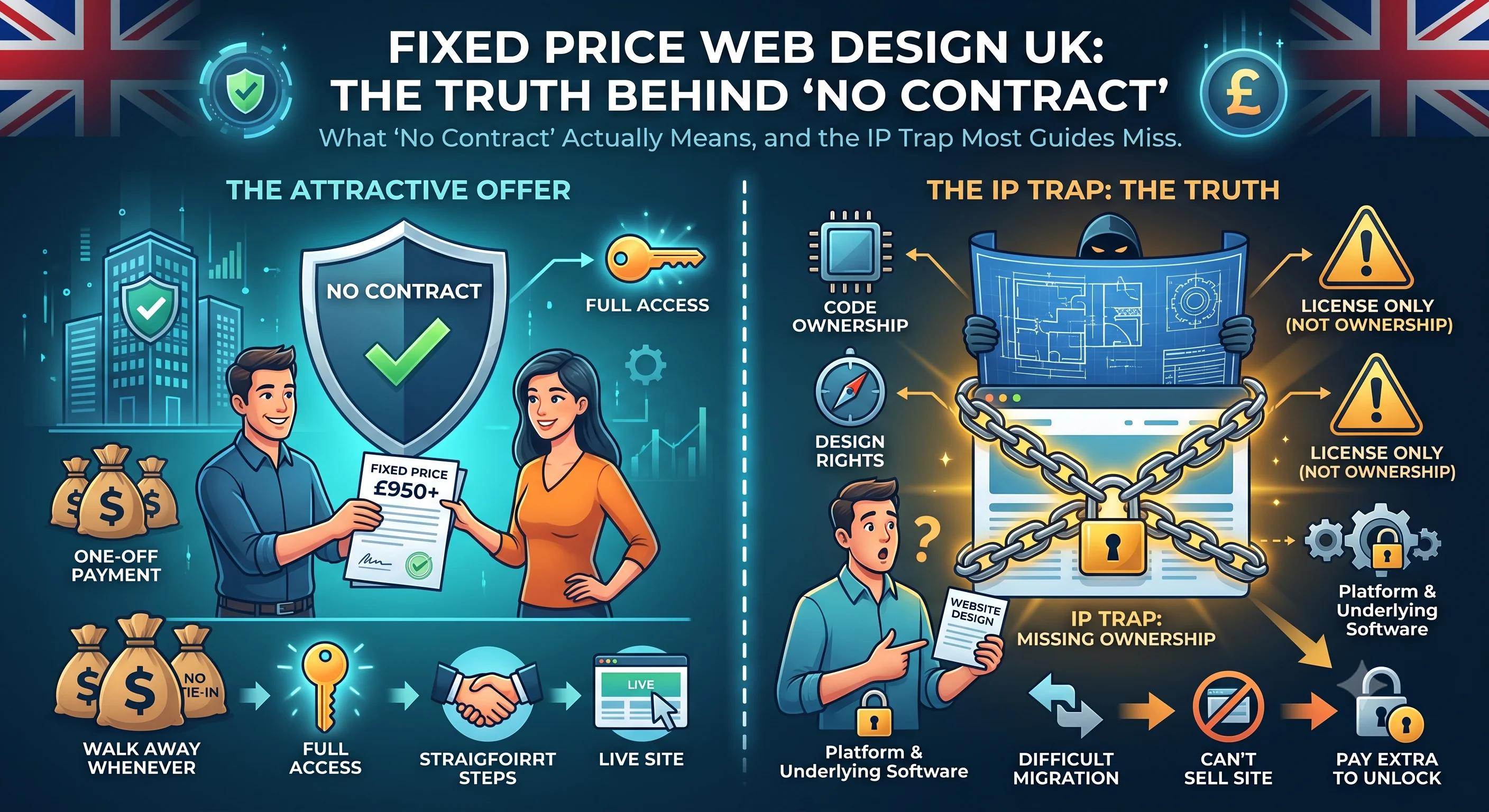
This is the most expensive hidden clause in web design. If your contract states that the agency retains ownership of the code, or that your site is built on their proprietary platform, you are renting, not buying. When you want to leave, you cannot take your site with you. You have to rebuild from scratch. Always confirm who owns my website code UK law protects — and ensure the answer is unequivocally you.
The "Free Design" Offer
Design is work. If it is free, it is either a recycled template or the cost is hidden elsewhere in the quote. Professional design requires research, creativity, and iteration. It has value. Be wary of anyone who gives it away.
The "No Contract" Agency That Has No Contract
Ironically, some agencies advertise "no contract" but then present you with a vague, one-page agreement that locks you into their hosting, their platform, or their support package. Read the fine print. A genuine no contract web design provider lets you walk away with your site, your domain, and your data.
The Portfolio of Mockups
If every portfolio piece is a Photoshop mockup or a "concept design," the agency has not actually shipped live work. Ask for URLs. Visit them on your phone. Test them. If they cannot show you real, functioning websites, they have not built real, functioning websites.
Question 6: Website design that actually converts visitors into customers.
A beautiful website that does not convert is art, not business. And you are not running an art gallery. You are running a business that needs enquiries, bookings, and sales.
The Conversion Architecture
Clear Value Proposition: Within three seconds of landing on your site, a visitor should know what you do, who you serve, and why they should choose you. Not "Welcome to our website." Not "We are passionate about excellence." Specific, benefit-driven language: "Emergency Plumbing in Manchester — Same-Day Call-Outs, Fixed Prices, Gas Safe Registered."
Prominent Calls to Action: Every page should have a primary call to action above the fold. Click-to-call on mobile. "Get a Quote" buttons. "Book Now" links. These should be visually distinct — contrasting colours, adequate size, and surrounded by white space so they cannot be missed.
Social Proof: Reviews, testimonials, case studies, client logos, trust badges. These should not be hidden on a separate page. They should be woven into every key page — especially your homepage and service pages.
Friction Elimination: Every field in a form, every click required to reach a contact method, every page that loads slowly — these are friction points that kill conversions. A lead generation web design approach ruthlessly eliminates them.
Urgency and Scarcity: Where appropriate, genuine urgency drives action. "Book this week for 10% off your boiler service." "Only three consultation slots left this month." Do not fake urgency. Real urgency converts. Fake urgency destroys trust.
The Data-Driven Approach
Conversion optimisation is not guesswork. It is measurement. Use heatmaps to see where visitors click. Use session recordings to watch how they navigate. A/B test headlines, button colours, and form lengths. The agency that builds your site should set up this tracking from day one and review it with you monthly.
Question 7: How to brief a web designer (and get what you want)?
The brief is the foundation of your entire project. A bad brief produces a bad website. A good brief produces a website that exceeds your expectations. The difference is not talent — it is clarity.
The Elements of a Bulletproof Brief
Your Business Context: What do you do? Who are your customers? What is your average job value? Who are your competitors? What makes you different? What are your growth goals for the next twelve months?
Your Current Situation: Do you have an existing website? What works and what does not? What are your current traffic and conversion numbers? What is your biggest frustration?
Your Target Audience: Be specific. "Homeowners in South Manchester aged 35–55 with properties valued over £300,000" is infinitely more useful than "anyone who needs a plumber."
Your Goals: What does success look like? Ten enquiries per week? Fifty online bookings per month? A 20% increase in average job value? Rankings on page one for "kitchen fitter Stockport"? The more specific your goals, the more specific the solution.
Your Functional Requirements: Booking system? Quote calculator? E-commerce? Client portal? Multi-language? Integration with existing software?
Your Design Direction: Websites you like. Websites you hate. Colours that reflect your brand. Adjectives that describe your desired tone: "professional but approachable," "modern but trustworthy," "bold but not aggressive."
Your Content: Do you have professional photos? Do you have written copy? Will you write it, or do you need a copywriting agency UK small business specialist? Will you provide testimonials, or does the agency need to collect them?
Your Timeline and Budget: When do you need to launch? What is your budget range? Be honest. An agency cannot propose the right solution if they do not know your constraints.
The Briefing Meeting
A good agency will conduct a structured briefing meeting — typically 45–60 minutes — where they ask these questions and document your answers. They will then produce a written brief for you to approve. This document becomes the contract's scope appendix. If it is not in the brief, it is not in the scope.
Question 8: Portfolio website design for creative professionals.
While this guide is primarily for small business owners, many creative professionals — photographers, designers, architects, consultants — need portfolio websites that showcase their work while also generating enquiries. The principles differ from standard business sites.
What Makes a Portfolio Site Effective
Visual-First Design: For creatives, the work speaks louder than words. Large, high-quality images. Minimal text. Let the portfolio breathe. A cluttered portfolio site undermines the very creativity it claims to showcase.
Project Case Studies: Not just a gallery of images. Each project should tell a story: the brief, the challenge, the process, the outcome. This demonstrates expertise and builds trust with potential clients who want to understand how you work.
Clear Service Definition: Creative professionals often struggle to articulate what they actually sell. "I do design" is not a service. "Brand identity packages for hospitality businesses starting at £3,500" is. Be specific about what you offer, who it is for, and what it costs.
Contactability: A portfolio site that makes it hard to hire the creative is a failed portfolio site. Contact forms, email links, social media, and booking links should be prominent and repeated.
Performance Optimisation: Portfolio sites are image-heavy, which makes them slow. Lazy loading, image compression, and modern formats (WebP, AVIF) are essential. A beautiful portfolio that takes six seconds to load is a beautiful portfolio that nobody sees.
Question 9: Do web design agencies in London charge more?
Yes. And it is not because they are better.
The London Premium Explained
A web design agency London small business specialist faces costs that agencies in Manchester, Birmingham, or Glasgow do not. Central London office rent can be £80–£150 per square foot per year. London salaries for designers and developers are 20–40% higher than the UK average. Transport, insurance, and operating costs all scale with location.
These costs are passed to you. A £3,000 website in Bristol might cost £4,500–£6,000 from an equivalent agency in London. The work is not necessarily better. The overheads are just higher.
Is the London Premium Worth It?
For some businesses, yes. If you are a high-end brand targeting London clients, a London agency may have cultural insights and network connections that justify the cost. If you need face-to-face meetings weekly, proximity matters.
For most small businesses, no. A remote web developer UK based in Manchester or Bristol can deliver identical quality via video calls, screen sharing, and collaborative tools. The UK has exceptional digital talent in every major city. The key is finding an agency with a proven process, clear communication, and a portfolio of results — regardless of postcode.
The Smart Approach
Search for a web developer UK not London specifically. You will save 30–50% without sacrificing quality. At WebWise, we work with clients across the UK and internationally. Our process is designed for remote collaboration from day one. The result is London-quality work without the London price tag.
Question 10: Website cost for ecommerce vs informational sites.
The cost difference between an informational website and an e-commerce website is not incremental. It is exponential. Understanding why helps you budget realistically and avoid nasty surprises.
Informational Site Costs
An informational site — sometimes called a brochure site — provides information about your business, your services, and your contact details. It does not take payments, manage inventory, or process orders.
Typical cost: £1,500–£6,000 depending on design quality, page count, and SEO depth.
What drives the cost: Custom design, copywriting, photography, SEO, and page count. A five-page site with template design and minimal content is at the low end. A fifteen-page site with bespoke design, professional copywriting, and advanced SEO is at the high end.
E-Commerce Site Costs
An e-commerce site sells products online. It requires product pages, a shopping cart, a checkout process, payment gateway integration, inventory management, and often shipping calculation.
Typical cost: £5,000–£25,000+ depending on product count, platform choice, and custom functionality.
What drives the cost: Product photography, product descriptions, payment processing setup, inventory system integration, shipping rules, tax configuration, and user account management. Each product requires individual attention: images, descriptions, variants, pricing, stock levels.
The Hybrid Model
Many service businesses — builders, consultants, therapists — need a hybrid site. Service pages that generate enquiries, plus a small product shop for supplements, tools, or merchandise. This sits between the two cost ranges, typically £4,000–£10,000.
The Platform Factor
Your platform choice significantly impacts cost. Shopify, WooCommerce, or BigCommerce have lower upfront costs but ongoing subscription fees. A custom e-commerce build has higher upfront costs but no platform fees. For most small businesses, a platform like Shopify with professional setup offers the best balance of cost, speed, and reliability.
Question 11: How to avoid overpaying for web design.
Overpaying for web design does not mean paying too much for a good website. It means paying anything at all for a bad one. Here is how to ensure you get value for every pound.
Know the Market Rate
Before you speak to any agency, research pricing. Read guides like our how much does it cost to hire a web developer breakdown. Understand what £2,000, £5,000, and £10,000 actually buy. If an agency quotes £8,000 for a five-page brochure site, you know something is wrong.
Define Scope Rigorously
Scope creep is the most common cause of overpayment. You start with a five-page site and end up with twelve pages, a blog, a booking system, and an email marketing integration. Each addition costs money. Define your scope in writing before work begins. If you want to add features later, treat it as a separate project with its own quote.
Compare Apples to Apples
When evaluating quotes, ensure you are comparing identical deliverables. One agency's £3,000 quote might include design, development, copywriting, and SEO. Another's £2,500 quote might include only design and development, with copywriting and SEO charged separately. The £3,000 quote may actually be better value.
Avoid the "All-in-One" Subscription Trap
A £200-per-month website subscription sounds affordable. Over three years, it costs £7,200. And you own nothing. A website design one off payment approach costs more upfront but delivers a genuine asset you control. Do the maths over a three-to-five-year horizon, not just month one.
Ask for Itemisation
A professional quote breaks down every element: design hours, development hours, content creation, SEO setup, testing, launch support. If an agency gives you a single number with no breakdown, you cannot evaluate whether it is fair.
Check What Is Excluded
What happens if you need changes after launch? Is there a warranty period? What does ongoing support cost? An agency that charges £4,000 for the build but £500 per hour for post-launch changes may not be the bargain they appear.
Question 12: What questions should I ask before signing a web design contract?
The contract is where promises become legally binding obligations. Before you sign, ask these questions and ensure the answers are in writing.
The Essential Contract Questions
Who owns the intellectual property? The code, the design, the content, the domain. The answer should be you. If the agency retains any rights, understand exactly what and why.
What is the exact scope of work? Page count, features, integrations, content creation, SEO. Vague language like "as agreed" is a dispute waiting to happen. Specificity protects both parties.
What is the timeline? Start date, milestone dates, launch date. What happens if deadlines are missed? Is there a penalty for late delivery? Is there a penalty if you delay feedback?
What is the payment schedule? Never pay 100% upfront. A typical schedule is 50% on project start, 50% on launch. For larger projects, 40% start, 40% design approval, 20% launch. If an agency demands full payment before work begins, walk away.
What happens if I want to cancel? A genuine no contract web design provider will have a clear cancellation clause. Understand what you owe for work completed to date and what assets you receive.
What is included in post-launch support? Bug fixes, training, minor adjustments, warranty period. How long does support last? What does it cost after the initial period?
What are the ongoing costs? Hosting, domain renewal, SSL certificate, plugin subscriptions, CMS licensing. Who pays for what, and when?
How are changes handled after launch? What is the process for requesting changes? What is the hourly rate? Is there a minimum charge?
What happens to my site if the agency goes out of business? This is critical. If the agency hosts your site on their servers and disappears, your site disappears with them. Ensure you have access to your hosting, your domain, and your code at all times.
Question 13: Website design for local businesses: does location matter?
For a local business — a plumber, a solicitor, a restaurant, a gym — location is not just relevant. It is the entire point. Your website exists to attract customers within your service area. And that changes how it should be designed, structured, and optimised.
The Local Business Website Difference
Area Pages: A local business needs dedicated pages for every area it serves. Not one "Areas We Cover" page with a bulleted list. Individual, optimised pages for "Plumber in Croydon," "Plumber in Bromley," "Plumber in Sutton." Each with local-specific content, local testimonials, and local landmarks.
Local Schema Markup: Structured data that tells Google your exact address, service area, hours, and phone number. This is essential for appearing in the Map Pack — the three business listings that dominate local search results.
Google Business Profile Integration: Your website and your GBP should work together. Reviews from your GBP should appear on your site. Your site's contact page should match your GBP exactly. Consistency across every platform reinforces your local authority.
Local Content: Blog posts and guides that answer local questions. "Building Regulations for Extensions in Salford." "Planning Permission Guide for Manchester Terraces." This content demonstrates local expertise and captures hyper-local searches your competitors ignore.
Click-to-Call Dominance: Local business customers are often in urgent situations. A burst pipe, a legal deadline, a broken boiler. They want to call now. Your phone number should be tap-to-call and visible on every page.
The Location Question for Agencies
When hiring an agency, does their location matter? For local SEO for contractors, an agency that understands your area has advantages. They know the local competition. They know the local search patterns. They can visit your premises for photography.
But for the website build itself, location is increasingly irrelevant. Video calls, collaborative tools, and cloud-based workflows mean a remote web developer UK can deliver identical quality regardless of geography. The key is local SEO expertise, not local office presence.
Question 14: How to find a web designer who understands my business
This is the question that separates satisfactory projects from exceptional ones. A designer who understands your business builds a site that resonates with your customers. A designer who does not understand your business builds a site that looks pretty and performs poorly.
The Sector-Specific Search
Do not search for "web design agency." Search for what you actually need: tradesman websites UK, UK solicitor website design, SRA compliant website design, builder website development. The more specific your search, the more likely you are to find an agency with relevant expertise.
The Portfolio Test
When reviewing an agency's portfolio, look for businesses like yours. Not identical — a competitor's site is a conflict of interest — but similar in size, sector, and customer type. If you are a £500,000-turnover consultancy, an agency whose portfolio consists entirely of FTSE 100 corporations may not understand your constraints or your customers.
The Discovery Call Test
On your first call, does the agency ask about your business, or do they talk about themselves? Do they understand your customer journey? Do they know your industry's regulations, buying cycles, and pain points? A web design agency for small business UK specialist will ask about your average job value, your lead sources, and your conversion goals before they mention a single design idea.
The Content Test
If your business requires specialist content — legal disclaimers, technical specifications, industry terminology — can the agency produce it? A content writing and web design agency that combines both disciplines under one roof delivers coherence that fragmented providers cannot match. Your website copywriting services UK should be written by someone who understands your sector, not just someone who knows English.
Question 15: Is a website template cheaper than custom design?
Yes. A template is cheaper. But cheaper is not the same as better value. Understanding the real trade-offs helps you make an informed decision.
The Template Route
A template is a pre-designed website layout that you customise with your colours, logo, and content. Platforms like WordPress, Wix, and Squarespace offer thousands of templates, many free, many premium.
Cost: £0–£400 for the template itself. Plus hosting, domain, and any premium plugins.
Pros: Fast setup, low cost, no design expertise required.
Cons: You look like everyone else using the same template. Limited customisation. Bloated code that slows load times. Poor SEO structure. No unique brand identity. Mobile optimisation is often an afterthought.
The Custom Design Route
A custom design is built from scratch for your brand, your customers, and your goals.
Cost: £2,500–£15,000+ depending on complexity.
Pros: Unique brand identity. Optimised for your specific conversion goals. Clean, fast code. Proper SEO architecture. Scalable and flexible. You own everything.
Cons: Higher upfront cost. Longer timeline. Requires a skilled agency.
The Hybrid Route
Many agencies, including WebWise, offer a hybrid approach: a custom design system built on a modern framework, with reusable components that keep costs manageable while delivering uniqueness. This is where a bespoke web design agency UK can offer custom quality at a semi-custom price.
The Honest Assessment
If you are a brand-new sole trader with a £500 budget and no immediate need for lead generation, a template is a reasonable starting point. If your website is business-critical — if it needs to rank on Google, convert visitors into customers, and reflect your professional credibility — custom design is an investment, not an expense.
Question 16: How to evaluate web design agency portfolios?
A portfolio is an agency's proof of work. But not all portfolios are created equal. Knowing how to evaluate one separates the professionals from the pretenders.
The Live Site Test
Ask for URLs, not screenshots. Visit each site on your phone. Test the navigation. Fill out the contact form. Check the load speed. If the agency claims to build mobile-first sites, but their portfolio sites take five seconds to load on 4G, they are not mobile-first.
The Relevance Test
Does the portfolio include businesses similar to yours? An agency that builds beautiful sites for fashion brands may not understand the urgency of a plumbing customer or the compliance requirements of a law firm. Look for sector relevance.
The Results Test
A portfolio should show outcomes, not just aesthetics. "We built a site for X" is less impressive than "We built a site for X that increased their enquiries by 40% in six months." Ask for case studies with metrics.
The Recency Test
Web design trends and technologies change rapidly. A portfolio full of sites from 2019 suggests an agency that is not actively shipping work. Look for recent projects from the last twelve months.
The Diversity Test
Does the portfolio show range, or is every site essentially the same layout with different colours? A diverse portfolio demonstrates creative problem-solving. A repetitive portfolio suggests template dependency.
Question 17: What's the difference between a web designer and web developer?
This is a fundamental distinction that many business owners do not understand. And it matters because hiring the wrong role for the wrong task produces bad outcomes.
The Web Designer
A designer focuses on aesthetics, user experience, and brand communication. They decide how the site looks: colours, typography, spacing, imagery, layout, and visual hierarchy. They create mockups and prototypes. They ensure the site feels right.
Skills: Graphic design, UI/UX design, brand strategy, visual communication, prototyping.
Tools: Figma, Adobe XD, Sketch, Photoshop.
The Web Developer
A developer focuses on functionality, performance, and technical implementation. They turn the designer's vision into a working website. They write the code, configure the server, optimise the database, and ensure the site works across all devices and browsers.
Skills: HTML, CSS, JavaScript, server configuration, database management, API integration, security, performance optimisation.
Tools: VS Code, Git, various frameworks (React, Next.js, Vue, etc.), content management systems.
The Overlap
Many professionals do both. A "full-stack" designer-developer can handle visual design and technical implementation. But true expertise in both disciplines is rare. Most professionals lean one way.
Why It Matters for Hiring
If you hire a designer who cannot code, you need a separate developer. If you hire a developer who cannot design, you need a separate designer. If you hire an agency, they should have both disciplines in-house or have a proven partnership. A custom web development company UK that also employs designers delivers a cohesive result that fragmented hiring cannot match.
At WebWise, our process explicitly separates design and development phases, with specialist designers creating the visual direction and specialist developers implementing it in code. Each expert focuses on their domain, and the result is better than either could achieve alone.
Question 18: Small business website: how to get started?
Starting from scratch can feel overwhelming. Here is a step-by-step framework that breaks the process into manageable pieces.
Step One: Define Your Goals
What does this website need to achieve? Enquiries? Bookings? Sales? Brand awareness? Be specific. "I want more customers" is not a goal. "I want ten qualified enquiries per week through my website" is.
Step Two: Research Your Competition
Visit the websites of your top three competitors. What do they do well? What frustrates you? What is missing? This research informs your own site architecture and content strategy.
Step Three: Set Your Budget
Be realistic. A professional small business website costs £2,500–£6,000. If your budget is under £1,000, consider whether now is the right time, or whether a phased approach works better.
Step Four: Choose Your Provider
Use the criteria in this guide. Check legitimacy. Review portfolios. Ask the contract questions. Get three quotes. Compare apples to apples.
Step Five: Prepare Your Content
Gather your existing materials: logo files, brand guidelines, photos, testimonials, service descriptions. If you do not have these, budget for professional creation. A copywriting agency UK small business specialist can transform your rough notes into compelling website copy.
Step Six: The Brief
Follow the briefing framework in Question 7. The more clarity you provide upfront, the smoother the project.
Step Seven: Design and Feedback
Review designs carefully. Check them on your phone. Show them to trusted colleagues or customers. Provide consolidated feedback — not a stream of individual messages.
Step Eight: Development and Testing
Once development begins, resist the urge to change scope. Test the site thoroughly before launch. Click every link. Fill every form. Check every page on mobile.
Step Nine: Launch and Promote
Launch is day one, not day done. Announce your new site to your email list, your social media, and your existing customers. Submit your sitemap to Google. Start gathering reviews.
Step Ten: Measure and Improve
Set up analytics. Track enquiries. Review monthly. A website is a living asset, not a static monument.
Question 19: Website design for service-based businesses.
Service-based businesses — consultants, agencies, tradesmen, therapists, accountants — have unique website requirements that differ fundamentally from product-based businesses.
The Service Business Challenge
You are not selling a physical object. You are selling time, expertise, and trust. A customer cannot hold your service in their hands before buying. They cannot return it if they are dissatisfied. This uncertainty makes trust the primary conversion factor.
The Service Business Website Framework
Service Clarity: Every service should have its own dedicated page. Not a generic "Services" page with a bulleted list. Individual pages for "Business Tax Planning," "Kitchen Extensions," "Cognitive Behavioural Therapy." Each page should explain exactly what the service includes, what it costs, how long it takes, and what the customer receives.
Process Transparency: Service customers want to know what happens. "Step 1: Free consultation. Step 2: Proposal and agreement. Step 3: Delivery. Step 4: Review and refinement." This reduces anxiety and builds confidence.
Credentials and Trust: Qualifications, accreditations, insurance, memberships, years of experience. For regulated professions — law, accounting, therapy — compliance badges are essential. A small law firm website UK must display SRA registration. A therapist might display BACP accreditation.
Social Proof: Reviews, testimonials, case studies, client logos. For service businesses, these are not optional. They are the primary evidence that you deliver what you promise.
Booking or Enquiry Simplicity: A service customer should be able to book or enquire in under thirty seconds. Complex forms, hidden contact details, or unclear next steps kill conversions.
Content That Demonstrates Expertise: Blog posts, guides, and resources that answer real customer questions. This builds authority, improves SEO, and nurtures visitors who are not yet ready to buy.
Question 20: Can a web designer guarantee more customers?
No. And if they say they can, they are lying.
What a Web Designer Can Guarantee
A professional web designer can guarantee:
A site that is technically sound, fast, and mobile-friendly
Proper SEO structure and on-page optimisation
A user experience designed for conversion
A launch date and a fixed price
These are deliverables. They are within the designer's control.
What a Web Designer Cannot Guarantee
A web designer cannot guarantee:
Specific Google rankings
A specific number of enquiries or sales
Specific conversion rates
Specific revenue increases
These outcomes depend on factors outside the designer's control: your market, your competition, your pricing, your reputation, your follow-up process, your customer service, and the quality of your actual product or service.
The Honest Promise
What a good agency promises is this: we will build you the best possible website for your budget, optimised for your goals, using proven techniques that have worked for similar businesses. We will track results, report transparently, and iterate based on data. We will give you the highest possible chance of success. But we cannot guarantee success, because success depends on you too.
This honesty is a trust signal. An agency that guarantees rankings or customers is either naive or dishonest. Either way, avoid them.
Question 21: Mobile-friendly website design: is it really necessary?
In 2026, this question is almost rhetorical. But we will answer it definitively: yes. It is not just necessary. It is the primary consideration.
The Mobile Reality
Google has been mobile-first since 2019. In 2026, mobile traffic accounts for over 60% of all web visits globally, and over 80% of local business searches. If your site is not built mobile-first, you are designing for a minority of your visitors.
For service businesses, the mobile percentage is often higher. A homeowner with a burst pipe searches on their phone. A landlord with a tenant complaint searches on their phone. A consultant between meetings checks your site on their phone. These are not casual browsers. They are potential customers in decision-making moments.
What Mobile-Friendly Actually Means
Responsive Design: The site adapts to any screen size. Not just "it works on mobile" — it works beautifully on mobile, with layouts, fonts, and interactions optimised for thumb navigation.
Fast Loading: Mobile networks are slower than broadband. A site that loads in one second on fibre might take four seconds on 4G. Mobile-first design prioritises speed through image optimisation, code efficiency, and content delivery networks.
Thumb-Friendly Interactions: Buttons large enough to tap. Forms that minimise typing. Click-to-call that works flawlessly. Navigation that does not require precision.
Readable Without Zoom: Text at least 16 pixels. Contrast that works in sunlight. No horizontal scrolling.
No Intrusive Interstitials: Pop-ups that cover the content on mobile are penalised by Google and hated by users.
The Business Impact
A non-mobile-friendly site does not just rank lower. It actively repels customers. A 2025 Google study found that 53% of mobile users abandon a site that takes longer than three seconds to load. For a small business with a £400 average job value, every abandoned visitor is a lost opportunity.
Mobile-friendly design is not a feature. It is the foundation.
Question 22: How to negotiate web design pricing.
Negotiation is not about driving the price to the absolute minimum. It is about ensuring you pay a fair price for the right scope, with the right terms.
The Negotiation Framework
Know the Market: Research what similar projects cost. If three reputable agencies quote £4,000–£5,000 and one quotes £2,000, the low quote is either missing something or cutting corners. If one quotes £12,000, they may be over-specifying.
Understand Scope: The most effective negotiation is not about lowering the price. It is about adjusting the scope. If your budget is £3,000 and the quote is £5,000, ask what can be removed or phased to meet your budget. Can the blog be added later? Can the advanced SEO be a phase two? Can you provide your own photography?
Ask for Itemisation: A detailed quote reveals where the money goes. You might negotiate by removing non-essential features or by handling some content yourself.
Payment Terms: Negotiate the payment schedule, not just the total. A 50/50 split is standard. For larger projects, 40/30/30 or milestone-based payments reduce your risk.
Post-Launch Support: Negotiate a warranty period. Thirty days of bug fixes and minor adjustments should be standard. Beyond that, understand the support model.
What Not to Negotiate
Do not negotiate on quality. Do not ask an agency to use a cheaper hosting provider that will slow your site. Do not ask them to skip SEO to save money. Do not ask them to compress your project timeline by 50% without paying a rush fee. These compromises hurt you more than they save you.
The Fixed-Price Advantage
A fixed price web design UK model eliminates negotiation anxiety. The price is the price. The scope is the scope. There are no surprises. This transparency is why we built WebWise around fixed pricing — it protects both parties and ensures the focus stays on delivering value, not haggling over hours.
Question 23: Website maintenance after design: what costs what?
The launch is not the end. It is the beginning. A website needs ongoing care to remain secure, fast, and effective. Understanding these costs upfront prevents nasty surprises.
The Maintenance Categories
Hosting: £10–£100 per month depending on quality. Shared hosting is cheap but slow. Managed WordPress hosting is mid-range. Dedicated or cloud hosting is premium. For a business-critical site, do not skimp.
Domain Renewal: £10–£30 per year. Set to auto-renew so you do not lose your domain.
SSL Certificate: Usually included with good hosting. If not, £30–£100 per year.
Security Updates: For CMS-based sites, regular security patches are essential. A hacked site destroys trust and rankings. Budget £50–£200 per month for professional maintenance, or handle it yourself if you have technical skills.
Content Updates: Fresh content improves SEO and engages visitors. Budget for quarterly blog posts, seasonal updates, and new project additions. A SEO content writing agency UK can handle this, or you can do it yourself with a website with admin panel small business owners can actually use.
Plugin and Software Subscriptions: Premium plugins, themes, and tools often require annual renewals. Factor these into your ongoing budget.
Technical SEO Monitoring: Search algorithms change. Competitors improve. Your site needs regular audits to maintain rankings. Budget for an annual small business website audit UK or a monthly care retainer.
The Care Retainer Model
Many agencies offer care retainers: a fixed monthly fee covering hosting, maintenance, security, updates, and support. This provides predictability and ensures your site never goes stale. Typical retainers range from £150–£400 per month depending on site size and activity level.
The DIY Approach
If you are technically confident, you can handle much of this yourself. But be honest about your time. A website that is neglected for six months loses rankings, accumulates security risks, and becomes outdated. Professional maintenance is usually cheaper than the lost revenue from a neglected site.
Question 24: Best practices for briefing a web design agency.
A great brief is the single most important document in your web project. It aligns expectations, prevents scope creep, and ensures the final product matches your vision.
The Brief Structure
1. Executive Summary: One paragraph summarising who you are, what you need, and why.
2. Business Context: Your history, your market, your customers, your competitors, your goals.
3. Current State: Your existing website (if any), what works, what does not, your analytics data.
4. Target Audience: Demographics, psychographics, pain points, and decision-making process.
5. Goals and KPIs: Specific, measurable outcomes. "Increase enquiries by 30% in six months." "Rank on page one for 'accountant Manchester.'"
6. Functional Requirements: Features, integrations, platforms, and technical needs.
7. Design Direction: Mood boards, competitor sites you like, brand guidelines, adjectives that describe your desired tone.
8. Content Strategy: Who provides content? What is the tone? What pages are needed? Do you need website copywriting services UK support?
9. Technical Requirements: Hosting preferences, CMS requirements, SEO needs, accessibility standards, compliance (GDPR, SRA, etc.).
10. Timeline and Budget: Your ideal launch date and your budget range.
11. Stakeholders: Who provides feedback? Who has final approval? What is the decision-making process?
The Briefing Meeting
A professional agency will conduct a structured discovery call — typically 45–90 minutes — where they ask these questions and document your answers. They will then produce a written brief for your approval. This document becomes the scope foundation for your contract.
Common Briefing Mistakes
Vague goals: "I want a nice website" is not a brief.
Design by committee: Too many stakeholders with conflicting opinions produces mediocre design.
Scope creep during design: Adding requirements after the brief is approved disrupts timelines and budgets.
Ignoring the user: A brief focused entirely on what the business wants, not what the customer needs, produces a site that does not convert.
Question 25: How to tell if a web design quote is too good to be true?
If a quote seems too good to be true, it almost certainly is. Here is how to spot the traps.
The £99 Website
A £99 website is not a website. It is a template with your logo pasted on top. It will not rank. It will not convert. It will not reflect your brand. And it will almost certainly come with hidden monthly fees that escalate over time. This is the "race to the bottom" segment we deliberately avoid at WebWise. It attracts customers who do not value quality, and it destroys the provider's reputation.
The "Unlimited Everything" Promise
Unlimited pages, unlimited revisions, unlimited support — these are marketing fantasies. Either the provider plans to deliver thin, duplicate content for "unlimited pages," or they will ignore your revision requests after the first round, or they will go out of business trying to honour "unlimited support." Professional agencies set clear boundaries because clear boundaries produce better work.
The Missing Deliverables
A suspiciously low quote often excludes essential elements: copywriting, photography, SEO, mobile testing, browser compatibility, or launch support. By the time you add these back in, the "cheap" quote exceeds the professional one.
The Ownership Trap
A low quote often means you do not own the site. The provider owns the platform. You are renting. When you want to leave, you cannot. This is the website ownership vs rental question in its most exploitative form. Always confirm: do I own the code, the design, and the domain?
The No-Process Provider
A legitimate agency has a process. Discovery, design, development, testing, launch. If a provider says "we will just build it and show you when it is done," you are not getting a professional service. You are getting a gamble.
The Pressure Tactics
"Sign today for 50% off." "This price expires at midnight." "We only have one slot left this month." These are sales tactics, not service indicators. A professional agency lets you take time to evaluate, compare, and decide.
The Gut Check
If something feels off, trust your instinct. A professional agency communicates clearly, answers questions directly, and gives you space to decide. A questionable provider pressures you, deflects questions, and creates artificial urgency.
Conclusion: Your Decision Checklist
Hiring a web design agency in 2026 is one of the most important business decisions you will make. Your website is not a brochure. It is a sales channel, a trust builder, and a 24/7 representative of your brand. Getting it wrong is expensive. Getting it right is transformative.
Before you sign with any agency, run through this checklist:
[ ] Is the agency legitimate? Registered company, real address, live portfolio, verifiable reviews.
[ ] Do they understand my business? Sector experience, relevant questions, customer-focused approach.
[ ] Is the pricing transparent? Fixed quote, itemised breakdown, no hidden fees.
[ ] Do I own everything? Code, design, domain, content.
[ ] Is the scope clear? Specific deliverables, timeline, and revision rounds in writing.
[ ] Is the contract fair? Reasonable payment schedule, clear cancellation terms, post-launch support defined.
[ ] Is the design conversion-focused? Not just beautiful, but built to generate enquiries, bookings, or sales.
[ ] Is the site mobile-first? Fast, thumb-friendly, and tested on real devices.
[ ] Is SEO built in? Technical structure, schema markup, speed optimisation, and content strategy.
[ ] Is post-launch support available? Clear maintenance model, training, and ongoing optimisation.
If an agency ticks every box, you have found a partner worth investing in. If they miss more than one or two, keep looking. The UK web design market is vast. The right agency for your business is out there.
At WebWise, we built our entire model around answering these questions before they are asked. Fixed price web design UK. No contract web design. Full ownership. Transparent process. Proven work. And a team that understands small businesses because we are one.
If you are ready to hire an agency that ticks every box, contact us for a 15-minute discovery call. No sales pitch. No pressure. Just honest answers to your questions, a fixed quote on the call, and a clear path to a website that works as hard as you do.
Frequently Asked Questions
Q: How long does it take to build a small business website?
A: A standard 5–10 page site takes 2–4 weeks from brief to launch. Complex sites with custom functionality take 6–12 weeks. Be wary of agencies quoting months for simple projects or days for complex ones.
Q: Should I pay a deposit before work begins?
A: Yes, but never the full amount. A 50% deposit is standard, with the balance due on launch. For larger projects, milestone-based payments (e.g., 40% start, 30% design approval, 30% launch) are common.
Q: What happens if I am not happy with the design?
A: A professional agency includes revision rounds in their process — typically two or three rounds of feedback. If you are fundamentally unhappy after the first design presentation, discuss it immediately. Good agencies want you to be satisfied and will work with you to find a solution.
Q: Can I update my website myself after launch?
A: If the agency builds on a proper CMS and provides training, yes. You should be able to edit text, swap images, and add blog posts. For complex changes, a care retainer or ad-hoc support arrangement is recommended.
Q: Do I need ongoing SEO after launch?
A: Yes. SEO is not a one-time task. It requires regular content updates, technical monitoring, link building, and algorithm adaptation. Budget for ongoing SEO or accept that your rankings will gradually decline.
Q: What is the difference between a website redesign and a new build?
A: A redesign preserves existing assets — domain authority, backlinks, indexed pages — while updating design, structure, and functionality. A new build starts from scratch. A website redesign UK small business project is often faster and preserves SEO value, but it requires careful planning to avoid losing rankings.
Q: How do I know if my existing website needs a redesign?
A: If your site is over three years old, not mobile-friendly, loads slowly, generates few enquiries, or looks outdated compared to competitors, it is time for a small business website audit UK. An audit will identify specific issues and prioritise fixes.
Q: Can I get a professional website for under £1,000?
A: Genuine professional web design — custom or semi-custom, mobile-optimised, SEO-structured, and conversion-focused — rarely costs under £1,500–£2,000. Anything cheaper involves significant compromises on quality, ownership, or support.
Q: Should I hire a local agency or can I work remotely?
A: For the build itself, remote work is perfectly effective. For local SEO and photography, local knowledge helps. A remote web developer UK can deliver identical quality via video calls and collaborative tools. The key is process and communication, not geography.
Q: What is the single most important question to ask a web design agency?
A: "Who owns the website when it is finished?" If the answer is anything other than "You do, completely," keep looking.
Ready to hire an agency that answers every question honestly? See our process, explore our services, view our work, read more on our blog, check our pricing, see frequently asked questions, or contact us for a fixed-quote discovery call.