
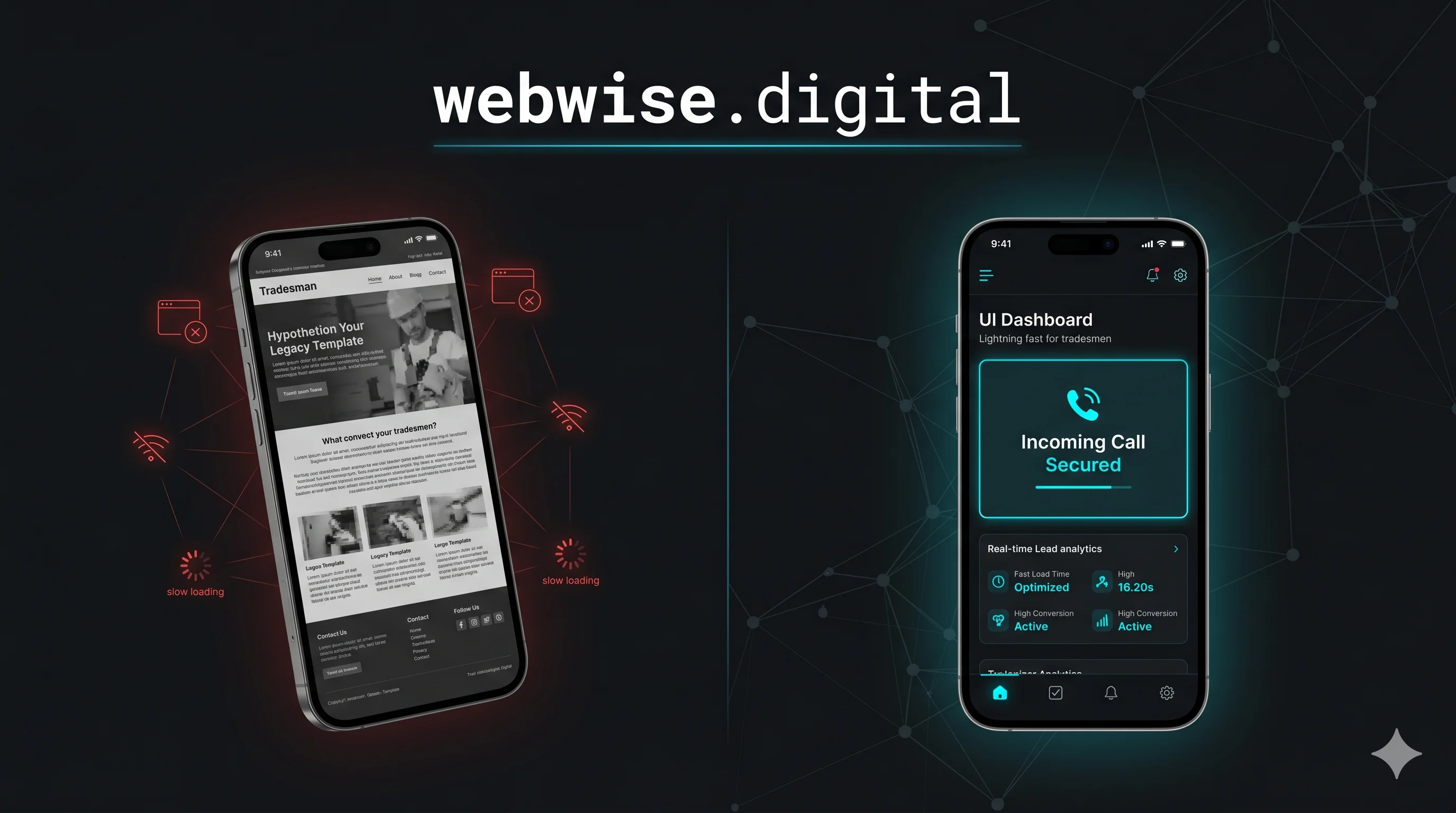
Every day across the UK, plumbers, electricians, builders, roofers, and dozens of other tradespeople wake up, load the van, and head to a job that came through word of mouth — while a dozen enquiries quietly disappear because their website either does not exist, loads in eight seconds, or buries the phone number in a footer nobody ever reaches. This is not bad luck. It is a predictable, fixable problem. And in 2026, the fix has never been clearer.
This guide is for every UK tradesman who has ever wondered why the calls are not coming in. It covers what Google actually rewards in 2026, why the website for tradesmen UK you already have is probably working against you, and the exact framework — from domain to review automation — that turns a static brochure into a phone-ringing machine.
1. The Online Gap That Is Costing UK Tradesmen Real Money
The UK trades market is enormous and largely still won on trust. A homeowner whose boiler breaks at four on a Sunday afternoon is not doing competitor analysis. They are typing a search query and calling whoever looks most credible in the results. The gap between "looks credible" and "does not look credible" is settled in under seven seconds — roughly the time it takes a page to load on a 4G connection and a first impression to form.
Here is what the data shows: the majority of local service searches on Google lead to a phone call within an hour. That means every search for "plumber near me" or "emergency roofer Croydon" is a live, time-critical commercial signal. The tradesman whose website loads fast, shows a clickable phone number, and has recent Google reviews gets the call. The tradesman whose site loads slowly, hides the number, and has no reviews gets overlooked — even if they are better at the actual work.
This is not theory. It is reflected in what WebWise sees across every tradesman website build: sites launched with proper local SEO and conversion architecture consistently record over 186% more inbound calls than the equivalent business was receiving before. That lift does not come from magic — it comes from doing a handful of things correctly that the majority of trade websites simply get wrong.
2. The 15 Target Keywords Every UK Trade Business Should Own in 2026
Before building or rebuilding a trade website, it is worth being deliberate about which searches you are trying to win. The most valuable searches share a common pattern: they combine a trade (plumber, electrician, builder) with a location modifier (near me, in Croydon, Kent), and they carry strong commercial intent — meaning the person searching is ready to hire, not just browsing.
The following fifteen keyword clusters represent the highest-value search territory for a UK trades website in 2026. Each one is linked throughout this article to the relevant section or page where it is discussed in detail.
website for tradesmen UK — the meta keyword that connects all of the above
tradesman website design tradesman website design — the design and UX decisions that separate converting sites from brochures
local SEO for tradesmen local SEO for tradesmen — the compound-interest discipline that builds map-pack rankings over months
Google Business Profile for tradesmen Google Business Profile for tradesmen — the single most-overlooked free lead channel in the UK trades market
how to get more leads as a tradesman — the outcome-level question every tradesman is actually asking
tradesmen website cost UK tradesmen website cost UK — what a proper build costs versus what a template costs you in missed work
hand-coded tradesman website — the technical quality signal that separates fast custom sites from slow page-builder clones
click-to-call website click-to-call website — the single on-page feature with the biggest impact on mobile conversion
tradesman lead generation — the broader category that includes site, SEO, GBP, reviews, and social
plumber website SEO plumber website SEO — trade-specific local SEO for the most competitive trade vertical in the UK
electrician website design electrician website design — the trust signals and page structure that convert electrician enquiries
builder website UK builder website UK — how construction and building companies rank locally in competitive metros
local SEO UK trades local SEO UK trades — the union of geographic targeting and trade-specific keyword strategy
conversion-focused website — the design philosophy that puts the phone call above aesthetics
Core Web Vitals tradesman site — the Google speed and UX score that determines where you rank
Every one of these terms has a place in your site architecture — not stuffed into pages artificially, but mapped to the pages that naturally cover those topics. A page about plumbing services in Croydon should contain natural references to plumber website SEO and local SEO for tradesmen. A pricing page should address tradesmen website cost UK directly. The sections below explain how to build that structure.
3. Why Most Tradesman Websites Fail Before a Single Visitor Arrives
The single biggest source of lost jobs for UK tradesmen is not a bad website — it is an invisible one. Most tradesman website design projects prioritise how a site looks on a desktop at launch day, not how Google reads it, how fast it loads on a phone, or whether it appears in a map-pack search at all. The result is a site that impresses in a portfolio and generates nothing in the real world.
3.1 The Template Trap
The UK web design market for tradespeople is dominated by page-builder templates. Wix, Squarespace, and WordPress with a visual builder can produce something that looks professional in an hour. The problem is that thousands of other tradesmen are doing the same thing — often using the same few dozen templates. Google's crawlers can detect thin, duplicated content structures, and they do not reward them. Visitors sense it too: a stock photo of someone else's van does not build trust the way a photo of your actual team does.
Beyond aesthetics, template-built sites carry a structural penalty. Page-builder code is bloated. It ships with CSS for every feature the template supports, whether you use those features or not. The result is pages that routinely score in the red zone on Core Web Vitals — Google's speed and user experience benchmark. A site that scores red on Core Web Vitals is one Google actively deprioritises in rankings.
3.2 The Phone-Number Problem
On a mobile device, a tradesman's phone number should be visible without scrolling, tappable without zooming, and present on every single page. Most template sites fail at least one of these. The phone number sits in a header that collapses on mobile, or appears only in the footer, or is rendered as an image that the phone cannot detect as a number. The gap between a visitor's intent and a click-to-call website is a matter of milliseconds if the number is in the right place — or a permanent exit if it is not.
3.3 The Local Signal Void
Google ranks local businesses by relevance, distance, and prominence. Relevance is about whether your page actually discusses the service and area the person searched for. Distance is about your registered business location. Prominence is about your reviews, links, and overall online footprint. Most tradesman sites fail on relevance and prominence: they have one "Services" page that lists everything the business does, no mention of specific towns they serve, no schema markup, no citations, and a Google Business Profile that is either unclaimed or last updated in 2021.
4. What Google Actually Rewards for Local Trade Searches in 2026
Understanding Google's local ranking algorithm at a practical level saves months of wasted effort. The algorithm has three primary signals for map-pack results — the three-business panel that appears above organic results on most local service searches — and they are not mysterious.
4.1 Relevance: Does Your Page Match the Search?
Relevance is about semantic match. When someone searches "emergency boiler repair Bromley", Google looks for pages that contain those concepts: the service (boiler repair), the modifier (emergency), and the location (Bromley). A site with a single "Plumbing Services" page has weak relevance. A site with a dedicated "Emergency Boiler Repair in Bromley" page, with natural mentions of the surrounding area, nearby postcodes, and the specific type of work, has strong relevance.
This is why the local SEO for tradesmen playbook includes building one page per town served. It is not about gaming the algorithm — it is about creating content that is genuinely more relevant to a searcher in that town than a generic services page. Google's job is to match intent. Your job is to create pages that precisely match the intent of every type of customer you want to reach.
4.2 Prominence: Are You Trusted Online?
Prominence is where most UK tradesmen fall furthest behind. It is built from three sources: Google reviews (number, recency, and response rate), citations (consistent mentions of your business name, address, and phone number across directories like Yell, Checkatrade, and TrustATrader), and schema markup (structured data embedded in your site's code that tells Google exactly what type of business you are, where you operate, and what you do).
Reviews are the most controllable lever. A business with 80 Google reviews averaging 4.8 stars will almost always outrank a business with 10 reviews at 4.5 stars, assuming the rest of the signals are similar. The most effective way to build reviews is a reviews automation system: a polite, personalised message sent to every completed job automatically, with a direct link to the Google review form. This turns the review ask from something that feels uncomfortable and manual into a quiet background process.
4.3 Distance: Where You Are Registered
Distance is the one signal you cannot manipulate and largely should not worry about. If you serve a ten-mile radius from Croydon, your Google Business Profile should be registered at your actual address in Croydon. You will rank better there than in Bromley, but a properly-built site with town-specific pages will capture searches in Bromley, Sutton, and Streatham too — not through map-pack ranking, but through organic results.
4.4 Core Web Vitals: The Speed Tax
Since Google's Page Experience update, Core Web Vitals — the measurements of how fast a page loads, how stable the layout is, and how responsive it is to interaction — have been official ranking signals. A site that scores red on Largest Contentful Paint (LCP), Cumulative Layout Shift (CLS), or Interaction to Next Paint (INP) is being actively penalised. The industry benchmark for a properly-built trade site, deployed on modern infrastructure like Next.js on Vercel with Cloudflare in front, is sub-second LCP and green across all three metrics.
5. The Architecture of a Tradesman Website That Actually Converts
A conversion-focused website for a UK tradesman is not defined by how it looks. It is defined by what it does: it turns a visitor into an enquiry. Every page structure decision should be made with that outcome in mind. The following page hierarchy is the architecture that works.
5.1 Homepage
The homepage serves three audiences simultaneously: the customer who found you via direct search, the customer who was referred by someone and is doing a quick trust check, and Google's crawler. For all three, the homepage needs to do the same things: establish what you do, where you do it, and why you are trustworthy — in that order, above the fold on mobile.
Above the fold must contain: your trade and location in a clear headline ("Emergency plumber in Croydon, available 24/7"), a tappable phone number, and one primary call to action. Below the fold can introduce services, show recent reviews, display a photo gallery of real work, and link to town-specific or service-specific pages.
5.2 Service Pages
Each distinct service should have its own page. Not a section on a single Services page — its own URL with its own title, its own content, and its own call to action. "Boiler servicing", "emergency boiler repair", and "new boiler installation" are three different searches with different intents and should be three different pages. This is one of the clearest structural improvements a tradesman can make, and it consistently produces ranking gains within weeks of publication.
5.3 Town and Area Pages
Town pages are the foundation of local SEO UK trades. Each town you serve should have a dedicated page that covers: what services you offer there, how long you have been operating in the area, any relevant local landmarks or districts, and a handful of genuine testimonials from customers in that postcode. Thin town pages — just the town name swapped in a template paragraph — do not work. Real local content with local specificity is what ranks.
5.4 The Blog
A trade blog is not about becoming a content creator. It is about answering the questions your best customers ask before they ring you. "How much does a new boiler cost in 2026?" "Do I need planning permission for a loft conversion in a conservation area?" "What is the difference between a gas safe engineer and a plumber?" Each answer is a page that captures a searcher, builds trust, and links to your service pages. The WebWise blog exists for exactly this reason — every post is a worked example of how to capture search intent and convert it.
5.5 The Contact and Quote Page
The contact page is often an afterthought. It should not be. It is the conversion endpoint — the page where intent becomes a lead. It should contain: a phone number (tappable), a WhatsApp link, a short quote form, and your service area. No lengthy paragraphs. No maps embedded from a third party that slow the page. Just the lead capture mechanism, clean and fast.
6. Google Business Profile: The Free Billboard Most Tradesmen Ignore
A fully-optimised Google Business Profile for tradesmen (GBP) is arguably the highest-return investment in local digital marketing. It is free, it ranks above the organic results in map-pack searches, and it is where the majority of mobile users make the call decision. Yet most UK tradesmen either have an unclaimed profile, a profile that was set up years ago and never touched, or a profile that is missing half of the information Google uses to rank it.
6.1 What a Fully-Optimised GBP Looks Like
The basics: business name (matching exactly how it appears on your website), primary and secondary categories (e.g., "Plumber" and "Gas installation service"), service area (the postcodes and towns you cover), hours (including whether you offer emergency or out-of-hours callouts), and phone number. These are the fields most profiles fill in. The fields most profiles leave empty are the ones that matter most for ranking:
Services list with descriptions — Google uses these to match your profile to specific service searches
Products (for tradesmen who install or supply products, such as boilers or solar panels)
Q&A populated with your own questions and answers — these appear on your profile and rank in voice search
Weekly posts — treated like a social feed by Google, rewarded with ranking signals for freshness
Photo updates — profiles with recent photos of completed work rank measurably higher than those without
Review responses Review responses— replying to reviews is a ranking signal, not just a courtesy
6.2 The Review Velocity Problem
Google does not just count reviews — it tracks their velocity. A profile that receives two reviews per month consistently outperforms one that received fifty reviews in a single month and then went quiet. This is why reviews automation is so effective: it creates a consistent drip of reviews that signals to Google that your business is actively trading, not coasting on historical momentum.
6.3 GBP and Your Website: The Feedback Loop
Your GBP and your website should reinforce each other. The website URL on your GBP should link to a location-specific page, not the homepage — this sends a stronger relevance signal. The website should display the same business name, address, and phone number as the GBP, exactly as written, so that Google can verify consistency across both properties. This is the foundation of what is called NAP (Name, Address, Phone) consistency, and it is one of the basic building blocks of local SEO for tradesmen.
7. The Hand-Coded Advantage: Why Custom Beats Template Every Time
The phrase "hand-coded tradesman website" sounds like a selling point that only a developer would care about. In practice, it is the difference between a site that loads in half a second and one that loads in eight — and the gap between those two figures is the gap between getting the call and watching it go to a competitor.
7.1 The Stack That Wins
A properly-built trade website in 2026 runs on a modern framework — Next.js is the current standard — deployed to a global content delivery network (CDN) like Vercel or Cloudflare. Every HTML page is pre-rendered, so there is no server processing delay when a visitor arrives. Images are compressed and served in next-generation formats (WebP, AVIF). JavaScript is minimal — enough for interactions, not enough to slow the page. The result is Core Web Vitals in the green zone across all three metrics, consistently, without ongoing optimisation work.
Page builders — whether Wix, Squarespace, or WordPress with Elementor — cannot achieve this without heroic effort. The weight of the underlying system is built into every page. This is why WebWise's website build service starts with a clean Next.js codebase for every client, not a theme or template.
7.2 Mobile-First Is Not Optional
Over 80% of local service searches in the UK are conducted on mobile. "Mobile-first" in web design means designing for the smallest screen first and expanding upwards, not designing a desktop site and compressing it for phones. The practical difference: on a genuine mobile-first site, the phone number is the most prominent element on the screen. The call-to-action button is within reach of a thumb. The page requires zero horizontal scrolling. The images are optimised for the download speed of a 4G connection.
7.3 Owning Your Code
One underrated advantage of a custom, hand-coded site is ownership. When you build on Wix or Squarespace, you are renting space on their platform. If they change their terms, raise prices, or shut down your account, your website disappears. A hand-coded site built on your own domain and hosted on infrastructure you control — through a provider like Hetzner or Cloudflare — is yours unconditionally. You can move it, modify it, or hand it to a different developer at any point. This matters because a website is a long-term asset, not a subscription service.
8. Lead Capture: The Part Most Sites Get Wrong After They Get the Visit
Getting found is only half the job. The other half is converting visitors into enquiries. This is where tradesman lead generation turns into actual revenue — and where most tradesman websites drop the ball even after doing everything else right.
8.1 Four Ways to Reach You, On Every Page
A trade customer in 2026 wants to contact you their way. Some will call. Some will WhatsApp. Some will fill in a form. Some will book online. A site that only offers one of these four channels is turning away the customers who prefer the others. Every page on a properly-built trade site should offer all four contact methods, accessible without scrolling.
Phone call: Tappable number, prominent, at the top of every page. Not a formatted image — an actual tel: link.
WhatsApp: A direct wa.me link, either as a button or a floating widget. Many customers in the 25–45 age bracket prefer WhatsApp to a phone call for non-emergency enquiries.
Quote form: Short. Three to five fields maximum. Name, phone or email, brief description of the job. Anything longer and customers drop out.
Online booking: For businesses offering fixed-time services (annual boiler services, regular maintenance), a Cal.com or similar self-serve booking link removes phone tag from the equation entirely.
8.2 The Follow-Up Gap
An enquiry that lands in a voicemail and is not followed up within an hour is a lost job. Research consistently shows that response time is the single biggest determinant of whether an enquiry converts into a booked job. A customer who sends a WhatsApp message and receives a reply in two minutes will almost always choose that tradesman over a competitor they have not yet heard from. This is where AI workflows change the game: automated acknowledgement messages that confirm receipt of an enquiry, set expectations on response time, and keep the customer in the loop while you finish the current job.
8.3 Analytics: Knowing Which Channel Won the Job
You cannot improve what you do not measure. A properly-configured Google Analytics setup with conversion tracking tells you: which page a customer visited before they called, which town page is driving the most enquiries, and which blog posts are attracting the highest-value visitors. Combined with Google Search Console — which shows you exactly which search queries are bringing people to your site — this is the data layer that turns gut instinct into informed decisions about where to invest next.
9. Trade-Specific Deep Dives: Plumbers, Electricians, Builders, and Roofers
Different trades have different search behaviours, different trust signals, and different conversion triggers. The SEO strategy that wins for a plumber differs in emphasis from the one that wins for a builder. Here is a trade-by-trade breakdown.
9.1 Plumber Website SEO
Plumbing is the most competitive trade vertical in local search. Emergency intent dominates — "emergency plumber near me", "burst pipe Croydon", "boiler not working" — and it drives some of the highest call volumes of any local service search. For plumber website SEO, the key differentiators are: Gas Safe registration prominently displayed, emergency availability clearly stated (with hours), a dedicated emergency page targeting "emergency plumber [town]", and a review profile that is recent and consistently positive.
Boiler-related pages perform exceptionally well: boiler installation, boiler repair, annual boiler service. Each deserves its own URL. A page titled "Boiler Service in Croydon" that contains genuine local content and links to the emergency plumber page creates a strong internal linking structure that compounds over time.
9.2 Electrician Website Design
Electrical work carries a regulatory weight that most other trades do not. Every visitor to an electrician website design is, consciously or not, asking: "Is this person qualified? Are they safe?" The trust signals that answer this question — NICEIC or NAPIT registration badge, NIC EIC number, details of Part P compliance for domestic electrical work — need to be visible without scrolling. Not in the footer, not on an "About" page: in the header or directly below the headline on every service page.
EV charger installation is the highest-growth search in the electrician vertical in 2026. A dedicated EV charger installation page for each town served is among the fastest ways an electrician can add ranking surface area right now.
9.3 Builder Website UK
Builder searches skew longer-journey and higher-value than emergency trades. A homeowner researching a loft conversion or rear extension is comparing multiple businesses over days or weeks, not minutes. For a builder website UK, the portfolio is the conversion engine. Before-and-after photos of real projects, with addresses or at least postcodes and project descriptions, build the social proof that tips a slow-researching customer toward making an enquiry. Case study pages — covering the challenge, the approach, the materials, and the outcome — also perform well in organic search because they answer the detailed questions a serious prospect is asking.
FMB (Federation of Master Builders) and TrustMark registration are the trust signals that most distinguish credible builders from less credible competitors online. These should be displayed in the header, not buried on an About page.
9.4 Roofer Local SEO
Roofing search behaviour is split between emergency (storm damage, leak repair) and planned (new roof, felt replacement). The emergency intent is high-conversion and time-sensitive; the planned intent is higher-value but longer research cycle. A roofer site needs dedicated pages for both intents: an "Emergency Roof Repair in [Town]" page for the storm-damage call, and a "New Roof Installation [Town]" page for the planned replacement. NFRC membership, before-and-after photos of completed roofs, and a section on materials (slate, concrete tile, flat roof EPDM) all reinforce authority and answer the questions a cautious homeowner is researching before they commit to a quote.
10. The Tradesmen Website Cost Question: What You Are Actually Buying
The most common objection to investing in a properly-built trade website is price. A page-builder template appears to cost nothing. A professional custom build from a studio like WebWise starts from £950. The relevant comparison is not what each option costs upfront — it is what each option earns, or costs you in missed work, over 12 months.
10.1 The Real Cost of a Free Template
Consider a plumber in Croydon who does not have a professional website and receives 30 enquiries per month via word of mouth. A properly-built site with local SEO, in a competitive but not saturated market, can realistically add 15 to 25 additional inbound enquiries per month within three to six months. At an average job value of £250, that is between £3,750 and £6,250 per month in additional revenue potential. Against that baseline, a one-off website build cost of £950 to £2,500 pays for itself in less than a month.
The template site, meanwhile, may generate zero additional enquiries — because it does not rank, does not convert, and does not make the phone ring. Its real cost is not zero. Its real cost is every job that went to a competitor who invested properly. This is the calculation that the tradesmen website cost UK question should always be framed around.
10.2 What the Pricing Tiers Actually Mean
The WebWise pricing tiers are structured around three levels of ambition:
Starter Site (from £950): Five pages, mobile-first, click-to-call on every page, Google Business Profile verified. For a tradesman entering the online market for the first time or replacing a non-functional existing site. Live in roughly two weeks.
Lead Generator (from £1,500): Ten pages including service-by-service breakdown, copywriting, on-page local SEO, and WhatsApp and lead form wired in. The most common starting point for tradesmen who want to actively compete in local search.
Full Local SEO Package (from £2,500): Twenty or more pages including town-by-town coverage, citations, schema, directory listings, and three months of active ranking work. For tradesmen who want to dominate a geographic market rather than simply participate in it.
10.3 The Monthly Retainer Question
SEO is not a one-time project. Google's results change. Competitors launch new pages. Algorithms update. The tradesmen who maintain first-page rankings over years are the ones who treat their site as a living business asset, not a one-off project. The WebWise care retainer (from £49/month) covers hosting, monitoring, security updates, and ongoing ranking work. The return on a £49 monthly investment, when it is the difference between ranking and not ranking for a £500 boiler installation job, needs no further justification.
11. Schema Markup and Technical SEO: The Invisible Work That Compounds
Most tradesman websites do not contain schema markup. This is a significant missed opportunity. Schema is structured data embedded in a page's code that tells Google's crawler exactly what type of entity the page describes — a local business, a service, a review, a FAQ. Google uses this structured data to generate rich results: star ratings appearing in the search snippet, FAQ accordions opening directly in the results page, and enhanced local business profiles. All of this increases click-through rate from search results, which feeds back into rankings.
11.1 LocalBusiness Schema
Every trade website should contain LocalBusiness schema on the homepage and contact page. This should include: business name, address, telephone, service area (as an array of towns or postcodes), opening hours, price range indicator, and the aggregate rating pulled from Google reviews. Getting this right is not difficult, but it requires someone who knows what they are doing — the schema must be valid JSON-LD, placed in the head of the document, and consistent with the rest of the page content.
11.2 Service Schema
Each service page should contain Service schema describing the specific service, the provider (the business), and the area served. This creates a machine-readable map of your services that Google can use to surface specific pages for specific searches — not just your homepage for generic searches.
11.3 FAQ Schema
FAQ schema is one of the most powerful additions to a trade website. An FAQ section at the bottom of each service or town page, with questions marked up in FAQ schema, can appear as expanded accordions in the search results. These take up significantly more real estate than a standard result, pushing competitors further down the page. The questions should mirror the actual queries customers ask — both the predictable ("How much does a new boiler cost?") and the specific ("Do I need to notify building control for a boiler replacement?").
12. AI and Automation: Buying Back the 11 Hours a Week That Admin Steals
The average UK tradesman spends roughly eleven hours per week on admin: returning missed calls, drafting quotes, chasing unpaid invoices, requesting reviews, and managing bookings. These are tasks that automation handles well — and that, when handled by a human, come at the cost of either personal time or job quality. The emergence of practical AI tools in 2026 has made it feasible to automate most of this without building anything complex.
12.1 Missed-Call Recovery
An estimated 31% of UK trade enquiries are lost to voicemail. A customer who calls an unanswered phone at 6pm on a weekday will, in most cases, call the next business on the list within seconds. An AI workflow that detects a missed call, transcribes the voicemail, and sends an automatic WhatsApp message — "Hi, sorry I missed your call, I'll be with you within the hour — can you let me know what the job is?" — recovers a significant proportion of those lost enquiries. The customer feels attended to. The tradesman has not had to stop working.
12.2 Quote Drafting
An AI content system trained on the business's past quotes can draft a new quote from a brief WhatsApp message or form submission. The tradesman reviews and sends it — or, in straightforward cases, approves it with a single tap. Quote drafting alone typically accounts for two to three hours of admin time per week for a busy sole trader.
12.3 Review Automation
As covered in the GBP section above, review automation is the highest-return automation a trade business can implement. The mechanics are simple: every time a job is marked complete in a diary system or CRM, a trigger fires a personalised WhatsApp or SMS to the customer with a direct link to the Google review form. No chasing. No awkward asks on the doorstep. Just a steady drip of five-star reviews accumulating month on month.
12.4 AI Chatbot for After-Hours Enquiries
An AI chatbot trained on a business's services, pricing, and service area can handle inbound enquiries outside business hours. It can answer common questions, qualify the lead (what trade, what area, roughly when), and book a callback at a convenient time. The customer gets an immediate response. The tradesman wakes up to a qualified, pre-informed lead rather than a missed call from an unknown number.
13. Case Studies: What Real Trade Websites Achieve After Proper Optimisation
Abstract principles are useful. Concrete examples are better. The following case studies are drawn from live WebWise builds, with full details available on the work page.
13.1 City Contractors — South East London
City Contractors is a multi-company building contractor operating across South East London and the wider South East. The requirement was a full-stack website capable of managing 120+ pages of content — staff profiles, vacancies, project showcases, case studies, and service pages — all administered in-house without developer involvement. The build delivered a custom content management system, a project gallery with filter by trade and area, and town-specific pages covering Croydon, Bromley, Lewisham, and the surrounding boroughs. The full case study is available at webwise.digital/work/city-contractors.
13.2 Marshall Brickwork & Construction — Kent
Marshall Brickwork & Construction is a multi-trade construction company based in Rochester, Kent. The requirement was a professional multi-page website covering their full service range (brickwork, extensions, landscaping, block paving, fencing, and more), a projects showcase, and an SEO-driven blog. A floating WhatsApp button appears on every page for immediate contact. Town-specific pages cover Maidstone, Sittingbourne, Chatham, Gillingham, and the wider Medway area. The blog has been the primary driver of organic growth, with posts targeting local search intent for cost guides, comparison guides, and service-specific queries. Full case study: webwise.digital/work/marshall-brickwork.
13.3 City Prime Investments — London
City Prime Investments is a London property investment firm with a different requirement: a professional multi-page website and admin panel for showcasing investment properties, managing case studies, and capturing high-value investor leads. The build demonstrates that the WebWise playbook extends beyond trades into any local professional service business where credibility, speed, and lead capture are the conversion drivers. Full case study: webwise.digital/work/city-prime-investments.
14. The Content Strategy That Compounds: Blog, Social, and Local Authority
Building a trade website is the foundation. Keeping it growing in authority — and therefore in rankings — requires a consistent content strategy. This does not mean daily posts or viral social videos. It means producing one or two high-quality, genuinely useful pieces of content per month and distributing them across the channels where your customers are.
14.1 Blog Post Strategy for UK Tradesmen
Every blog post should target a specific keyword that a real customer is searching. The three most productive content categories for UK trade businesses are:
Cost guides: "How much does a new roof cost in 2026?" These attract high-intent searchers who are actively planning a job. They are perennially popular, rank for long-tail cost queries, and build enough trust that the reader often calls directly after reading.
Comparison guides: "Flat roof vs pitched roof: which is right for your extension?" These attract researchers at the consideration stage. They position the writer as the expert and link naturally to service pages.
Local informational: "Do I need planning permission for a loft conversion in [specific borough]?" These attract local searchers who are early in the buying journey. They rank for location-specific queries and build brand awareness in specific postcodes.
The WebWise AI content service produces one to two trade-specific posts per month: drafted by AI from a supplied brief, edited by the WebWise team for accuracy and tone, and signed off by the client before publication. Each post is optimised for the target keyword, includes internal links to service and town pages, and is submitted to Google Search Console for indexing on the same day it goes live.
14.2 Social Media for Trades in 2026
The most effective social strategy for a UK tradesman in 2026 is also the simplest: photograph every completed job, write a three-sentence caption (what was the problem, what did you do, where was it), and post it to Instagram, Facebook, and Google Business on the same day. This produces a consistent feed of proof — real work, real locations, real outcomes — that builds trust with prospective customers who encounter the business on any platform.
Video content — a 30-second before-and-after, a time-lapse of a job in progress, a quick tip about a common problem — performs exceptionally well on Instagram Reels, TikTok, and YouTube Shorts. It does not require professional filming. A phone camera and natural light are sufficient. The barrier is consistency, not quality.
14.3 Building Local Authority Over Time
Local authority in Google's eyes is built from the sum of all the above: a fast, well-structured site; a consistently-updated GBP; a growing review profile; a blog that answers real questions; and citations on relevant directories. None of these is individually difficult. Together, compounding over 6 to 12 months, they produce the kind of local SEO UK trades dominance that is very hard for a competitor to dislodge — because it is built on genuine quality signals, not shortcuts that can be penalised.
15. The 2026 Action Plan: What to Do This Week
Every trade business is at a different starting point. The following action plan is ordered by impact, with the highest-leverage items first.
Step 1: Audit Your Current Online Presence (Day 1)
Before changing anything, know where you stand. Check:
Does your business appear in the map pack for "[trade] near me" from your service area?
Is your Google Business Profile claimed, verified, and fully completed?
What does your current site score on Google PageSpeed Insights?
How many Google reviews do you have, and when was the last one?
Is your phone number tappable on mobile from every page?
If the answers to more than two of the above are unsatisfactory, the most efficient next step is a free site review from a studio that specialises in trade websites. WebWise offers a free 15-minute site review call that covers all of the above and identifies the highest-priority fix.
Step 2: Claim and Optimise Your Google Business Profile (Days 2–3)
If your GBP is unclaimed, claim it now. If it is claimed but incomplete, fill in every field: categories, services, service area, hours, and a minimum of ten photos of real completed work. Set up weekly posts. If you have fewer than twenty reviews, set up a reviews automation process this week.
Step 3: Brief a Proper Website Build (Days 4–7)
If your current site is template-built, loads slowly, or is not generating enquiries, the investment in a proper build pays back within weeks, not months. The brief does not need to be complex: your trade, your area, your typical jobs, and the price point you work at. A studio like WebWise can translate a fifteen-minute phone call into a fixed quote, a locked launch date, and a site live within two weeks. Start with the contact page.
Step 4: Publish Your First Town Page and Service Page (Week 2)
Once the site is live, the compounding work begins. Pick the two towns outside your home postcode where you most want to win work and create a dedicated page for each. Pick the two services that have the highest job value and create a dedicated page for each. These four pages, properly written and submitted to Search Console, will begin ranking within weeks.
Step 5: Publish One Blog Post Per Month (Ongoing)
Commit to one cost guide or comparison article per month. Each post should be 1,000 to 2,000 words, target a specific keyword your customers search for, and link internally to at least two service or town pages. The cumulative effect of twelve months of this is a site that ranks for dozens of long-tail queries and positions the business as the most visible, most trusted trade contractor in its area. The WebWise blog documents exactly how this works in practice.
Conclusion: The Phone Rings When the Work Is Done Properly
The UK trades market is not running short of work. There are millions of homeowners searching for trustworthy plumbers, electricians, builders, and roofers every day. The businesses that win those searches share a common profile: a fast, custom, mobile-first tradesman website design built on a proper stack, a fully-optimised Google Business Profile that is updated weekly, a growing review profile built through automation, town-specific and service-specific pages that match local search intent, and a consistent content strategy that compounds authority over months.
None of this is beyond any UK tradesman. It is not expensive relative to the work it generates. It is not technically complex, provided the right studio does the build. And the results — measured in additional calls, additional enquiries, and additional revenue — are consistent and repeatable across every trade and every postcode.
If you are a plumber in Bromley, an electrician in Swindon, a roofer in Glasgow, or a builder in Cardiff, the playbook is the same. Build the site right. Rank it properly. Make the phone easy to call. And let the site work the night shift while you do the actual work.
The next step is a 15-minute call. WebWise will tell you what is costing you jobs and what to fix first — even if you do not hire us. Start at webwise.digital/contact.