
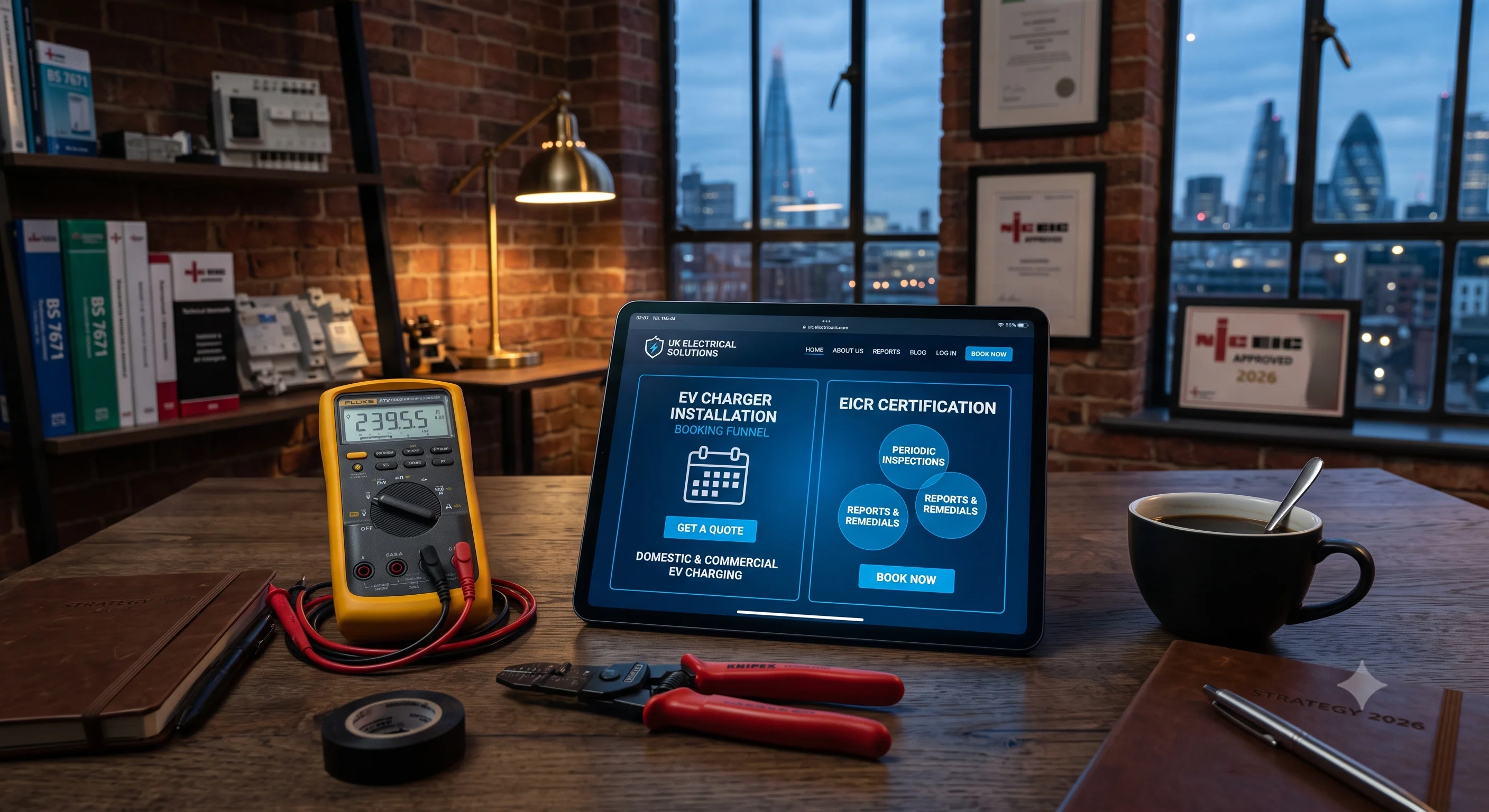
Most electrician websites in the UK rank for nothing, own nothing, and convert nobody. Here's what the ones that work are actually doing differently.
There are over 26,000 NICEIC-approved electrical contractors in the UK. Add in the NAPIT-registered contractors and the Part P-competent scheme members who aren't in either of those directories, and you're looking at tens of thousands of qualified electricians across the country — most of whom have a website that isn't generating a single qualified enquiry per month.
The problem isn't that electricians are bad at marketing. It's that the advice they typically receive about their website is built for a generic business, not for the specific way electrical work is searched for, evaluated, and booked in the UK. The homeowner who needs an EICR for a rental property thinks and searches completely differently from the homeowner who had their fuse box trip on a Saturday night. The facilities manager tendering commercial electrical work uses entirely different search behaviour from either of the above. Yet the typical "electrician website" tries to serve all three from a single generic page, and wonders why it ranks for none of them.
At WebWise Digital, we build websites specifically for UK trade businesses — including electricians — hand-coded in Next.js, live in 7 days, one flat fee, no subscription. We've built and optimised enough electrician sites to have strong opinions about what works and what's a waste of money. This guide shares all of it.
26,000+ — NICEIC-approved electrical contractors in the UK — the competition is real, and most of their websites are poor
80%+ — of people searching for an electrician do so on a mobile phone, often in a moment of stress or urgency
EV chargers — the fastest-growing, currently least-competed search category in domestic electrical work — and most electrician sites have zero dedicated content for it
1. Why Most Electrician Websites in the UK Don't Work
Before we get into what a good electrician website looks like, let's be specific about what a bad one looks like — because "bad" in this context doesn't mean ugly. Some of the worst-performing electrician websites we've seen are genuinely well-designed. They're just built wrong for the purpose they're supposed to serve.
The "domestic and commercial" trap
Open any electrician website in the UK and there's a near-certain chance the services page says some version of "we offer domestic and commercial electrical services." That's it. Possibly with a bulleted list underneath: rewires, consumer unit upgrades, EICRs, lighting, EV chargers, emergency callouts.
This structure has two critical failures. First, it's trying to rank for everything simultaneously from a single page — which means it ranks for nothing specifically. Google sees a page about "rewires, consumer units, EICRs, lighting, EV chargers, and emergencies" and can't confidently rank it for any one of those searches because the relevance signal is split across all of them. Second, it fails every customer who lands on it: the homeowner who specifically needs an EICR gets a list of eleven services and has to work to find that theirs is included. The landlord who needs multiple property EICRs has no idea whether you do portfolio work. The homeowner with a tripped fuse box at 10pm needs to see "emergency callouts available" in the first three seconds, not buried in a list.
The subscription platform problem
A significant proportion of UK electrician websites are built on platforms where the electrician doesn't own the site. Monthly subscription models — sometimes as low as £49/month, sometimes considerably higher — where the website disappears the moment you stop paying, and where the technical architecture makes it structurally impossible to achieve the Core Web Vitals scores that matter for mobile ranking.
We cover the full economics of this in our website pricing guide, but the short version for electricians specifically: after 24 months on a £49/month subscription, you've paid £1,176 for a site you don't own, that's likely slow on mobile, and that will vanish the moment you switch. That same money could have bought a fast, properly built, fully owned website that you keep indefinitely, with budget remaining for a genuine SEO content programme.
⚠️ WATCH OUT — The specific question to ask before signing anything
Ask this: "If I cancel my subscription tomorrow, what happens to my website?" If the answer is "it goes offline" — you don't own it. Ask it as a direct question, get a direct answer, and don't sign anything until you've received it in writing. This applies whether you're talking to a £49/month subscription service or a £5,000 agency. Ownership is non-negotiable.
The "fast" myth
The most common claim in electrician website marketing is speed. "Live in 24 hours." "Up and running in a week." Speed of delivery and speed of the resulting website are entirely separate things, and both matter — but in completely different ways. Delivery speed matters for getting your business online quickly. Page load speed matters for whether Google shows you to potential customers. A website that's delivered in 24 hours but loads in 6 seconds on mobile is, for all practical SEO purposes, a liability rather than an asset.
Google's Core Web Vitals are the specific, publicly measurable metrics that assess whether a page genuinely performs for real users on real devices. More than half of mobile visitors abandon a page that takes longer than three seconds to load. For an electrician where the majority of bookings originate from a mobile search — many of them urgent — this isn't an abstract performance metric: it's directly determining whether your phone rings. We cover this in technical detail in our Core Web Vitals guide.
2. The EV Charger Opportunity That Most Electricians Are Missing
Here's one of the most concrete, time-sensitive opportunities in UK electrician marketing in 2026: EV charger installation search volume is growing rapidly — exactly how rapidly depends on the data source you're looking at, but the directional consensus is unambiguous — and the vast majority of competing electrician websites have either no dedicated EV charger content at all, or a paragraph buried in a general services list.
That combination — growing demand, minimal competition — is, in SEO terms, a window that won't stay open indefinitely. The electricians who build genuinely good dedicated EV charger installation pages right now are capturing a category that, in eighteen to twenty-four months, will be significantly more contested as every electrician realises the opportunity and scrambles to build the same content. We covered this in our electrician SEO guide, but it belongs prominently in any guide to electrician website design because the page structure is where it begins.
What a genuine EV charger installation page actually needs
Most EV charger pages that exist on electrician websites are thin: a paragraph saying "we install EV chargers," a list of brands ("Zappi, Ohme, Myenergi"), and a contact form. This is better than nothing, but it doesn't demonstrate the genuine technical expertise that converts a homeowner who's been researching for two weeks into a confirmed booking.
A homeowner considering a home EV charger installation typically has a specific set of anxieties: Will my existing electricity supply handle it? Do I need to tell my electricity supplier? Will I need a new fuse board? What's the difference between a tethered and untethered charger? Can I charge overnight using cheap-rate electricity? Is there still a government grant? These questions are being typed into Google thousands of times per day, and the electrician whose website genuinely answers them — with the kind of specific, technical honesty that demonstrates actual installation experience — captures those searches and builds the trust that converts them.
🛠️ FROM EXPERIENCE — What the load assessment conversation actually looks like
The technical reality most EV charger pages skip entirely: a proper home EV charger installation begins with a load assessment. A competent electrician checks the existing electricity supply capacity, assesses the main fuse rating, calculates the total connected load of existing circuits, and determines whether the current supply can support the additional demand of a 7kW home charger without overloading. In older properties with a 60-amp main fuse already running an electric shower, oven, and electric heating, a supply upgrade may be needed before the charger can be safely installed. A website that explains this honestly — including the scenarios where extra work is needed and what that work costs — builds the kind of genuine expertise signal that sets it apart from every generic "we install EV chargers" page.
The grant situation in 2026
The OZEV Electric Vehicle Homecharge Scheme (EVHS) for general homeowners closed in April 2022. This is a critical piece of information to get right on your website, because outdated grant information is one of the most common trust-eroding mistakes on electrician sites — a homeowner who reads about a grant that no longer applies loses confidence in everything else on the page.
What does still exist: the Workplace Charging Scheme (WCS) for businesses, available until March 2027, covering up to £500 per socket for eligible installations. The Electric Vehicle Infrastructure Grant for staff and fleets. Scotland has its own separate scheme. Keeping this information current and accurate is one of the clearest demonstrations of genuine expertise a website can offer on this topic — and it's one of the easiest things to get wrong through neglect.
The complete EV charger page structure
Section | Content required | Why it matters |
H1 and opening paragraph | EV Charger Installation [Town] — the specific keyword and location in the first sentence | Direct relevance match for the primary search |
The process explained honestly | Load assessment, supplier notification if needed, dedicated circuit, cable routing, charger mounting, testing and commissioning | Demonstrates genuine expertise; differentiates from generic pages |
Tethered vs untethered explained | Honest pros and cons of each, not a sales pitch for one over the other | Builds trust; answers the question every EV charger researcher has |
Smart charger capability | App control, scheduled charging, load balancing, PEN fault protection | Shows current technical knowledge; captures "smart charger" searches |
Grant information — current, accurate | WCS for businesses, Scotland scheme, any current OZEV guidance | Accuracy is itself a trust signal; outdated grants destroy credibility |
Installation timeline and what to expect | Typical installation time, any preparation needed by the homeowner | Reduces pre-booking anxiety |
NICEIC/NAPIT accreditation with verification link | Registration number linked to live register entry | Verifiable credentials convert hesitant customers |
Recent EV charger installation photos | Real jobs from real customers in the local area | Experience signal per E-E-A-T; converts comparison-stage visitors |
FAQ with schema markup | Common questions answered specifically, marked up for AI extraction | Voice search eligibility + featured snippet target |
3. The EICR Problem: Three Audiences, One Generic Page, Zero Rankings
If there's a single structural error that appears on more UK electrician websites than any other, it's this: one page called "EICR Testing" or "Electrical Safety Certificates" that tries to serve three genuinely different customer types simultaneously, ranks for none of their specific searches, and converts a fraction of the visitors it should.
The three EICR audiences are not minor variations on the same customer. They have different motivations, different search patterns, different concerns, different timelines, and different price sensitivities. Treating them identically isn't just a missed opportunity — it's actively alienating each of them with content that doesn't speak to their specific situation.
Audience 1: The homeowner
A homeowner searching for an EICR is typically doing so for one of a few reasons: they've been asked for one by a mortgage lender or insurer, they're buying or selling a property, or they're being a responsible homeowner who's seen a recommendation to have their installation checked. They're typically unfamiliar with the terminology, anxious about what the report might reveal, and sensitive to cost.
What this audience needs from a page: plain English explanation of what an EICR is and what the process involves (not a technical definition — "we check that your electrical installation is safe" is better than "we assess compliance with BS 7671"), typical cost and what affects it, how long it takes, what happens if issues are found and what the different classifications (C1, C2, C3, FI) mean in practice, and reassurance that the process isn't invasive or disruptive.
Audience 2: The landlord
A landlord searching for EICR work is an entirely different customer. They know what an EICR is. They know it's a legal requirement with a five-year renewal cycle. They are probably managing multiple properties and their primary concerns are: booking efficiency (can we schedule multiple properties in a batch?), turnaround time for the certificate, whether you can deal directly with tenants to arrange access, and whether you can provide multi-property pricing.
They're also, in 2026, acutely aware of the raised stakes we covered in our landlord compliance guide — the £40,000 maximum fine per offence and the Section 21 abolition that means a landlord with a lapsed certificate can be blocked from repossessing their property. This audience needs a page that speaks their language immediately, confirms multi-property capability, and makes the booking process for multiple properties straightforward.
Audience 3: The letting agent or property manager
A letting agent or facilities manager managing properties on behalf of multiple landlords is the highest-value EICR customer available to most electricians, and the one most completely ignored by typical electrician websites. They're looking for: a reliable, accountable contractor they can add to their approved supplier list, someone who communicates professionally (not just a mobile number), capacity to handle volume across a portfolio, and comprehensive documentation delivered promptly.
This audience will frequently look at your Google reviews, your website's professionalism, and whether you appear to have the organisation and capacity to handle repeat, scheduled work across multiple sites. A website built for emergency domestic callouts will not convert a letting agent enquiry, even if the underlying electrical work is identical.
The page structure solution
The correct answer is three separate pages — one per audience — each with its own URL, its own specific content, its own keyword targeting, and its own conversion architecture. This isn't a complicated or expensive solution. It's the application of the same one-keyword-one-page discipline we describe throughout our keyword mapping guide to this specific situation.
Audience | Recommended URL | Primary keyword | Specific content requirements |
Homeowner | /services/eicr-testing-[town] | EICR cost [town] OR electrical safety certificate [town] | Plain English explanation, cost range, what C1/C2/C3 means, timeline, what to expect |
Landlord | /services/landlord-eicr-[town] | EICR landlord [town] OR landlord electrical certificate [town] | Legal requirement framing, £40k fine context, multi-property booking, compliance deadline urgency |
Letting agent/portfolio manager | /services/commercial-eicr-testing | commercial EICR testing OR portfolio electrical certificates | Capacity, professional communication, approved supplier process, reporting standards |
4. Part P: The Trust Signal That Sets Every Registered Electrician Apart
Part P of the Building Regulations is one of the most powerful trust signals available to a UK electrician — and most electrician websites either mention it in passing without explaining it, or don't mention it at all. This is a significant missed opportunity, because Part P is genuinely not well understood by most homeowners, and explaining it clearly does something no generic "we're qualified and insured" claim can do: it answers the homeowner's implicit anxiety before they've even articulated it.
Here's what most homeowners don't know: certain types of electrical work in England and Wales are notifiable under Part P of the Building Regulations. This means they must either be carried out by a registered competent person (an electrician registered with a scheme like NICEIC or NAPIT), or notified to the local authority building control department, which involves a fee and an inspection. When a homeowner hires an unregistered electrician for notifiable work, they take on both the administrative burden and the legal risk of non-compliance.
A website that explains this clearly — and confirms that your NICEIC or NAPIT registration means you can self-certify notifiable work, issue the necessary Electrical Installation Certificate, and notify the relevant parties without the homeowner having to do anything — is answering an anxiety the homeowner may not have consciously identified yet. That's genuine, useful expertise. It's also the kind of specific, credible content that Google's quality raters are trained to recognise as genuine expertise, per the E-E-A-T framework we cover in our E-E-A-T guide.
💡 THE INSIGHT — How to display your NICEIC or NAPIT registration for maximum trust impact
Don't just put the badge image in your footer and leave it there. Put your contractor number beneath it, and make the badge itself a clickable link to your live entry on the NICEIC contractor finder (niceic.com/find-a-contractor) or NAPIT find-a-member tool. A badge that links to live, independently verifiable registration data is categorically different from a badge image that any unregistered person could copy and paste onto their website. One is a trust signal. The other is just a logo.
5. The Emergency Callout Page: The Highest Urgency, Highest-Stakes Conversion Moment
Emergency electrical searches — "emergency electrician near me," "fuse box tripped," "no power to house," "24 hour electrician [town]" — represent the highest-urgency, most time-sensitive conversion moment in all of electrical marketing. The person searching is stressed, possibly in the dark, definitely on a phone, and making a decision in minutes rather than days. The stakes of your website's performance at this specific moment are correspondingly high.
We've written at length about the specific mobile conversion mechanics of emergency trade searches in our mobile conversion guide and our dedicated article on voice search for local trades. But the electrician-specific application deserves direct treatment here.
The five seconds that determine whether you get the call
Research consistently shows that emergency searches are decided in the first five seconds of landing on a page. In those five seconds, the visitor is asking three questions simultaneously, usually without consciously articulating them: Is this a real, legitimate electrician? Can they come out tonight/now? What do I do next?
Your emergency callout page needs to answer all three within the first visible screen on a mobile device — before any scrolling. That means: a tappable phone number in the header (a tel: link, not just text), a clear emergency availability statement ("24/7 emergency callouts available — we attend within the hour during business hours"), your NICEIC registration number visible, and a response time commitment that's specific, not vague. "Fast response" means nothing. "We aim to attend within 60 minutes during business hours" is a commitment you can be held to, and it's far more persuasive for exactly that reason.
Why 24/7 hours on your GBP matter as much as the page itself
Google's local algorithm factors opening hours into map pack rankings for time-sensitive searches. An electrician whose GBP shows 9am-5pm Monday to Friday will not appear in the map pack for an emergency search made at 9pm on a Saturday — regardless of how well-optimised their emergency page is. If you genuinely offer emergency callouts, your Google Business Profile hours must reflect actual emergency availability. This isn't a technicality — it directly determines visibility for the searches with the highest commercial value.
We cover the full GBP setup in our GBP guide for UK tradesmen, but the hours point is worth emphasising here because it's one of the most common configurations we find wrong when auditing new electrician client accounts.
6. The Rewire and Consumer Unit Pages: High Value, Longer Decision Cycle
Full rewires and consumer unit upgrades sit at a different point on the conversion timeline from emergency callouts and EICRs. These are planned, relatively high-value jobs where the customer typically does research over days or weeks, requests multiple quotes, and makes a considered decision. This different timeline requires a genuinely different page approach.
House rewire page strategy
A house rewire is typically the highest-value single residential electrical job — ranging from £3,000 for a small property to £8,000 or more for a large older house — and it's a decision the homeowner makes carefully. The typical research journey involves: understanding what a rewire involves and how disruptive it is, understanding the cost and what it includes, assessing the credentials and experience of the electrician, and seeing evidence of completed rewire projects.
Your rewire page needs to address all of this directly: what a full rewire involves step by step, how long it takes and how disruptive it is (being specific and honest is far more reassuring than vague reassurance), what's included (consumer unit replacement, all circuits, sockets, light fittings, or not?), and what happens with decoration after the cables are routed. A before-and-after photo of a completed rewire — including the finished consumer unit — does more to convert a rewire enquiry than any amount of descriptive text.
Consumer unit upgrade page strategy
Consumer unit upgrades — sometimes called fuse board replacements — occupy a slightly different position: they're often prompted by a specific trigger (a property sale/purchase survey, a failed EICR with a C2 finding, an insurance requirement) and the customer typically has less room for extended deliberation. The page should lead with the trigger scenarios ("your surveyor recommended a consumer unit upgrade," "your EICR showed a C2 finding on the consumer unit") and provide clear information on what the upgrade involves, how long it takes (typically a full day), and why RCBO-fitted boards are the standard you install.
💰 REVENUE OPPORTUNITY — The consumer unit upgrade + EICR bundle opportunity
One of the most commercially effective service combinations available to a UK electrician is the consumer unit upgrade bundled with an EICR. Many customers who need a consumer unit upgrade don't have a current EICR, and many customers who commission an EICR discover a C2 finding on the consumer unit that recommends upgrade. Building a clearly described bundle (EICR + consumer unit upgrade if required, with a quoted price for both) on the consumer unit page captures both the standalone searches and the combination decision that follows a C2 finding. This is the kind of specific, practical content that generic electrician website advice never covers.
7. Local SEO for Electricians: The Complete Visibility System
A well-designed electrician website with brilliant conversion architecture is still invisible if nobody can find it. Local SEO is the system that makes it findable — specifically for the local, service-plus-location searches that produce real bookings. We've published the complete local SEO framework in our local SEO guide, and the electrician-specific application of that framework in our electrician SEO guide. Here's the practical summary.
The Google Business Profile setup for electricians
The primary category for an electrician's GBP should be "Electrician" — not "Electrical Installation Service," not "Contractor," not "Home Services." The most specific accurate category available is always the right choice, and for a domestic electrician, "Electrician" is it. Add "Emergency Electrician" and "Electrical Installation Service" as secondary categories. Enable the Emergency Service attribute. Set your opening hours to genuinely reflect your emergency availability.
Your services list on GBP should be specific: EV Charger Installation, EICR Testing, Consumer Unit Upgrade, House Rewiring, Fuse Board Replacement, Emergency Electrical Callout, Landlord Electrical Certificates. Not "domestic and commercial electrical services." Each specific service listed is an additional relevance match for that specific search, and collectively they paint a detailed, credible picture of what you actually do.
The citation foundation
Beyond your GBP, local search authority is built through consistent business data (name, address, phone number, identical everywhere) across the directories that Google treats as trusted sources. For UK electricians specifically, the highest-value trade-specific citations are: the NICEIC contractor finder (already covers you if you're registered, but ensure the data matches your GBP exactly), the NAPIT find-a-member tool if registered, Checkatrade if you use it, TrustMark if registered, and local authority approved contractor lists if applicable.
Town pages: the geographic expansion strategy
If you cover an area beyond your immediate registered location — as most UK electricians do — dedicated town pages are how you capture searches in those areas without relying solely on proximity. A dedicated "Electrician [Town]" page, with genuine specific content about your coverage of that area, creates a ranked organic entry point for that location that the map pack alone can't provide from a distance.
The key principle, covered in our local SEO guide, is that a list of towns at the bottom of your homepage does not rank for any of them. Fifteen towns in your service area need fifteen pages — built incrementally, one or two per month, as part of the content programme described in our content system guide.
8. Schema Markup for Electrician Websites: The Technical Layer That Wins AI Citations
Schema markup — the structured data code that tells search engines and AI systems exactly what your website is about, who you are, and what you offer — is one of the most consistently neglected technical elements of UK electrician websites. It's also, in 2026, one of the most consequential, because AI-powered search answers increasingly draw on structured data to identify, verify, and cite local businesses.
We cover schema in technical depth in our schema markup guide. For electricians specifically, the schema setup that matters:
LocalBusiness schema on the homepage: Business name, address, phone, opening hours (reflecting emergency availability), service area, aggregate rating, NICEIC or NAPIT registration number in the appropriate schema property, and sameAs links to your GBP and verification register entry.
Service schema on each service page: Each service page (EV charger installation, EICR testing homeowner, EICR testing landlord, consumer unit upgrade, etc.) should have Service schema naming the service, describing it, specifying the area served, and linking to the LocalBusiness entity.
FAQPage schema on key pages: The EV charger page, the homeowner EICR page, and the emergency callout page all have obvious FAQ content. Marking this up correctly makes each Q&A a potential AI Overview extraction point and a voice search result.
Article schema on blog posts: With a properly structured Person entity (your name, linked to a LinkedIn profile or similar) nested within an Organization entity, creating the author-entity chain that supports AI attribution of expertise.
Every WebWise build includes this full schema stack as standard. It's not an add-on, and it's not optional — it's part of the foundational technical build that determines whether your site can participate in the AI-powered search landscape that's increasingly dominant for local trade searches.
9. Reviews and Reputation: What Makes an Electrician's Profile Actually Persuasive
Reviews matter for every trade business website, but they matter specifically differently for electricians. The type of review content that performs best for an electrician is different from what performs best for a plumber or a builder, because the homeowner's anxieties before hiring an electrician are somewhat specific: Is this person genuinely qualified? Are they going to be safe in my home? Will the work be done properly and certified correctly?
A review that says "brilliant job, very happy, would recommend" is fine. A review that says "NICEIC registered, issued the electrical certificate same day, explained exactly what Part P compliance means and handled the notification automatically — five stars" is actively answering the specific pre-hiring anxieties of the next potential customer. The latter type of review is the kind worth actively encouraging, and the review automation system we describe elsewhere in our guides includes a prompt that invites customers to mention the specific service performed — precisely because this generates the specific, useful review content rather than generic praise.
Handling negative reviews as an electrician
Electrical work is one of the categories where negative reviews most commonly involve disputed fault responsibility — a customer claiming a circuit developed a fault that the electrician says is unrelated to the work they performed. This is a specific, difficult reputation management scenario. The advice in our negative review guide applies, but the key electrician-specific addition: always respond to any technically disputed review with a calm, professional reference to the certificate issued, the standard to which the work was completed, and the offer to discuss directly. Never get drawn into a public technical argument in the review thread — it damages your reputation regardless of who is correct.
10. The WebWise Electrician Website: What We Build and Why It Works
Everything described in this guide is what a WebWise electrician website build delivers. We're transparent about this not as a sales pitch but because we think the specific detail matters: knowing what a well-built electrician website actually looks like, page by page, is useful information regardless of who you hire to build it.
The standard WebWise electrician build — five pages, hand-coded in Next.js, live in 7 days, one flat fee from £950 — covers: the homepage with NICEIC/NAPIT credential display and tappable phone above the fold, a services overview page with clear links to specific service pages, a contact page with a qualification-first enquiry form and embedded GBP map, genuine photography integration (yours if you have it, guidance on capturing it if you don't), full LocalBusiness and Service schema setup, GBP connection and optimisation, and Core Web Vitals optimisation before launch.
The Lead Generator tier at £1,500 adds: the three separate EICR pages (homeowner, landlord, commercial), a dedicated EV charger installation page with the full technical content structure described in Section 2, an emergency callout page with 24/7 availability signalling, and on-page SEO including keyword-optimised title tags and meta descriptions. The Full Local SEO tier at £2,500 adds: town pages for your primary service area towns, a content programme of three initial blog posts, and schema citation building.
Details of the full build process — from first call to launch — are in our build process guide. The specific comparison against other agency models and pricing structures is in our agency comparison article. The full pricing breakdown is in our website cost guide.
11. The Long Game: Building an Electrician Website That Compounds Over Time
The most common mistake after a website launch is treating it as a finished project. A website is infrastructure, not a deliverable — and the businesses currently sitting at the top of electrician searches in their area are not there because they built a great website three years ago and did nothing with it. They're there because they've been building on that foundation consistently: new reviews every month, new content every month, GBP posts every week, updated photography from completed projects.
The compound effect in practice
We detailed the realistic month-by-month trajectory in our larger complete trades website guide. For electricians specifically, the pattern we see consistently: months one to three produce initial GBP improvements and organic visibility for lower-competition terms (specific service + specific town combinations that don't yet have strong competition). Months three to six produce map pack movement for primary terms. Months six to twelve establish top-three positions for the most competitive terms in a typical UK local market.
The EV charger opportunity we described in Section 2 is particularly time-sensitive within this trajectory: a dedicated EV charger installation page published now has a meaningful head start on competitors who haven't built the page yet. That advantage closes over time. Build it now, not after your competitors do.
Email and the recurring revenue layer
One element that's almost completely absent from electrician marketing strategies we've reviewed: email automation for recurring work. An EICR customer is, structurally, a guaranteed repeat customer in five years. A consumer unit replacement customer who's just had their installation updated is likely to want an EICR at the same time or shortly after. A landlord whose first batch of EICRs you've handled is a recurring annual and five-yearly revenue stream.
The email automation system described in our email marketing guide applies directly and specifically to electricians: capturing the email address at job completion, logging the EICR date, and sending an automated five-year renewal reminder a month before the certificate expires is one of the most concrete, high-value automations available to any UK electrician. The AI workflow service we offer to WebWise clients builds exactly this.
Conclusion: One Page Per Job, One Clear Owner, One Fast Load
This guide has covered a lot of ground. But the principle underlying all of it is simpler than it might appear: an electrician website that generates real work does three things consistently. It has one dedicated page per specific service and per significant location — not a list, not a generic "services" page, but individual pages with individual keyword targets and individual conversion architectures. It loads fast on mobile, because that's where the majority of bookings start and where slow pages lose them. And the electrician who owns it can prove who they are: their NICEIC or NAPIT number is visible, verifiable, and linked to a live register entry.
Everything else in this guide — the EV charger opportunity, the three-audience EICR strategy, the Part P explanation, the schema setup, the review velocity — is detail in service of those three core principles. Get the three core things right, build on them consistently, and the phone rings more. That's the only metric that matters.
If you'd like to discuss what your specific electrician website needs — whether that's a first build, a rebuild of something that's not performing, or a local SEO programme layered on top of a working site — the starting point is a 15-minute call at webwise.digital/contact. Or if you're ready to see the specific packages and pricing, visit our electricians page directly.
Further reading: our electrician SEO guide for the deeper keyword strategy, our landlord EICR marketing guide for the compliance opportunity specific to 2026, and our complete local SEO guide for the citation and NAP foundation that supports everything described here.