
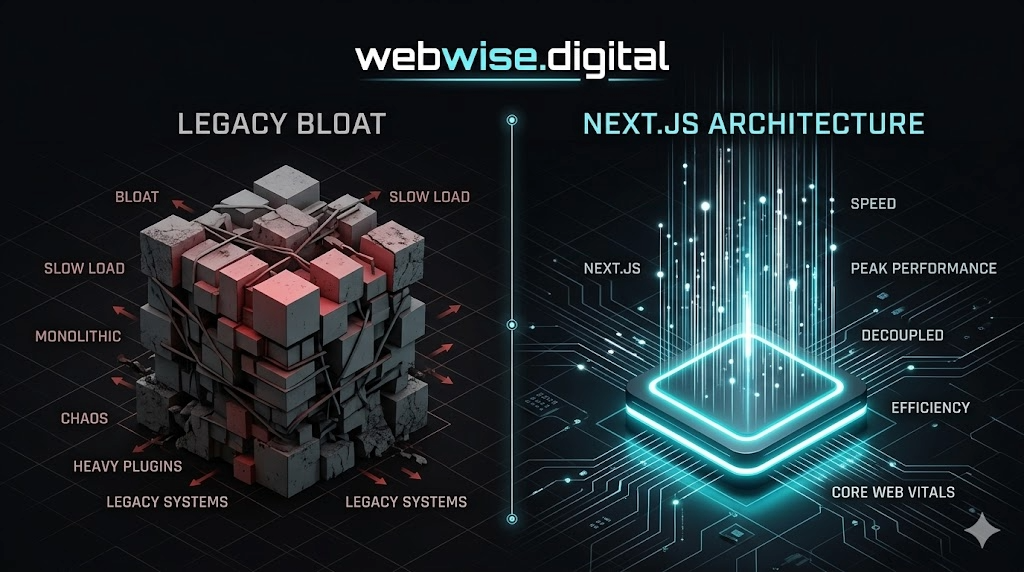
The evolution of web engineering has reached a critical bottleneck. For years, the mass market relied heavily on monolithic content management systems and visual page builders to deploy digital properties. While these tools democratized web creation, they introduced an unsustainable debt of code bloat, unoptimized rendering paths, and severe latency. In an era where user retention is calculated in milliseconds and search crawlers prioritize performance metrics above all else, legacy architecture has become a liability.
To achieve sustainable organic visibility and maximize conversion efficiency, organizations must transition away from monolithic systems toward a decoupled front-end architecture. Utilizing a professional web development company to implement a custom Next.js infrastructure represents the definitive paradigm shift required to eliminate architectural bloat and secure absolute market dominance.
1. The Anatomy of Page-Builder Bloat: Why Legacy Frameworks Fail
To understand the necessity of modern frameworks, one must first diagnose the structural failures inherent in legacy page builders like WordPress, Elementor, Wix, and Squarespace. These platforms operate on a monolithic, server-compiled principle. When a request is made, a database query is triggered, and the server dynamically compiles the page before sending it to the client.
The critical flaw in this process lies within the document object model (DOM) tree. Legacy builders rely on deep nesting of structural containers to achieve responsive visual layouts. A simple text block often sits inside dozens of nested division tags, creating an unnecessarily complex DOM.
The Document Object Model Overhead
A massive DOM tree places heavy strain on the browser's rendering engine. During the critical rendering path, the browser must parse the HTML, construct the DOM tree, parse the CSS, and construct the CSSOM tree. It then combines these trees into a layout model to paint pixels onto the screen. When the DOM tree contains thousands of unnecessary nodes, the browser experiences significant performance costs during both the initial style calculations and subsequent layout adjustments caused by user interactions.
Unused Resource Accumulation
Monolithic configurations suffer from indiscriminate asset loading. When a page builder relies on plugins to achieve specific visual features—such as sliders, form fields, or animations—the underlying stylesheets and scripts are loaded across the entire site architecture.
As a result, a simple contact page frequently downloads megabytes of unused JavaScript libraries and style rules that have no relevance to the actual content being viewed. This unused code blocks the browser's main thread, stalling asset execution and directly causing performance degradation.
2. The Next.js Architecture: Decoupling the Presentation Layer
Next.js fundamentally re-engineers how data is processed and delivered to the end-user. By functioning as a headless frontend framework, it severs the direct dependency between the data layer and the user interface. Content can be managed within any decoupled environment and exposed exclusively via secure endpoints, allowing a dedicated Next.js development agency to curate a completely optimized interface.
+-----------------------------------------------------------+
|                      Data Repository                      |
|            (Headless CMS, Databases, API Feeds)          |
+-----------------------------------------------------------+
                              |
                     Secure API Endpoints
                              |
                              v
+-----------------------------------------------------------+
|                    Next.js Edge Layer                     |
|          (React Server Components / Edge Runtime)         |
+-----------------------------------------------------------+
                              |
               Pre-compiled Semantic HTML
                              |
                              v
+-----------------------------------------------------------+
|                    Client Browser                         |
|             (Instant Rendering, Zero Bloat)               |
+-----------------------------------------------------------+
React Server Components (RSC)
The primary mechanism behind this performance leap is the implementation of React Server Components as the default architecture. In traditional client-side applications, the entire framework runtime must be downloaded and executed on the user's device to render the visual elements.
With React Server Components, the computational heavy lifting occurs entirely on the build server or edge node. The component logic executes on the server side, data dependencies are resolved internally, and the output is streamed directly to the client browser as lightweight, semantic HTML. The client device receives zero framework overhead for these components, reducing the initial payload sizes significantly.
Static Site Generation and Incremental Migration
Next.js provides hybrid rendering lifecycles, enabling developers to mix Static Site Generation (SSG), Server-Side Rendering (SSR), and Incremental Static Regeneration (ISR) within the same application.
For core informational structures, SSG compiles the pages into flat HTML documents during the initial build phase. When a user requests a static asset, it is served instantly from a global edge node without requiring any database lookups or runtime compilation. If content changes, ISR allows specific routes to rebuild asynchronously in the background, updating the cached document across the global network without causing any visible downtime or performance dips for the active user.
3. Mastering Core Web Vitals: Technical Optimizations for Sub-Second Speeds
Google's user-experience scoring framework, the Core Web Vitals, acts as a strict programmatic filter within the ranking algorithms. Sites that fail to meet the targeted performance thresholds face continuous downward pressure on their visibility. Custom custom web development services resolve these metrics directly through code optimization and advanced deployment models.
Metric | Focus Area | Target Threshold | Next.js Engineering Strategy |
Largest Contentful Paint (LCP) | Visual Loading Speed | Under 2.5 Seconds | Edge Caching, Server-Side Rendering, Preloading Prioritization |
Cumulative Layout Shift (CLS) | Visual Rendering Stability | Under 0.1 | Explicit Aspect Ratios, Reserved Layout Containers |
Interaction to Next Paint (INP) | Interface Responsiveness | Under 200 Milliseconds | Thread Isolation, Asynchronous Handlers, Stripping Third-Party Scripts |
Eliminating Largest Contentful Paint Delays
LCP tracking evaluates how quickly the largest meaningful element above the fold becomes fully visible on the screen. In a legacy setup, LCP is delayed by deep resource waterfalls, where the browser must download multiple style files and scripts before discovering the hero graphic.
Next.js minimizes this waterfall sequence by inline-rendering critical styles directly into the server-sent HTML document. Furthermore, by utilizing optimized asset components, the system automatically converts images into modern formats like WebP or AVIF, resizes the asset based on the viewport parameters, and injects explicit preload tags to ensure the browser prioritizes downloading the file during the initial parse phase.
Securing Perfect Visual Stability
CLS evaluates the visual movement of elements within the viewport during the rendering process. This shift typically happens when images, fonts, or ad containers load without predefined layouts, forcing the browser to recalculate element positions on the fly.
Custom component libraries solve this issue by requiring explicit aspect ratios and bounding boxes on all dynamic nodes. The browser builds the rendering layout tree with the exact layout boundaries already reserved, ensuring the page remains perfectly still as assets load asynchronously in the background.
Optimizing Long-Term User Interaction
INP tracks the application's long-term responsiveness to user inputs across the entire browsing session. High INP values occur when extensive JavaScript operations block the browser's main thread, preventing it from processing user clicks or form typing.
By isolating complex logic inside server components and utilizing code splitting, Next.js reduces the main bundle footprint. The browser only processes the script tags necessary for the active page, keeping the main execution thread completely open and keeping INP well under the target threshold.
4. Algorithmic Advantages: Why Search Crawlers Prioritize Decoupled Architecture
Search engine web crawlers are bound by real-world constraints, specifically computational time and crawl budgets. When an automated bot arrives at a digital property, it allocates a limited amount of time to ingest, parse, and index the underlying content. If a platform is unoptimized, the bot spends its entire resource allocation waiting for scripts to execute, leaving massive portions of the site directory unindexed.
A specialized performance SEO agency recognizes that a decoupled architecture presents automated crawlers with clean, pre-rendered semantic documents. Because the content is already baked directly into the initial HTML response from the edge server, crawling bots do not need to execute a secondary JavaScript rendering cycle to discover the text layers.
Monolithic (Client-Side dependent):
[HTML Download] -> [Parse Script Tags] -> [Execute Hydration] -> [Secondary Content Indexing]

Next.js Decoupled (Server-Rendered):
[HTML Download] -> [Instant Text & Semantic Graph Indexing]
This structural efficiency ensures that search bots can crawl thousands of deep inner pages efficiently, maximizing overall indexing velocity. Furthermore, because the routing architecture allows for clean execution of nested schema graphs and automated XML sitemap generation at the compilation level, search systems can seamlessly map out the business entities, local operations, and topical clusters without encountering internal technical errors.
5. Seamless API Integrations: Transitioning into a Connected Web Application
A modern digital presence cannot function effectively as an isolated marketing brochure. To build a highly competitive lead-generation asset, the front-end interface must operate as an integrated intake channel for a broader operational network. Executing advanced web application development workflows means turning user interactions into organized data payloads that sync instantly with your internal systems.
By using serverless API routes within the Next.js directory, form submissions can connect directly to third-party services without needing heavy external plugins. When a customer inputs their data into a custom booking form, the request is handled by an isolated, secure edge routine:
The payload is validated and sanitized instantly to protect against cross-site scripting vulnerabilities.
The customer record is updated within enterprise CRM suites like HubSpot, Salesforce, or dynamic database tables.
Transactional messages are triggered via automated communication gateways like Twilio or WhatsApp to update field operations teams.
Calendars, invoicing systems, and resource logs update automatically, entirely bypassing manual administrative steps.
This decoupled application layer ensures that even if a backend automation service encounters a temporary delay, the public frontend continues to run flawlessly at peak speeds.
6. Future-Proofing Digital Assets through Modern Engineering
The technical standards of the global web ecosystem are constantly moving forward. As user expectations shift toward instant loading experiences and search engine algorithms tighten their performance requirements, platforms built on bloated, outdated foundations will continue to see drops in organic visibility and user conversion rates.
Investing in bespoke web application development is the ultimate method for future-proofing your business infrastructure. By choosing a decoupled, component-driven design powered by global edge runtimes, organizations strip away the limitations of legacy page builders.
The result is a fast, highly secure, and deeply scalable digital property built to maximize user conversion and dominate search results across any competitive landscape.