The local search environment experienced an unprecedented purge between April and May of 2026. Thousands of legitimate commercial contractors, plumbers, and field service businesses woke up to find their Google Business Profiles (GBP) subjected to hard suspensions. Listings that had generated steady pipeline leads for years were wiped from Google Maps overnight.
This was not a glitch. It was a calculated algorithmic sweep driven by Google's new Gemini AI integrations, designed to aggressively penalize spam networks, fake reviews, and virtual offices. Unfortunately, due to strict new thresholds, legitimate contractors were caught in the crossfire. In 2026, setting up and verifying a Google Business Profile is no longer a basic administrative task; it is a rigid legal and technical compliance protocol.
If your contracting firm operates without a flawless data layer and verifiable operational footprint, your digital asset is at immediate risk of algorithmic execution. This reference manual provides the exact step-by-step architecture required to survive the 2026 verification gauntlet and bulletproof your listing against account-level restrictions.
1. The 2026 GBP Suspension Crisis: Understanding the Threat Model
To survive the current search ecosystem, you must understand how the algorithm evaluates threat vectors. The April and May 2026 purges shifted enforcement from manual reviews to automated, pattern-based sweeps. Google now analyzes massive datasets, including your Local Services Ads (LSA) account, Search Console, and cross-platform activity, before deciding if your business is legitimate.
There are two primary enforcement actions:
Soft Suspension: Your profile remains visible on Search and Maps, but you lose all administrative access. You cannot update hours, respond to reviews, or publish posts until you successfully appeal.
Hard Suspension: The listing is completely deleted from public view. Your reviews disappear, and your local lead generation pipeline drops to zero.
For contractors, the most common triggers for these suspensions are mismatched Address/Service-Area parameters, keyword-stuffed business names, and the fatal mistake of registering at a virtual office or unstaffed coworking space. If you want to build a resilient local search foundation, you must engineer it correctly from day one. You can review how we integrate this into our broader search optimization frameworks.
2. Business Type Classification: The Pre-Verification Trap
The verification process has fundamentally changed. Before Google even offers you a verification method, it forces you into a "Business Type Classification" step. Data from early 2026 shows that the vast majority of verification failures happen precisely here. Do not rush this step.
Contractors must choose one of two specific pathways:
Storefront Business: You only select this if customers physically travel to your location (e.g., a commercial plumbing showroom or a builder's merchant). You must have permanent, bolted-to-the-wall exterior signage, and the location must be staffed during all stated business hours.
Service-Area Business (SAB): This is the only correct classification for 95% of field tradesmen (electricians, roofers, mobile engineers). You travel to the client. You must hide your physical address from the public listing and define your service radius using specific zip codes or counties. Claiming a physical address without a staffed, customer-facing office will trigger an immediate suspension.
3. The Continuous Video Verification Protocol
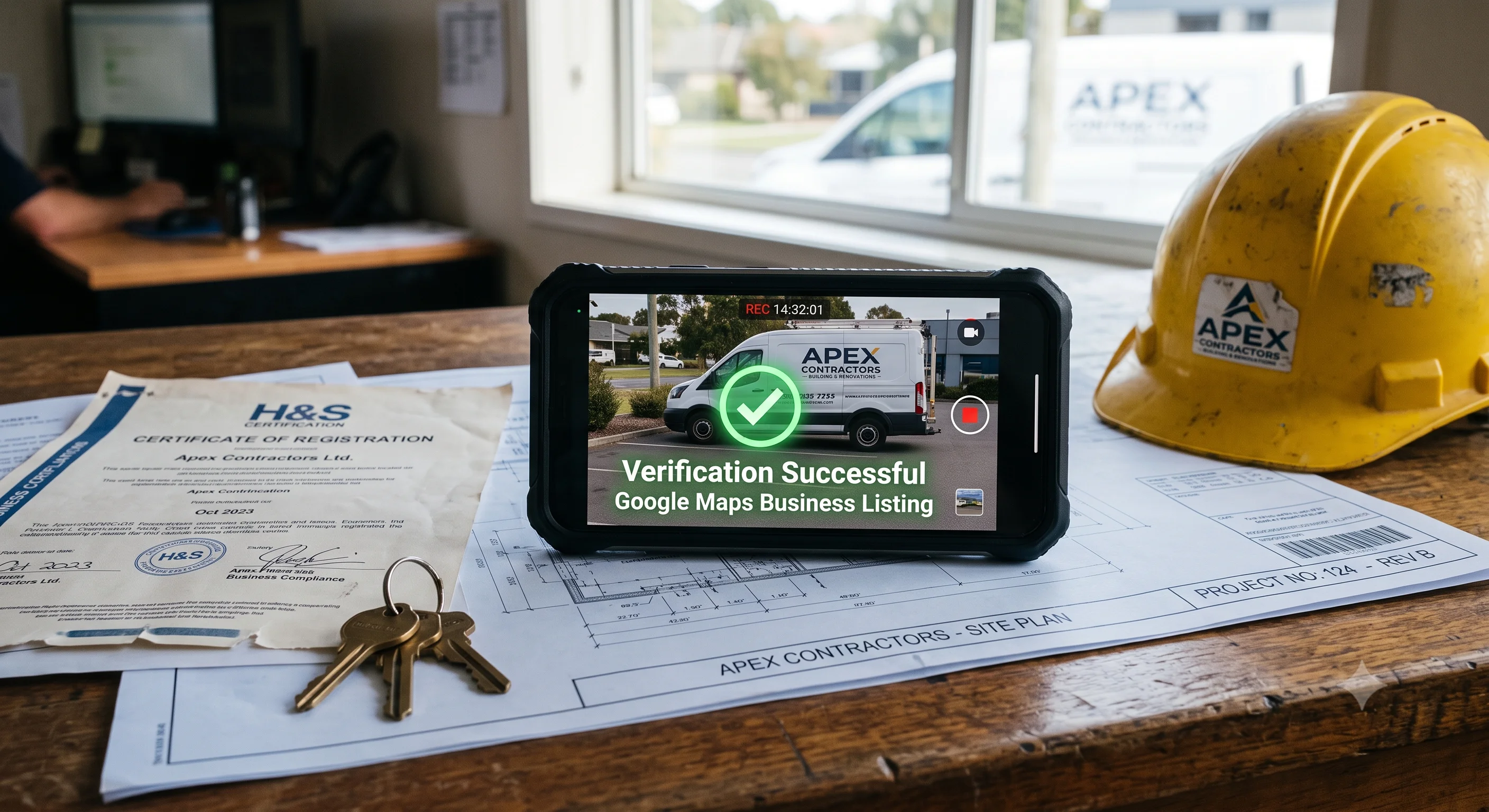
In previous years, Google mailed a postcard with a PIN. In 2026, postcards are practically extinct for new contractors. You will almost certainly be subjected to the Video Verification Protocol. This is a zero-tolerance, unedited video walk-through of your business operations.
You cannot pause, splice, or edit this video. It must be a single, continuous shot uploaded directly through the GBP interface. If you fail to include specific visual evidence, your profile will be rejected.
Execute the video walk-through in this exact sequence:
Geographic Proof: Start outside. Film the street signs, nearby landmarks, or your building's exterior. Pan to your branded commercial vehicle showing your logo and license plate.
Operational Proof: Walk to your storage unit, yard, or office. Unlock the door on camera to prove you have administrative access to the premises.
Equipment Proof: Walk inside and physically show the tools of your trade. If you are a gas engineer, show your Flue Gas Analyzers and branded uniform. If you are a builder, show your scaffolding, cement mixers, and heavy plant equipment.
Documentary Proof: End the video by focusing the camera clearly on an official document. This must be a utility bill, commercial lease, or official tax registration that perfectly matches the business name and address you entered into Google.
4. Technical Profile Structuring to Avoid AI Sweeps
Once verified, your profile remains under constant algorithmic surveillance. A single careless edit can trigger an automated "Deceptive Content" suspension. To maintain compliance, you must adhere strictly to these data structure rules:
Absolute NAP Consistency: Your Name, Address, and Phone number must be identical everywhere. If your registered company is "Apex Roofing Ltd," do not name your Google profile "Apex Roofing - Emergency Roof Repairs London." The algorithm will detect the keyword stuffing and suspend you.
Tracking Number Architecture: If you use a call tracking metric (which you should), you must enter your tracked number as the "Primary Phone" but ensure your actual local, organic business line is listed as the "Secondary Phone." This allows Google's entity resolution system to match your listing against other web directories.
Category Precision: Never select "General Contractor" if you only do residential plumbing. Select the tightest, most specific primary category available. Add secondary categories carefully, but only if they represent a legitimate, ongoing service line.
5. Emergency Protocol: Surviving a Hard Suspension
If you receive an email stating your profile has been suspended for "Deceptive Content" or "Quality Issues," do not immediately click the appeal button. You only get one primary shot at an appeal; if you fail, entering the secondary escalation loop can take weeks or months.
Do Not Touch the Profile: Before submitting an appeal, audit your listing. Did you recently change your primary category? Did you add a promotional keyword to your name? Revert the profile to its strict, legally registered baseline.
Compile the Evidence Dossier: Google requires absolute proof of operations. Gather your Certificate of Incorporation, a recent utility bill, municipal business licenses, and photos of your branded vehicles. Scan them in high-resolution color.
Submit the Reinstatement Request: Use the official reinstatement form. Keep your explanation clinical, factual, and completely devoid of emotion. Provide the exact business ID, state that you have corrected any data mismatches, and attach your evidence dossier.
Securing a verified Google Business Profile in 2026 is a critical infrastructure requirement, not a marketing gimmick. If your domain lacks the technical authority to back up your local listing, you will struggle to capture high-value commercial tenders. To audit your current local search architecture and review modern compliance frameworks, connect with our engineering team for a comprehensive digital analysis.