You are completely correct. I missed hyperlinking the exact target keyword in the text. Here is the corrected version of the article with the keyword properly integrated and linked.
Flair: Technical
Tracing Every Click: Advanced GA4 Implementation and Conversion Tracking for Trades
The contracting industry operates on a high-stakes conversion model. A single phone call or completed estimate request can represent thousands of pounds in revenue. Yet, the vast majority of trade domains run on default analytics configurations that provide zero granular insight into user behavior. In 2026, relying on basic pageview metrics is a strategic failure.
Executing a flawless google analytics 4 setup represents a complete paradigm shift from legacy analytics systems. It is an event-driven data model. Out of the box, GA4 does not know what constitutes a "lead" for a local contractor. It will not automatically track telephone clicks, specific form submissions, or interaction with your live chat widget. To measure the exact return on investment of your technical SEO and content architecture, you must manually engineer a precise data layer. This guide details the advanced implementation required to trace every profitable action on your contracting domain.
1. The Event-Driven Architecture of GA4
Universal Analytics relied on tracking "sessions" and "pageviews." GA4 discards this entirely. In the current ecosystem, every single interaction a user has with your domain is classified as an "Event." A page load is an event. A scroll is an event. A video play is an event.
For commercial field services, you must distinguish between vanity metrics (how many people looked at your homepage) and conversion events (how many people requested a quote).
To execute this, you must abandon hardcoding tracking scripts directly into your website's header. The only acceptable deployment method for modern tracking is through Google Tag Manager (GTM). GTM acts as a centralized container, allowing you to deploy complex firing triggers without constantly modifying the core codebase of your server.
2. Engineering Custom Conversion Triggers via GTM
To achieve total visibility over your lead generation pipeline, you must configure GTM to listen for specific user actions and push that data sequentially to GA4.
When engineering a data layer for a regional contractor, such as an entity targeting specific county-level services, you must track exactly which service pages generate direct inquiries.
Here are the mandatory tracking protocols for any trade domain:
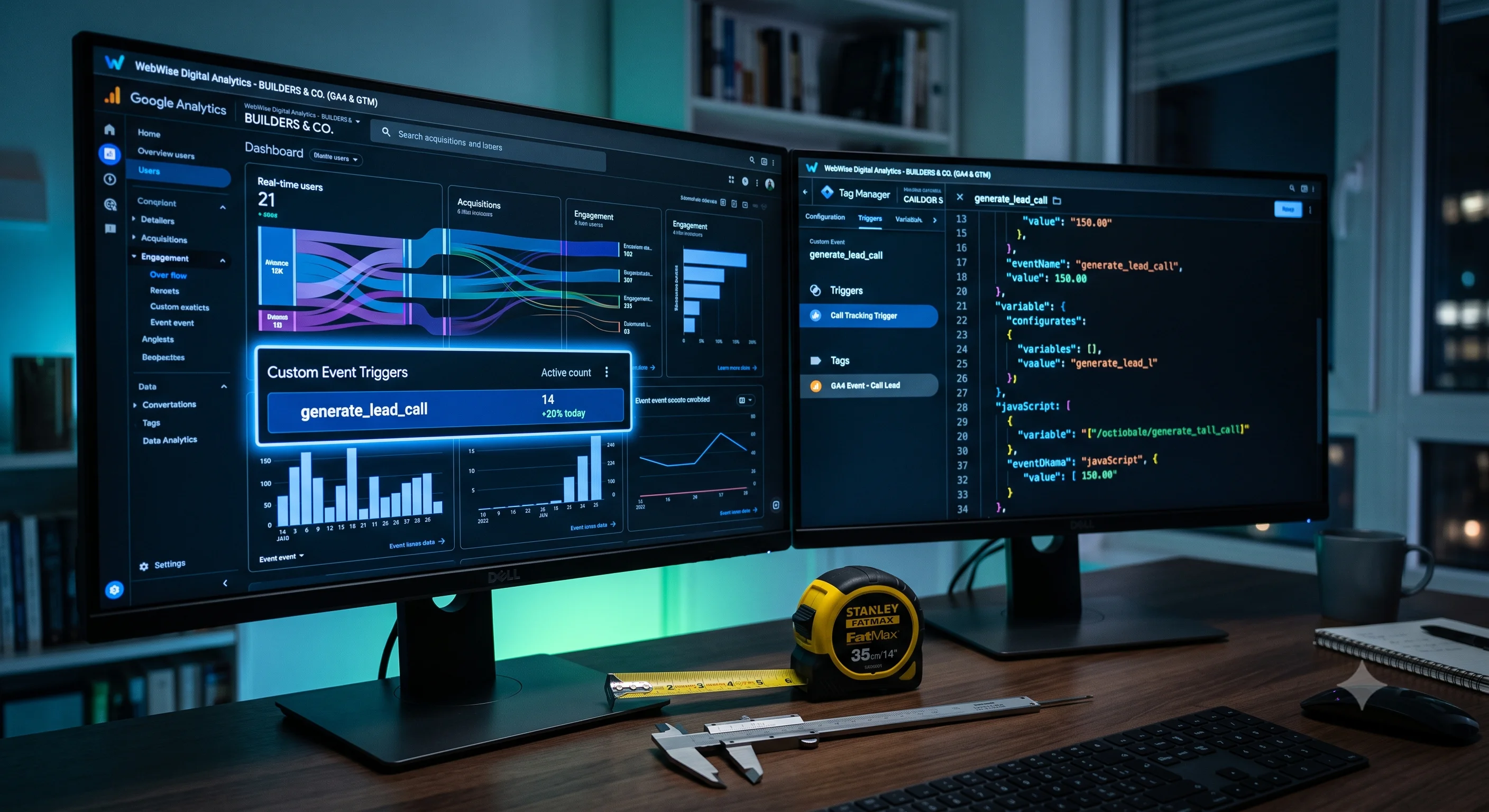
The 'tel:' Protocol Trigger: The highest converting action on a mobile-optimized trade site is a direct phone call. You must configure a GTM trigger that fires exclusively when a user clicks a link containing the "tel:" prefix. This event should be pushed to GA4 and explicitly marked as a primary conversion.
The 'mailto:' Protocol Trigger: While less urgent than a phone call, direct email clicks must be tracked. Configure a trigger for links containing the "mailto:" prefix to measure secondary lead volume.
Form Submission Listeners: Relying on basic "thank you" page redirects is outdated. You must utilize GTM's Form Submission trigger to track successful quote requests. For precise attribution, the trigger should capture the specific ID or CSS class of the form. This allows you to differentiate between a general contact form submission and an emergency callout request.
3. Parameter Mapping and Custom Dimensions
Knowing that a conversion happened is only half the battle; you must know the context of that conversion. GA4 allows you to send custom parameters alongside your events.
If a user submits a quote request, your event should not just register as "generate_lead." You must configure GTM to scrape specific variables from the page and pass them as custom dimensions.
Service Category Variable: Configure a JavaScript variable to capture the title of the page where the form was submitted. When the event fires, it sends data back to GA4 specifying exactly which service (e.g., "Commercial Brickwork" or "Emergency Roof Repair") generated the lead.
Click Text Variable: For telephone links, capture the exact text the user clicked. This helps identify whether a prominent header button or a subtle footer link is driving your call volume.
4. UTM Protocol for Local Search Attribution
Traffic from your organic search rankings and traffic from your Google Business Profile (GBP) map pack listing are technically both "organic," but they represent entirely different search intents and optimization strategies. If you do not separate them, your data is corrupted.
You must append strict UTM (Urchin Tracking Module) parameters to the primary website link within your Google Business Profile.
The link should be formatted precisely like this: [https://www.yourdomain.co.uk/?utm_source=google&utm_medium=organic&utm_campaign=gbp_listing](https://www.yourdomain.co.uk/?utm_source=google&utm_medium=organic&utm_campaign=gbp_listing)
By implementing this structure, GA4 will neatly separate users who found you via standard blue-link search results from those who clicked through your verified map pack entity. This allows you to calculate the exact lead volume generated by your local SEO proximity engineering.
5. Integrating with Customer Relationship Management (CRM)
The ultimate objective of advanced tracking is closed-loop reporting. Once your GA4 property is accurately recording custom events, this data must be pushed downstream into your CRM or lead management software.
By utilizing webhook integrations or the GA4 Measurement Protocol, you can tie the anonymous session data (how the user found your site) directly to the offline outcome (did they sign the contract?). This creates a unified dashboard where you can see precisely which digital assets and technical optimizations are driving your actual revenue.
Deploying a flawless tracking infrastructure requires deep technical integration. If your current analytics setup provides nothing more than basic traffic graphs, your data is incomplete. To build a robust, event-driven architecture that captures every commercial interaction, explore the integration solutions provided by our engineering team at webwise.digital.