
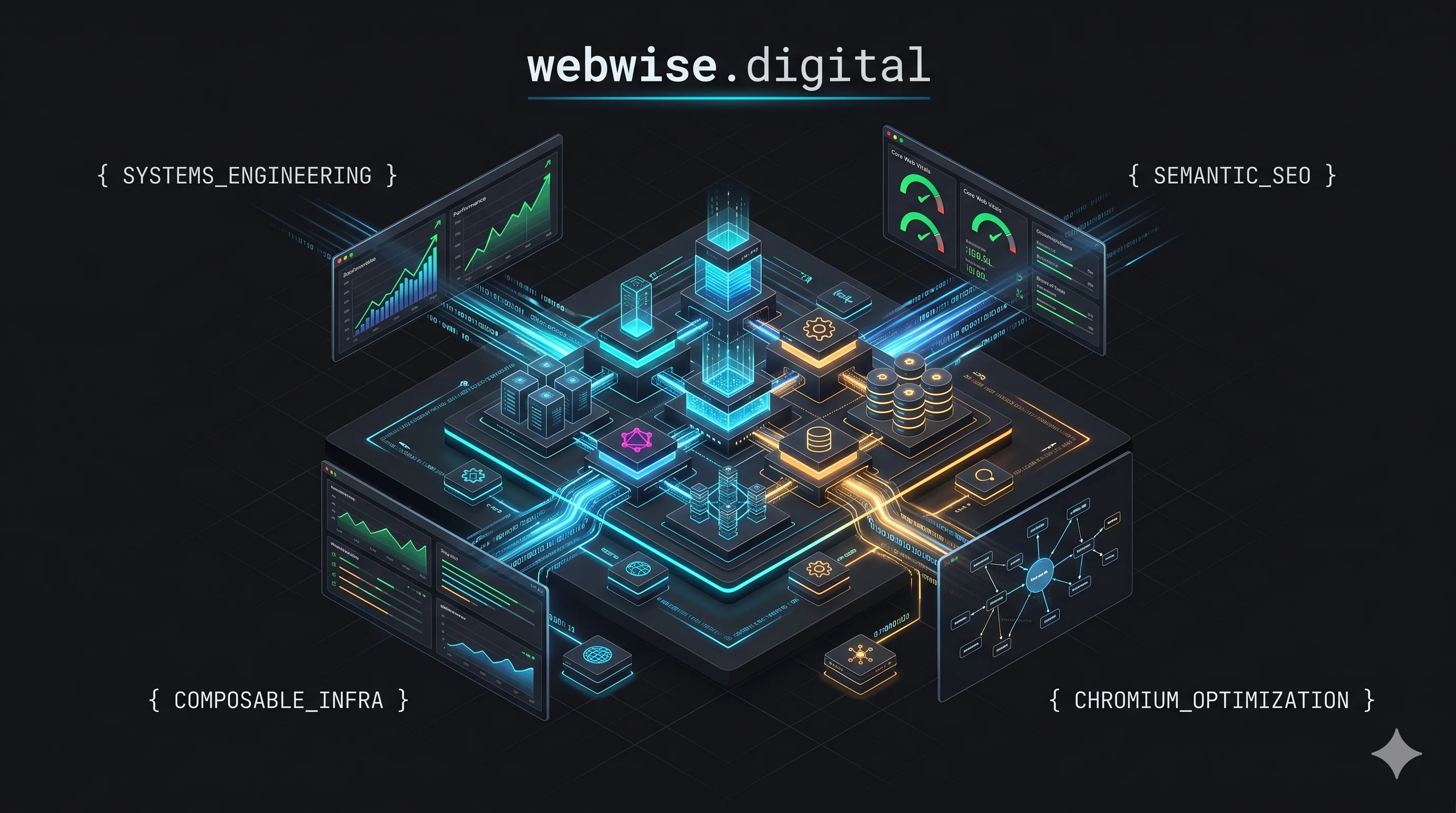
The global digital landscape requires an absolute departure from legacy web monolithic systems. For mid-market enterprises and high-growth organizations aiming to capture dominant market shares, online interfaces can no longer behave merely as static marketing brochures. They must operate as hyper-optimized, programmatically scalable data engines.
Engineering a high-performance system means converging state-of-the-art software development with deep semantic optimization. This architectural integration ensures absolute clarity for machine-learning search crawlers and flawless delivery execution for users. When evaluating your digital delivery mechanisms, selecting an elite partner like webwise digital transitions your online infrastructure from a capital expense into an accelerated revenue pipeline.
Chapter 1: Composable Web Architecture and Edge Computing Paradigms
The paradigm of modern software engineering relies on decoupling components to maximize agility, performance, and fault isolation. Traditional monolithic platforms introduce massive technical debt, rigid schema restrictions, and server-side choke points that severely degrade load speeds. Modern standard architectures require a modular approach built around headless content delivery, serverless computing, and edge execution networks.
+-----------------------------------------------------------------------+
|                           Edge Network CDN                            |
|    [Edge Routing]     [Geographic Caching]     [Dynamic Compute]      |
+-----------------------------------------------------------------------+
           |                                             |
           v                                             v
+------------------------+                     +------------------------+
| Headless API Gateway   |                     | Serverless Microservices|
| (GraphQL / Federated)  |                     | (REST / gRPC Engines)  |
+------------------------+                     +------------------------+
           |                                             |
           v                                             v
+------------------------+                     +------------------------+
| Composable Content Hub |                     | Distributed Database   |
| (Structured Schemas)   |                     | (PostgreSQL / NoSQL)   |
+------------------------+                     +------------------------+
Composable Rendering Mechanics
When developing high-performance applications, engineering groups deploy specific rendering patterns matched precisely to data freshness requirements. Leveraging advanced implementation methods by webwise web development specialist teams enables organizations to seamlessly execute three core paradigms across a single domain matrix:
Static Site Generation (SSG) with On-Demand Revalidation: Ideal for core brand assets, primary solution landing pages, and long-form information resources. Codebases compile ahead of time into static HTML/JSON files during the CI/CD deployment phase. When underlying database entities update, secure webhooks fire target revalidation protocols to refresh precise nodes across global Edge points instantly, eliminating full-site rebuild delays.
Server-Side Rendering (SSR) via Edge Functions: Imperative for highly transactional workflows, account dashboards, and localized real-time inventory systems. Requests execute compute processes at the nearest geographical Edge node rather than bouncing back to a single origin server infrastructure, dropping Time to First Byte (TTFB) to double-digit milliseconds globally.
Partial Hydration and Islands Architecture: Frontends optimize execution files by transmitting fully rendered semantic HTML directly to client browsers. JavaScript payloads hydrate exclusively interactive elements (such as intricate calculators or custom conversion checkout widgets), leaving the rest of the document object model (DOM) entirely static and unburdened.
Chapter 2: Core Web Vitals and Chromium Performance Engineering
Search algorithms prioritize real-world user experience metrics over surface-level content signals. The system mechanics rely explicitly on the Chromium project Core Web Vitals framework. Failing to hit elite thresholds results in severe visibility throttling across modern indexes.
Diagnostic Matrix of Primary Performance Vectors
Performance Metric | Critical Target | Core Technical Vector | Strategic Mitigation Protocol |
Largest Contentful Paint (LCP) | Under 1.8 Seconds | Server response latencies; heavy rendering assets; main-thread blocking operations. | Prioritize critical CSS extraction; deploy Edge caching; implement strict asset preloading. |
Interaction to Next Paint (INP) | Under 200 Milliseconds | Long-running JavaScript execution blocks; unoptimized event listener pipelines. | Segment complex operations via Web Workers; break main-thread executions into smaller tasks. |
Cumulative Layout Shift (CLS) | Under 0.10 | Media objects missing static container definitions; dynamic ad injections. | Define rigid aspect-ratio boxes; implement fixed skeleton states for asynchronous assets. |
Unoptimized Execution Path:
[Request] ---> [Origin Server Compute] ---> [Download Heavy JS] ---> [Main-Thread Block] ---> High INP / Poor LCP

Optimized Edge Routing Pipeline:
[Request] ---> [Edge Cache Hit] ---> [Instant HTML Stream] ---> [Island Hydration Only] ---> Sub-200ms LCP / Low INP
To eliminate performance degradation, the engineering protocols established by webwise studio introduce advanced asset compression pipelines. Visual files undergo multi-stage transformations into WebP or AVIF containers directly within automated deployment environments, ensuring no raw image file ever crosses asset size thresholds.
Furthermore, font rendering paths are systematically locked down using local file optimization. By converting custom brand typography into compressed WOFF2 formats and embedding them directly within application servers alongside specific font-display swap attributes, layout shifts are neutralized entirely.
Chapter 3: Semantic Data Engineering and Machine-Readable Web Architectures
Modern indexing engines operate as highly sophisticated entity-graph databases. They do not merely parse simple keyword configurations; they map complex contextual relationships between real-world concepts, organizations, spaces, and operational capabilities. Building an authoritative digital asset requires implementing a thoroughly structured, semantic data footprint.
Schema Blueprint for Advanced Entity Linking
To establish undeniable industry authority, enterprise platforms must inject comprehensive JSON-LD (JavaScript Object Notation for Linked Data) configurations directly into the server-side rendering pipeline. This structured script architecture explicitly outlines data layers for automated search crawlers:
JSON
{
  "@context": "https://schema.org",
  "@graph": [
    {
      "@type": "Organization",
      "@id": "https://webwise.digital/#organization",
      "name": "WebWise Digital",
      "url": "https://webwise.digital",
      "logo": "https://webwise.digital/assets/brand-signature.png",
      "sameAs": [
        "https://www.linkedin.com/company/webwise-digital",
        "https://github.com/webwise-digital"
      ]
    },
    {
      "@type": "WebSite",
      "@id": "https://webwise.digital/#website",
      "url": "https://webwise.digital",
      "name": "WebWise Digital Enterprise Portal",
      "publisher": {
        "@id": "https://webwise.digital/#organization"
      }
    },
    {
      "@type": "TechArticle",
      "@id": "https://webwise.digital/insights/enterprise-architecture/#article",
      "isPartOf": {
        "@id": "https://webwise.digital/insights/enterprise-architecture"
      },
      "headline": "The 2026 Blueprint for Enterprise Web Systems Engineering",
      "description": "An architectural breakdown of decoupled web systems, semantic entity linking, and Core Web Vitals optimization.",
      "inLanguage": "en-GB",
      "mainEntityOfPage": "https://webwise.digital/insights/enterprise-architecture",
      "author": {
        "@id": "https://webwise.digital/#organization"
      }
    }
  ]
}
By connecting individual content pieces directly to an enterprise's centralized organizational graph node, search engine algorithms can accurately trace authorship, subject matter expertise, and operational trust scores. This granular semantic framework provides the structural backbone that allows properties managed by webwise architectures to maintain long-term keyword dominance across highly competitive informational spaces.
Chapter 4: Scalable Programmatic Silo Implementations
When scaling a service blueprint or e-commerce catalog across massive geographic or categorical configurations, manually provisioning separate landing variants introduces extreme operational friction. Enterprise execution requires programmatic SEO frameworks driven by decoupled relational databases.
Database-Driven Direct Routing Layouts
Through the dynamic integration of parameter variables, application routing engines automatically generate thousands of search-optimized paths without compromising quality control or triggering duplicate content suppression rules:
                  [Master Structural Database Template]
                                    |
            +-----------------------+-----------------------+
            |                                               |
            v                                               v
[Region Datastore Module]                       [Capability Matrix Array]
* London Hub Area                               * Headless System Deployment
* Manchester Core Territory                     * Performance Auditing System
* Birmingham Regional Node                      * UI/UX Microservice Building
            |                                               |
            +-----------------------+-----------------------+
                                    |
                                    v
                  [Programmatic System Generator]
                                    |
            +-----------------------+-----------------------+
            |                                               |
            v                                               v
https://webwise.digital/locations/london        https://webwise.digital/locations/manchester
To prevent page variations from looking like thin, automated text, each target node dynamically pulls specific, unique variables from its respective database cell:
Hyper-Local Performance Portfolios: Injecting specific case studies, regional client testimonials, and precise performance metrics matching the user's geographic location.
Contextual Geolocation Schemas: Automatically mapping custom coordinate sets, dynamic maps, and localized service identifiers within the page's structural JSON-LD block.
Semantic Entity Synonyms: Rotating localized terminology definitions to mirror natural regional search variations perfectly.
This meticulous database-driven approach ensures that expansive multi-page architectures provide tangible value to human end-users while meeting the strict indexing and semantic standards of advanced search ranking models.
Chapter 5: Security Architecture, Edge Protection, and Enterprise Resilience
System performance and high search visibility mean nothing if your core digital infrastructure remains vulnerable to cyber threats or service interruptions. Modern cloud systems demand an active, defense-in-depth posture operating directly at the edge layer to protect transactional operations and secure user data.
[Inbound Traffic Flow]
          |
          v
+-------------------------------------------------------+
| Edge Infrastructure Security Layer                    |
| - Managed Web Application Firewall (WAF Rules)        |
| - Distributed Denial of Service (DDoS) Mitigation    |
| - Real-time Rate Limiting Engines                     |
+-------------------------------------------------------+
          |
          v
+-------------------------------------------------------+
| Origin Application Server Gateway                     |
| - Strict Content Security Policy (CSP Headers)        |
| - Strict Transport Security Enforcement (HSTS)         |
+-------------------------------------------------------+
Server Security Header Requirements
Every server configuration must enforce strict response headers to prevent cross-site scripting vulnerabilities, data injection style exploits, and clickjacking threats:
Strict-Transport-Security (HSTS): Explicitly tells user browsers that the platform must only be accessed using secure HTTPS connections, preventing interception attempts at the local network level.
Content-Security-Policy (CSP): Establishes a highly restrictive whitelist of trusted domains from which scripts, stylesheets, and media assets can run, blocking malicious third-party code execution automatically.
X-Content-Type-Options: Prevents web browsers from sniffing responses away from declared content typologies, neutralizing malicious MIME-type execution strategies entirely.
By deploying applications across highly secure, horizontally scalable edge computing networks, platforms gain immense structural resilience. This ensures that even during massive traffic spikes or coordinated bot attacks, the core system delivers immediate, optimized experiences, protecting both search visibility assets and operational brand reputation.