One of the most common promises in UK web design marketing is also one of the most dangerously ambiguous. Here is what it should actually mean.
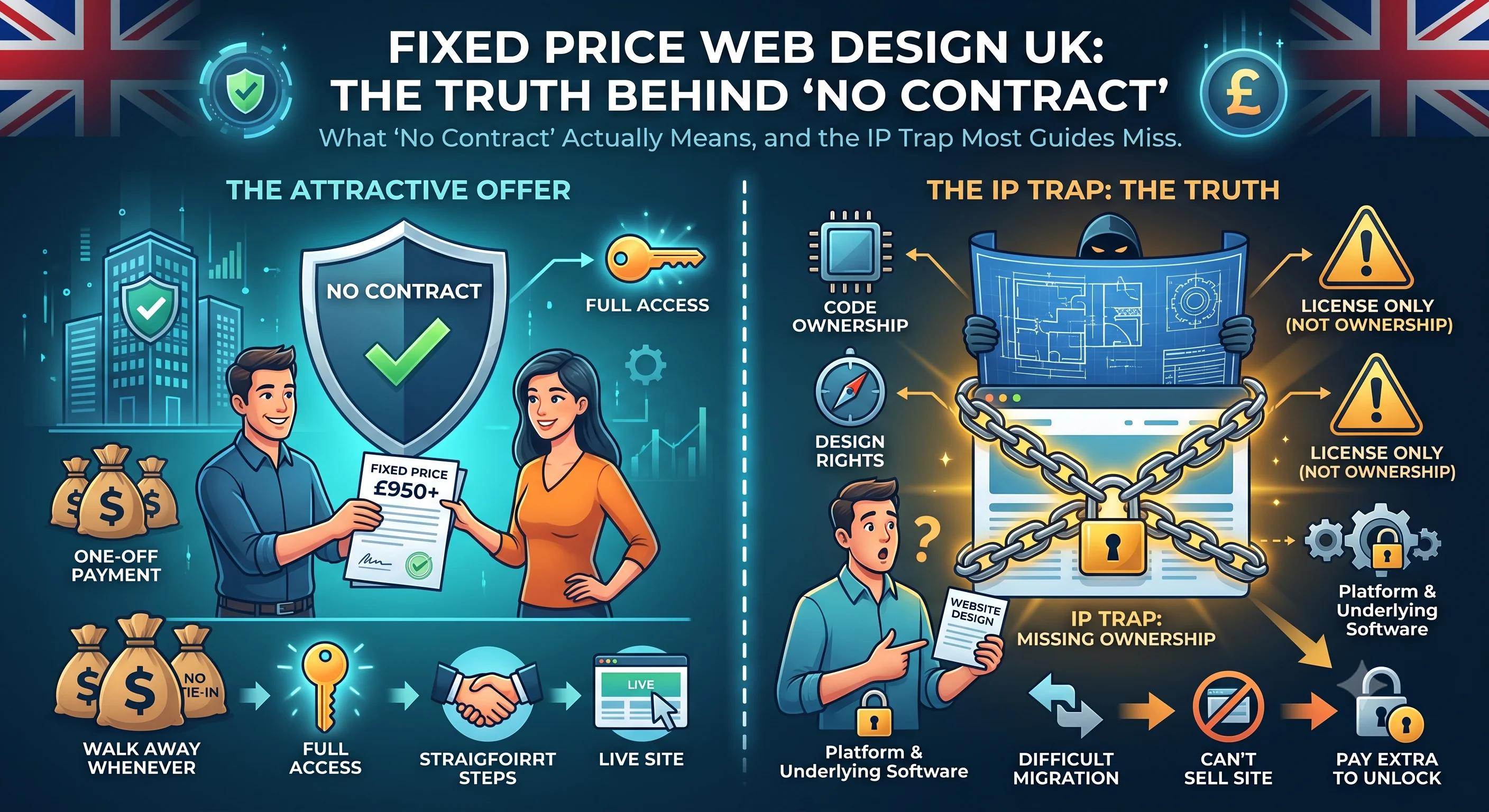
"Fixed price" and "no contract" appear on the homepage of a huge number of UK web design providers, and for good reason - they answer the two anxieties every small business owner has before commissioning a website: will the final bill match the quote, and am I locking myself into something I cannot get out of? Both are genuinely important questions. But "no contract" specifically is a phrase that can mean two completely different things, and getting them confused can leave a business owner with a website they do not legally own.
Designer keeps copyright by default - under UK law, unless a written agreement explicitly says otherwise - the single most misunderstood fact in this entire market
£500 to £35,000+ - the genuine 2026 UK market range for a business website - and fixed-price milestone payment structures, not hourly billing, are what current expert guidance recommends to protect both parties
1. The Two Meanings of "No Contract" - and Why Confusing Them Is Risky
When a web design provider advertises "no contract," they almost always mean one specific thing: no ongoing obligation to keep paying a monthly fee indefinitely, and no penalty for cancelling optional add-on services like hosting or maintenance. This is a genuinely good thing, and it is the meaning covered throughout our own website cost per month guide.
WATCH: The meaning that should worry you
Some providers, and some business owners searching for "no contract web design," interpret the phrase literally - no written agreement of any kind, just a verbal understanding and an invoice. This is where the risk sits. A build with no written agreement at all is not a safer, more flexible arrangement. It is a project with no documented scope, no documented ownership terms, and - critically - no explicit assignment of intellectual property.
2. The UK Copyright Default Almost Nobody Explains
UK LAW: What UK law actually says if nothing is written down
Under UK copyright law, the creator of a work - in this context, the web designer or developer - is the default owner of the copyright in that work, unless a written agreement explicitly assigns or licenses those rights to the client. This applies to bespoke code, custom design elements, and original written content produced during a build. It does not automatically transfer to you simply because you paid the invoice. If there is no written scope document or contract stating that ownership passes to you on completion or on final payment, the default legal position is that your designer or developer retains it.
This is precisely why "no contract" should never mean "no paperwork at all." A short, clear, one-time scope document - not a rolling, lock-in service agreement, but a simple written record of what is being built, what it costs, and who owns what at the end - is not the opposite of a fixed-price, flexible arrangement. It is the thing that makes a fixed-price, flexible arrangement genuinely safe.
3. What "Fixed Price" Should Actually Protect You From
Current UK web design market data confirms a genuine, well-documented problem: getting three quotes for what sounds like the same project and receiving back wildly different numbers - commonly cited examples include £900, £4,500, and £11,000 for ostensibly comparable small business websites. The reason is rarely dishonesty. It is usually undefined scope: hourly billing against a vague brief, where "extra" requirements discovered mid-project become additional invoices.
INSIGHT: Why milestone-based fixed pricing is the expert-recommended structure
Current UK industry guidance consistently recommends fixed-price projects with milestone payments over open-ended hourly billing specifically because this structure protects both parties: the client knows the total cost before work begins, and the provider is protected from scope creep by having the boundaries of the work defined in writing from the outset. This is not a compromise between fixed price and having a proper agreement - the two are meant to go together.
4. The Real UK Market Range, and Where the Money Actually Goes
Current UK market data across multiple 2026 sources converges on a consistent picture: DIY builders run roughly £100-£360 a year in ongoing platform fees, but with the significant hidden cost of the owner's own time - commonly estimated at 20-40 hours to build something professional-looking, and even then, a widely cited figure suggests 68% of UK small businesses using DIY builders report needing a full rebuild within three years, at an average rebuild cost of £3,000-£7,500. A properly built small business site with genuine design and technical foundation, from a specialist rather than a large agency, typically runs £1,500-£6,000 as a one-time fixed cost, in line with the full pricing breakdown in our website cost guide.
Route | Typical build cost | The ownership question to ask |
DIY builder subscription | £100-£360/year ongoing | You never own the underlying code or design regardless of how long you pay |
No written agreement, verbal quote only | Varies wildly, often unpredictable | Ownership defaults to the builder under UK law unless stated otherwise in writing |
Fixed price with a short written scope document | One-time fee, clearly stated upfront | Ownership should be explicitly assigned to you in writing on completion |
5. The Five Questions That Separate a Genuine Fixed-Price Offer from a Risky One
Is the total price written down before any work begins, or only an hourly rate with an "estimate"? A genuine fixed-price offer states the total, not just the rate.
Is there a written scope document, however short, describing what is actually being built? This is the document that protects you from scope creep in either direction.
Does that document explicitly state that you own the code, the domain, and the content on completion? If this is not written down, UK copyright default means it does not automatically transfer to you.
If there is an optional ongoing fee (hosting, maintenance), is it genuinely separable from ownership of the site itself? A properly structured offer means cancelling the monthly fee costs you support, not ownership - covered in full in our monthly cost comparison guide.
Can you get a straight answer to "what happens if I stop paying" before you sign anything? Covered in the full agency evaluation framework in our agency questions guide.
6. The WebWise Model, Explained Plainly
WebWise builds are priced as a genuine one-time fixed fee, covered in full in our website cost guide and our build process guide, starting at £950 for a five-page site. Before any work begins, a written scope covers exactly what is included and the total price. On completion, ownership of the domain, the code, and the content passes to you explicitly and in writing - not left to the UK copyright default. The optional care retainer at £49 a month covers ongoing hosting and support, and is genuinely separable: cancelling it does not affect your ownership of the site itself.
The starting point is a 15-minute call at webwise.digital/contact.
Conclusion: "No Contract" Should Mean No Lock-In, Never No Agreement
The phrase "no contract" in UK web design marketing is genuinely appealing, and the underlying promise - no ongoing obligation, no lock-in, cancel anytime - is a real and valuable thing to offer. But it should never be confused with, or marketed as, the absence of any written agreement at all. A short, clear, one-time scope document that fixes the price and explicitly assigns you ownership on completion is not the opposite of flexibility. It is what makes flexibility safe, because without it, UK copyright law defaults to the person who built the site, not the person who paid for it.
Further reading: our agency questions guide for the complete buyer's checklist, and our agency comparison article for how fixed-fee, ownership-first pricing compares against the wider UK market.