
There is a fundamental misunderstanding in the modern business world regarding what a website is actually supposed to do. For the vast majority of business owners, a website is viewed as a digital business card, a static brochure that exists simply because having one is a societal expectation. You hire a designer, they put your logo at the top, list your services in the middle, slap a generic contact form at the bottom, and you call it a day.
Then, you wait. And wait. And the phone never rings.
This passive approach is the exact reason why millions of businesses are entirely invisible online. In the current digital landscape, and especially following Google's recent algorithmic shifts prioritizing absolute user utility and Experience, Expertise, Authoritativeness, and Trustworthiness (E-E-A-T), a static brochure is a liability. Your website must be engineered as a 24/7 autonomous sales representative.
If you find yourself constantly wondering how to get a website that brings in more customers, the answer requires a complete paradigm shift. You must stop thinking about aesthetics and start thinking about behavioral psychology, technical architecture, and search intent.
Here is the definitive, step-by-step guide to transforming a digital ghost town into a high-performance client acquisition asset that aligns perfectly with modern search engine requirements.
Step 1: Aligning with the Utility-First Search Algorithm
Search engines have evolved far beyond matching keywords on a page. Today, Google's core updates heavily penalize sites that exist solely for SEO purposes and reward sites that genuinely solve a user's problem.
When a prospective customer searches for your service, they are in a state of friction. They have a problem they need solved, whether it is a leaking roof, a need for corporate accounting, or a desire for landscaping. The algorithm measures how effectively your website resolves that friction.
If a user clicks your link, scans the page, fails to find the immediate answer, and hits the "back" button to return to the search results, you have signaled to the algorithm that your site is useless. This is known as "pogo-sticking," and it will tank your rankings faster than any technical error.
To bring in customers, your content must be brutally direct. Answer the specific questions your clients ask during their initial consultation. Address pricing openly. Explain your specific methodology. Publish comprehensive, long-form service pages that leave no ambiguity about what you do, who you serve, and how you solve their exact problem.
Step 2: Demonstrating Undeniable E-E-A-T
Anyone can spin up a website and claim to be an expert. Search engines and human consumers know this, which is why trust signals are the highest currency in digital marketing today.
To convert traffic into paying customers, your website must bleed authority. You must prove your Experience, Expertise, Authoritativeness, and Trustworthiness on every single page.
How do you engineer this?
Ban Stock Photography: Nothing destroys trust faster than a generic photo of models in hardhats or suits shaking hands. Use high-resolution, original photos of your actual team, your actual office, and your actual job sites.
Publish Verifiable Case Studies: Do not just list a portfolio. Write detailed case studies that outline the client's initial problem, the specific technical solution you deployed, and the measurable outcome.
Aggregate Third-Party Validation: Pull raw, verified reviews from Google, Trustpilot, or industry-specific directories directly into your pages.
Display Accreditations: If you are licensed, bonded, or part of a recognized trade association, those trust badges must be prominently displayed above the fold.
Step 3: Architecting a Frictionless User Experience (UX)
You can have the most informative content in the world, but if your site navigation is a labyrinth, potential customers will abandon it. A website that brings in customers is structurally engineered for simplicity.
Your navigation menu should not be a dumping ground for every page on your site. It should be a curated funnel.
The Homepage acts as the ultimate routing mechanism, instantly telling the user exactly what you do and directing them to their specific service need.
Service Pages act as deep-dive educational hubs, answering all technical and logistical questions.
The About Page builds the local and human connection, proving you are a legitimate entity.
The Contact Portal removes all barriers to entry.
Furthermore, this experience must be flawless on mobile devices. Over half of all commercial search traffic occurs on mobile. If your text is too small to read, if your buttons are too close together to accurately tap, or if your images load off-screen, you will lose the customer instantly. Mobile-first design is not a buzzword; it is a strict commercial requirement.
Step 4: The Technical Baseline (Speed and Security)
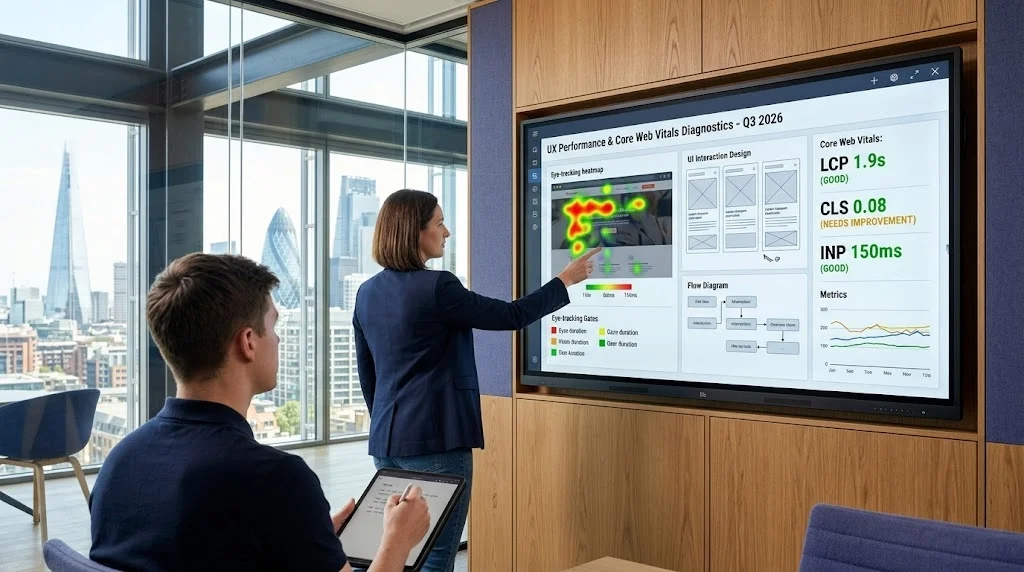
Search engines will not recommend a slow, insecure website to their users. It is that simple. Passing Google's Core Web Vitals assessment is the absolute baseline for playing the game.
To capture customers, your technical infrastructure must be pristine.
Largest Contentful Paint (LCP): The main content of your page must load in under 2.5 seconds. This requires aggressive image compression, edge caching, and a premium hosting environment.
Cumulative Layout Shift (CLS): Your website cannot jump around as it loads. If a customer goes to click a button and the page shifts, causing them to click an advertisement or the wrong link, the frustration leads to immediate abandonment.
Strict HTTPS: Security is non-negotiable. If a browser flags your site as "Not Secure," the vast majority of consumers will instantly leave.
Step 5: Implementing Autonomous Lead Capture
The final, and most critical, phase of getting a website to bring in more customers is fixing your lead capture mechanism.
As we have engineered time and time again at WebWise, standard contact forms are conversion killers. They require too much cognitive effort from the user and offer zero immediate gratification.
To maximize client acquisition, you must replace the static contact page with an interactive quote funnel or scheduling matrix. Ask the user qualifying questions about their project (timeline, scale, specific needs) using conditional logic. Once they have invested the effort to answer three or four simple multiple-choice questions, they are vastly more likely to provide their contact information.
Connect this front-end capture mechanism directly to your CRM via server-side webhooks. When a prospect submits their information, they should instantly receive an automated confirmation email outlining the next steps, while your sales team receives a push notification to call them back within five minutes.
A website that brings in more customers is not a piece of art; it is a precisely calibrated machine. By aligning with search engine utility guidelines, establishing undeniable trust, optimizing technical performance, and engineering frictionless lead capture, you stop hoping for traffic and start systematically acquiring market share.