
Written by the delivery team at WebWise — a uk web design agency specialising in tradesman websites UK for over a decade. We have quoted, built, and launched hundreds of trade websites across London, Birmingham, Manchester, and Glasgow. The numbers in this guide come from our actual 2025–2026 project data, not industry averages pulled from thin air.
1. Why Pricing Transparency Matters for Tradesmen
Here is a dirty secret about the web design industry: most agencies hide their pricing. They want you on a call first. They want to "understand your needs" before they mention a number. And by the time you hear the figure, you are already halfway sold.
We think that is nonsense. If you are a plumber in Croydon or a builder in Bromley, you should know roughly what a professional website costs before you ever pick up the phone. You would not call an electrician and ask them to visit before giving you a ballpark figure for a rewire. The same standard should apply to contractor web design.
The problem is that trade website pricing in the UK is all over the map. You have everything from £10-a-month Wix templates to £15,000 bespoke builds from top web design agency outfits in Mayfair. And somewhere in that enormous range is the right price for your business — the price that gets you a site that ranks, converts, and pays for itself within months.
This guide exists because we are tired of seeing tradesmen get ripped off. We are tired of seeing them pay £3,000 for a WordPress template that loads in six seconds and generates zero leads. And we are tired of seeing them quoted £8,000 for features they do not need by agencies who have never spoken to a tradesman in their lives.
So here it is. The full, unvarnished truth about what a trade website costs in the UK in 2026.
2. What Type of Website Do You Actually Need?
Before we talk numbers, we need to talk about what you are actually buying. Not all trade websites are the same, and the type of site you need determines roughly 70% of the cost.
The Brochure Site
This is the digital equivalent of a business card. Five to ten pages: Home, Services, About, Areas, Contact, maybe a Gallery. It tells people who you are, what you do, and how to reach you. It does not take bookings, it does not generate quotes automatically, and it does not integrate with your CRM.
Who needs this: Sole traders and small firms who are just starting out or who get most of their work through word-of-mouth and want a professional presence to validate their business.
Typical cost: £950 – £2,500
The Lead Generation Site
This is where most tradesmen should be. A lead generation web design focused site with click-to-call on every page, quote request forms, live Google reviews, service area pages, and basic SEO baked in from day one. It is built to do one thing: turn visitors into phone calls.
Who needs this: Established tradesmen who want their website to actively bring in new business, not just sit there looking pretty.
Typical cost: £2,500 – £5,500
The Conversion Machine
This is the next level. An automated quote funnel for field services, integrated booking calendars, WhatsApp chat, AI-powered lead qualification, and advanced local SEO. The site does not just capture leads — it pre-qualifies them, books them into your calendar, and sends automated follow-ups.
Who needs this: Growing trade businesses with multiple vans, staff, and a serious appetite for scaling. Also ideal for firms offering recurring maintenance contracts.
Typical cost: £5,500 – £12,000+
The E-Commerce Hybrid
Some tradesmen sell products alongside services — boilers, radiators, security systems, tools. These sites need product pages, payment processing, stock management, and shipping integration. This is where ecommerce web development agency capabilities become relevant, though most pure tradesmen do not need this complexity.
Who needs this: Trade suppliers, merchants, or service firms with a significant product arm.
Typical cost: £8,000 – £25,000+
3. The Complete Cost Breakdown: 2026 UK Pricing
Let us get specific. Here is what you are actually paying for when you hire web development agency professionals to build your trade website.
Design & Brand Direction (£400 – £1,500)
This is not just "making it look nice." Good B2B web design UK for trades starts with understanding your brand, your customers, and your competition. It includes:
Brand moodboard and colour palette
Typography system
Mobile-first wireframes
High-fidelity mockups of key pages
At WebWise, we always present two distinct creative routes before writing a single line of code. One might be heritage and trustworthy; the other might be modern and bold. You pick the direction, and we codify it into the build.
Development & Build (£600 – £4,000)
This is where the site actually gets built. The cost depends on:
Platform: A custom build on Next.js/Vercel costs more than a WordPress template but performs significantly better.
Pages: More pages = more cost. But also more opportunities to rank.
Functionality: Click-to-call, quote forms, live review feeds, booking integrations — each feature adds development time.
CMS: Do you need to update content yourself? A proper content management system adds complexity but saves you money long-term.
Content & Copywriting (£200 – £800)
Most tradesmen underestimate this. Your website needs words — and not just any words. It needs words that rank on Google and convince a stressed homeowner to pick up the phone. Professional copywriting for a five-page trade site typically runs £200–£400. For a ten-page site with area pages and service descriptions, budget £600–£800.
Photography & Visual Assets (£0 – £1,000)
Stock photos of tradesmen with clipboards are the fastest way to look generic. Real photos of your van, your team, and your work build trust instantly. If you have a decent phone and good lighting, you can shoot these yourself. If you want a professional photographer for a half-day shoot, budget £400–£800.
On-Page SEO & Technical Setup (£300 – £1,200)
This includes:
Keyword research and mapping
Title tags and meta descriptions
Header structure and internal linking
Schema markup (LocalBusiness, Service, Review, FAQ)
XML sitemap and robots.txt
Google Search Console and Analytics setup
Core Web Vitals optimisation
Skip this, and you have a beautiful website that nobody ever finds. This is why trades marketing UK must include technical SEO from day one, not as an afterthought.
Domain, Hosting & SSL (£50 – £300/year)
Your domain name (£10–£20/year). Your hosting (£100–£300/year for quality UK-based hosting). SSL certificate (usually included with good hosting). Do not skimp on hosting — a slow site kills rankings and conversions.
4. Monthly Costs vs. One-Time Build Costs
This is where many tradesmen get caught out. They budget for the build but forget about the ongoing costs. Here is the reality of website cost per month for a trade business.
Essential Monthly Costs
Table
Item | Cost/Month | Why You Need It |
|---|---|---|
Hosting | £15 – £80 | Fast, reliable, UK-based hosting. Non-negotiable. |
Maintenance & Updates | £0 – £150 | Security patches, plugin updates, backups. |
SEO & Content | £300 – £800 | Ongoing optimisation, new content, link building. |
Paid Ads (optional) | £200 – £1,000+ | Google Local Service Ads, PPC for competitive terms. |
The Care Retainer Model
At WebWise, most of our trade clients are on a care retainer. For a fixed monthly fee, we handle hosting, maintenance, monthly content updates, SEO monitoring, and technical support. It is predictable, it compounds over time, and it means your site never goes stale.
Typical care retainer: £150 – £400/month depending on the site size and SEO activity level.
5. What Drives the Price Up or Down?
Not every quote is created equal. Here is what separates a £1,000 site from a £10,000 site.
Factors That Increase Cost
Custom design vs. template: A bespoke design built from scratch costs 3–5x more than a customised template. It also converts 2–3x better.
Number of pages: Each service page, area page, and case study page requires design, development, content, and SEO.
Advanced functionality: Booking systems, quote calculators, CRM integrations, membership areas.
E-commerce: Product pages, payment gateways, stock management — all complex.
Content creation: Professional photography, video, copywriting.
SEO depth: Basic on-page SEO is standard. A full SEO strategy for roofing companies UK or other trade sectors with ongoing content creation is an additional investment.
Factors That Decrease Cost
Using a template: Faster, cheaper, but you will look like everyone else.
Providing your own content: If you write the copy and supply the photos, you save £500–£1,000.
Fewer pages: A tight, focused five-page site costs less than a sprawling twenty-page site.
Simpler functionality: Click-to-call and a contact form are cheaper than a full booking system.
6. DIY Builders vs. Hiring a Professional
Should you build your own site on Wix, Squarespace, or GoDaddy? Or should you hire web development agency professionals?
The DIY Route
Pros: Cheap (£10–£30/month), fast (hours not weeks), no technical knowledge needed.
Cons:
You look like everyone else using the same template
Slow loading speeds (bad for SEO)
Limited customisation
You own nothing — if Wix changes their pricing or shuts down a feature, you are stuck
Mobile optimisation is often an afterthought
No proper schema markup or technical SEO
Verdict: Fine for a brand-new sole trader who needs something live this afternoon. A dead end for anyone serious about growth.
The Professional Route
Pros:
Unique design that reflects your brand
Built mobile-first with trade customers in mind
Fast loading (Lighthouse 95+)
Proper SEO from the sitemap up
You own the code and the domain
Scales with your business
Cons: Higher upfront cost, longer timeline (typically 2–4 weeks).
Verdict: If your website is going to be a primary source of leads, professional contractor web design is not an expense — it is an investment.
7. The Hidden Costs Nobody Talks About
Beyond the obvious build and hosting costs, here are the expenses that catch tradesmen off guard.
The "Cheap" Website That Needs Rebuilding
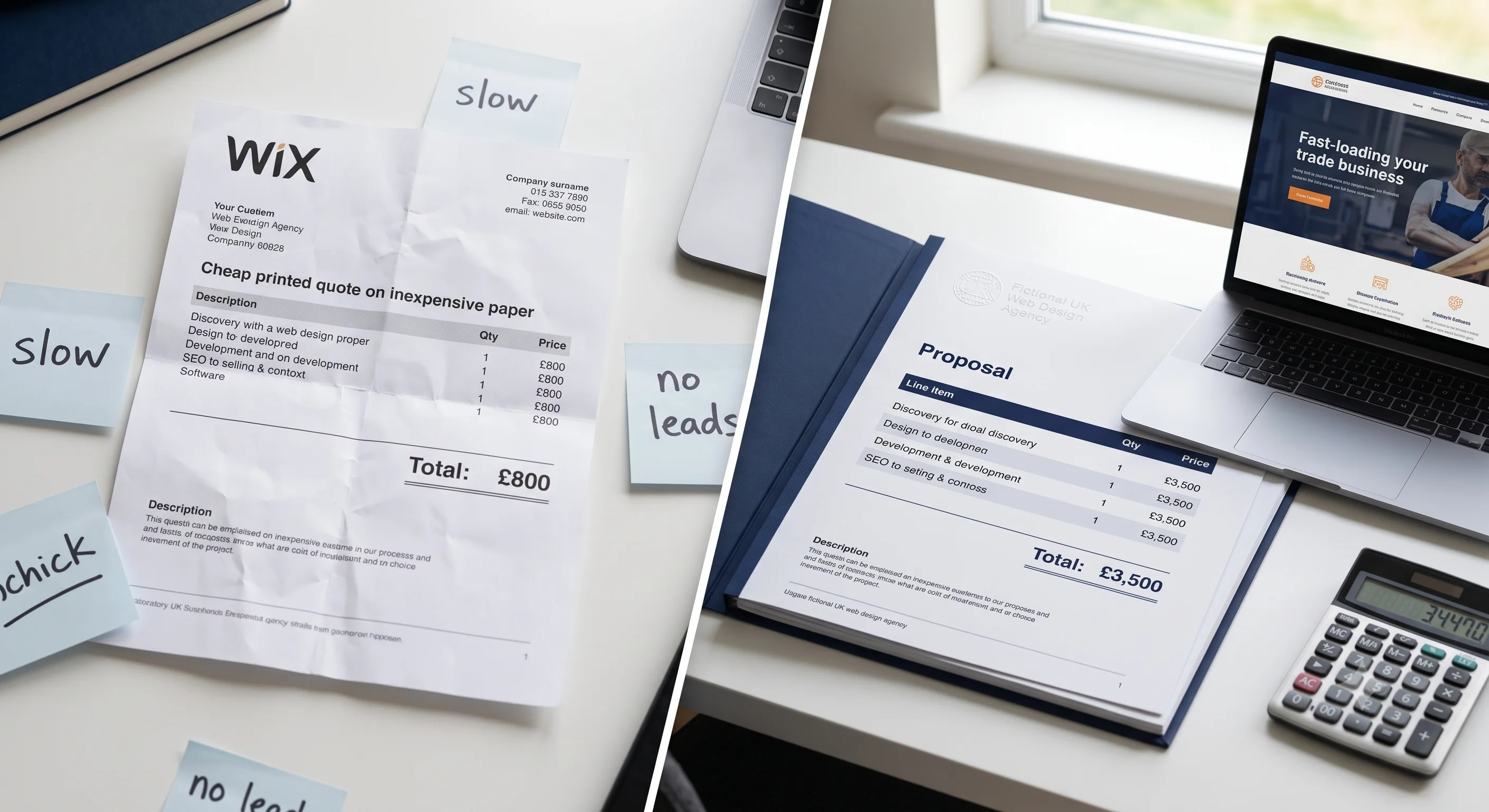
We see this constantly. A tradesman pays £800 for a site on Fiverr or from a mate's cousin. Six months later, it is not ranking, the mobile layout is broken, and the contact form does not work. They end up paying twice: once for the cheap site, and again for the proper rebuild.
Plugin Subscription Creep
WordPress sites often rely on premium plugins: form builders, SEO tools, security scanners, backup systems. Each one is £30–£100/year. A site with five premium plugins can easily cost £300/year in subscriptions alone.
Stock Photo Licences
That "free" stock photo site? Often requires a licence for commercial use. Proper stock photography subscriptions (Shutterstock, Adobe Stock) run £25–£50/month.
Google Business Profile Management
While GBP itself is free, optimising it properly — adding posts, responding to reviews, uploading photos, monitoring insights — takes time. If you value your time at £50/hour and spend three hours a month on it, that is £150/month in opportunity cost.
Content Refresh
Google rewards fresh content. A blog post from 2022 about boiler regulations is not helping you in 2026. Budget for quarterly content updates or accept that your rankings will slowly decline.
8. What Should Your Budget Be? Real Numbers
Let us cut through the noise. Here is what we recommend tradesmen budget in 2026, based on where they are in their business journey.
Just Starting Out (Sole Trader, 0–2 Years)
Budget: £1,500 – £2,500 build + £50 – £150/month ongoing
What you get: A clean, professional 5–7 page site with click-to-call, basic SEO, and mobile optimisation. Built on a solid platform that can grow with you.
Timeline: 1–2 weeks
Established & Growing (2–5 Years, 1–3 Vans)
Budget: £2,500 – £5,000 build + £150 – £300/month ongoing
What you get: A lead-generation focused site with 8–12 pages, area pages, service breakdowns, live reviews, schema markup, and proper local SEO. This is where tradesman websites UK start to become genuine business assets.
Timeline: 2–3 weeks
Scaling (5+ Years, Multiple Staff, Serious Growth Ambitions)
Budget: £5,000 – £10,000 build + £300 – £600/month ongoing
What you get: A conversion-optimised site with advanced functionality — quote funnels, booking integration, CRM connectivity, automated follow-ups, and a comprehensive ongoing SEO and content strategy.
Timeline: 3–6 weeks
9. ROI: When Does Your Website Pay for Itself?
A website is not a cost centre. It is a sales channel. And like any sales channel, it should be measured by return on investment.
The Maths
Let us say you are a plumber with an average job value of £350. Your new website costs £2,500 to build and £200/month to maintain. Total first-year cost: £4,900.
If that website brings you just one extra job per week — 52 jobs a year — that is £18,200 in revenue. Even at a 40% margin, that is £7,280 profit. Your website paid for itself in under eight months.
In reality, a well-built, well-optimised trade website should bring in 3–5 additional qualified leads per week. At a 50% conversion rate, that is 1.5–2.5 extra jobs per week. Over a year, that is 78–130 additional jobs.
Revenue impact: £27,300 – £45,500 per year.
That is not fantasy. That is what happens when you treat your website as a sales tool, not a brochure.
The Compounding Effect
Unlike paid advertising, which stops working the moment you stop paying, SEO and content compound. A blog post you publish today can still be bringing in traffic three years from now. A well-optimised area page can rank for dozens of related searches. The longer your site is live and optimised, the more valuable it becomes.
10. How to Choose the Right Web Partner
Not every b2b web design agency understands trades. In fact, most do not. Here is how to separate the specialists from the generalists.
Do They Understand Trade Customers?
Ask them: "What percentage of your clients are tradesmen?" If the answer is less than 30%, they are a generalist. They might build you a beautiful site, but they will not understand that your customer is standing in a flooded kitchen, thumb-scrolling on a cracked iPhone, looking for a phone number they can tap.
A specialist in tradesman websites UK knows that:
80%+ of traffic is mobile
Click-to-call is more important than a contact form
Area pages drive local rankings
Reviews need to be front and centre
Speed directly impacts conversions
Do They Show Real Work?
Any agency worth considering should have a portfolio of live trade websites. Not mockups. Not concepts. Real sites, with real URLs, that you can visit on your phone right now. Check out our work to see live builds for plumbers, builders, electricians, and detailers across the UK.
Do They Talk About Business Outcomes?
If an agency leads with "we make beautiful websites," run. You do not need beautiful. You need effective. The right partner talks about:
Conversion rates
Average time on page
Bounce rates
Lead volume
Cost per lead
Search rankings
Do They Offer Ongoing Support?
A website is not a one-and-done project. It needs maintenance, updates, security patches, and fresh content. Does the agency offer a care retainer? Do they respond to support requests within 24 hours? Or do they disappear after launch?
The Process Matters
At WebWise, our process follows the same rigorous six-step approach we apply to every build: Brief, Sitemap, Design, Build, Polish, Launch. Six steps, about two weeks for a standard site. No surprises. No scope creep. A fixed quote locked on the call.
11. Red Flags: Quotes That Should Worry You
If a quote or proposal includes any of the following, proceed with caution.
"Unlimited Pages"
There is no such thing. Either the pages are thin, duplicate content that hurts your SEO, or the agency is planning to charge you change requests later.
"We Guarantee Page One of Google"
Nobody can guarantee this. Not us. Not anyone. Google's algorithm is proprietary and changes constantly. Guarantees are a sign of desperation or dishonesty.
"The Design Is Included Free"
Design is work. If it is "free," it is either a template they are recycling or they are making it up elsewhere in the quote.
"You Do Not Own the Code"
You should always own your website, your domain, and your content. If the agency retains ownership or locks you into their proprietary platform, you are renting, not buying.
No Mention of SEO
If the quote does not include on-page SEO, schema markup, speed optimisation, and mobile testing, you are buying a brochure, not a business tool.
No Timeline
A professional build has a timeline. "It will be done when it is done" is not acceptable.
12. Conclusion: Get a Quote That Makes Sense
Pricing a trade website is not about finding the cheapest option. It is about finding the option that delivers the highest return on investment. A £1,000 site that generates zero leads is infinitely more expensive than a £3,000 site that brings in £30,000 of work in its first year.
The tradesmen we work with at WebWise do not come to us because they want a website. They come to us because they want more phone calls, more bookings, and more revenue. The website is just the vehicle.
If you are serious about growth, here is what we recommend:
Be realistic about your budget. A professional site is an investment, not an expense. If £2,000 feels like too much, consider what one lost job per week costs you over a year.
Think beyond the build. The launch is day one. The real value comes from ongoing optimisation, fresh content, and steady SEO improvement.
Choose a partner who understands your trade. Generalist agencies build generalist sites. You need a specialist who knows that a tap-to-call button above the fold is worth more than a parallax video background.
Demand transparency. Fixed quotes. Clear timelines. No hidden fees. If an agency cannot give you a straight answer about cost, they will not give you a straight answer about anything.
If you want a fixed quote on your trade website — no sales pitch, no pressure — bring your trade, your postcode, and a rough budget to a 15-minute call with our team. We will tell you exactly what we would build, what it would cost, and when it would go live.
Frequently Asked Questions
Q: What is the absolute minimum I should spend on a trade website?
A: If you are serious about generating leads, £1,500 is the floor for a professional build. Anything less and you are compromising on design, speed, or SEO — usually all three.
Q: Why do some agencies charge £10,000+ for a trade website?
A: Usually because they are bundling in extensive strategy, copywriting, photography, advanced functionality, or ongoing SEO. For most tradesmen, that is overkill. A £2,500–£5,000 build with a monthly retainer delivers better ROI.
Q: How long does it take to build a trade website?
A: A standard 5–10 page site takes 2–3 weeks from brief to launch. Larger sites with custom functionality take 4–6 weeks.
Q: Do I need to pay monthly after the site is built?
A: Yes. Hosting, maintenance, and security updates are essential. Think of it like van insurance — you would not drive without it. Budget £50–£300/month depending on your needs.
Q: Can I update the website myself?
A: If it is built on a proper CMS, yes. We always include a handover session showing you how to update text, photos, and blog posts. For complex changes, our care retainer covers those.
Q: Will I own my website?
A: You should. At WebWise, the source code and domain are always in your name. You can walk away anytime. Be wary of agencies who retain ownership or lock you into proprietary platforms.
Q: Is a £50/month Wix site good enough?
A: For a brand-new sole trader who just needs a digital business card, it is better than nothing. But if you want your website to actively generate leads, Wix will hold you back. The templates are slow, the SEO is limited, and you look identical to hundreds of other tradesmen.
Ready to stop guessing and get a fixed quote? See our process, explore our services, view our work, read more on our blog, check our pricing, see frequently asked questions, or contact us for a 15-minute call.