
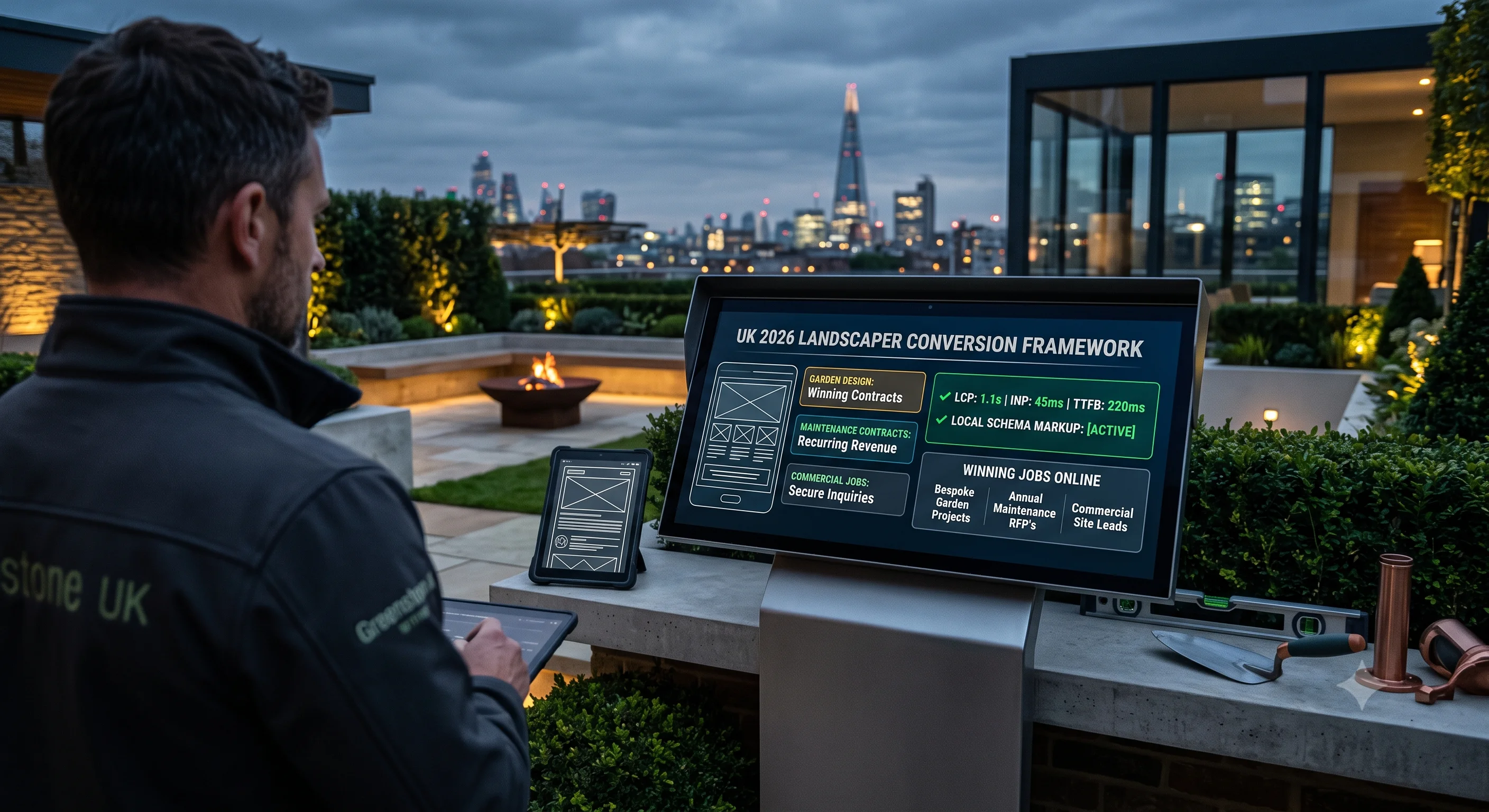
Garden design jobs are booked from portfolios. Maintenance contracts are won through trust. This is how to build a website that does both.
Landscaping has a unique marketing challenge among UK trade businesses: it's one of the most visually driven trades, yet most landscaper websites have either no genuine portfolio or a gallery of uncontextualised photographs that tells a visitor almost nothing about the quality, scale, or type of work the business does. The homeowner planning a complete garden redesign — often a project worth £5,000 to £25,000 — is making a highly visual decision, and they're making it primarily from evidence they can see on a website and in Google reviews.
At WebWise Digital, we build websites for UK trade businesses. Our landscapers page covers the specific packages. This guide covers what makes a landscaper website genuinely effective at winning both high-value garden design jobs and the recurring maintenance contracts that provide stable year-round revenue.
Portfolio quality — the single biggest factor determining whether a garden design enquiry converts — more than price, more than reviews
Spring — when 60%+ of garden design enquiries arrive — which means your website needs to be ranking and ready in February, not April
1. The Three Landscaping Customer Types
Customer type | What they search | Decision timeline | What converts them |
Garden design (full project) | garden designer [town], landscape gardener [town], garden redesign [town] | Weeks — high value, careful decision | Portfolio of comparable completed gardens, specific project descriptions, designer credentials |
Regular garden maintenance | garden maintenance [town], garden clearance [town], lawn care [town] | Days — trust and reliability | Consistent local reviews, clear regular visit pricing, direct booking option |
Commercial/communal landscaping | commercial landscaper [town], grounds maintenance [town], housing association landscaping | Weeks — often multiple quotes | Portfolio of commercial work, capacity indicators, public liability insurance stated |
2. The Portfolio: Where Garden Design Jobs Are Won and Lost
A homeowner commissioning a garden redesign wants to see gardens that look like the garden they want. Not abstract "great results" — specific before-and-after sequences of projects comparable to theirs in scale, style, and (ideally) their area. The portfolio is not a gallery — it's the primary evidence base for the most important purchasing decision most homeowners will make about their outdoor space.
Each portfolio project should contain: a before photograph taken from the same viewpoint as the after, a brief project description (size of garden, what existed before, what the brief was, key materials used), and ideally a client quote specifically referencing the design process and outcome. The location should be named — "Completed in Chislehurst, 2025" — because a homeowner in Chislehurst seeing a completed local project is significantly more likely to enquire than one who sees an unspecified "recent project."
3. Seasonal Content: The Timing Strategy That Beats Your Competitors
Garden design enquiries follow a strongly seasonal pattern: the overwhelming majority arrive in late winter and spring, as homeowners emerging from winter start planning what they want their outdoor space to look like by summer. This means your website needs to be ranking for garden design searches before spring arrives — not in April when you notice demand increasing, but in January and February when you're building toward the peak.
💡 THE INSIGHT — The February ranking deadline most landscapers miss
Publish your garden design service pages and any seasonal content in January at the absolute latest for spring relevance. A page published in April has had no time to accumulate the trust signals and indexing authority needed to compete for spring's peak searches. Build the content, get it indexed, and let Google evaluate it in February and March before your busiest enquiry month arrives.
4. Maintenance Contracts: The Recurring Revenue Engine
Regular garden maintenance contracts — weekly or fortnightly visits, seasonal clear-ups, lawn treatment programmes — represent the most stable, predictable revenue stream available to a UK landscaping business. Unlike design jobs which are episodic, maintenance contracts generate income through every season and create the kind of long-term client relationships that produce referrals.
A dedicated maintenance page with clear pricing (per visit or per month), an explanation of what's included in a standard visit, and a simple booking or enquiry process converts the homeowner who wants to outsource the whole problem rather than manage individual gardening jobs. Email automation for contract renewal, as described in our email marketing guide, ensures maintenance clients renew annually rather than drifting to a competitor when their current arrangement feels stale.
5. Local SEO for Landscapers
The Google Business Profile primary category for a landscaper should be "Landscaper" — not "Gardener" or "Garden Center." The photos section is particularly important for landscapers because potential clients actively browse GBP photos during the comparison stage. A landscaper GBP with rich, regularly updated project photographs — before-and-afters, seasonal transformations, commercial installations — is providing exactly the portfolio evidence that comparison-stage homeowners need.
The local SEO foundation — NAP consistency, citation building, review velocity — is covered fully in our complete local SEO guide. The landscaper-specific addition: the RHS (Royal Horticultural Society) directory and trust marks, and any professional association memberships (British Association of Landscape Industries, Association of Professional Landscapers) represent high-relevance citation sources that generic directories cannot replicate.
6. What WebWise Builds for UK Landscapers
Our landscapers trade page covers the specific packages. A five-page starter site from £950 — homepage, garden design service page, maintenance service page, portfolio page, and contact page — live in seven working days, mobile-first, Core Web Vitals green, with LocalBusiness schema and GBP connection. The starting point is a 15-minute call at webwise.digital/contact.